
Diagnose marine diesel engine problems quickly with this marine diesel troubleshooting guide built from over 30 years of real-world experience. This interactive marine diesel troubleshooting guide helps boat owners identify the root cause of common engine problems including no-start conditions, loss of power under load, overheating, and black, white, or blue exhaust smoke. What is the fastest way to diagnose a marine diesel engine problem? The fastest way to diagnose a marine diesel engine problem is to start with the primary symptom and follow a system-based troubleshooting process. Identifying whether the issue involves fuel, air, cooling, electrical, or mechanical systems allows for faster and more accurate diagnosis.
How to Diagnose Your Marine Diesel Engine Problem
Start by identifying your primary symptom, then follow the correct diagnostic path below. Each section walks you through real-world troubleshooting steps covering fuel system issues, air intake restrictions, turbocharger faults, cooling failures, electrical problems, and mechanical damage.
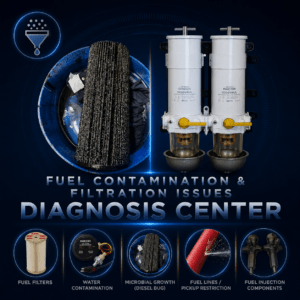
Marine Diesel Troubleshooting Guide for Boat Engine Problems Use the diagnostic centers below to continue troubleshooting by system, symptom, or failure area.
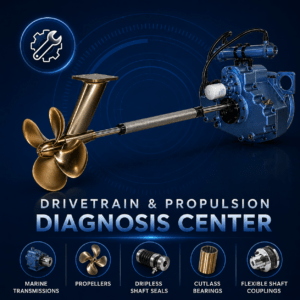
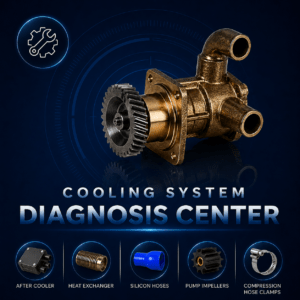

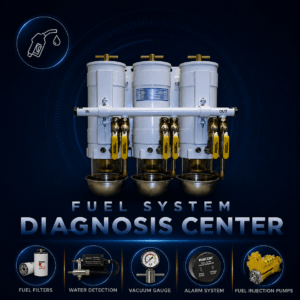
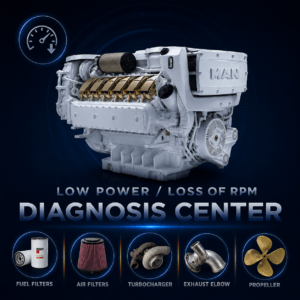
Low Power / RPM Loss
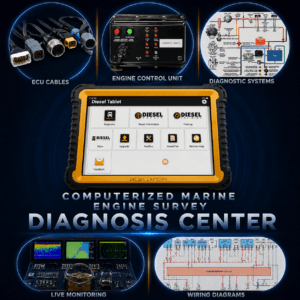
Computer Diagnostics
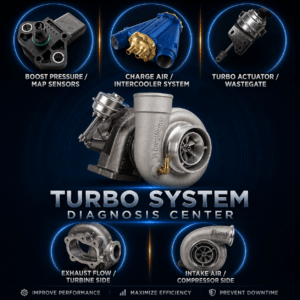
Start Here: Follow the Symptom Path
This guide is based on over 30 years of inboard marine diesel diagnostic experience working on engines throughout Ventura, Oxnard, Channel Islands Harbor, and Santa Barbara. Use the clearest symptom first. The fastest marine diesel diagnosis usually comes from following the strongest clue, not guessing at parts.
Marine Diesel Diagnostic Process
Start With the Symptom, Not the Guess
A strong marine diesel diagnostic process starts with the operating symptom, not a parts list. The fastest path is to identify what changed, when it changed, and the exact condition that makes the problem appear: cold start, hot restart, idle, cruise RPM, heavy load, reverse, rough water, after fueling, after layup, or after recent maintenance.
When the symptom is described correctly, the failure path usually narrows quickly. A cold engine that hard starts after sitting points in a different direction than an engine that loses RPM after 20 minutes at cruise. Black smoke under load is not the same diagnostic event as white smoke during startup. A shutdown after wave action is not the same as an instant electrical cutout. The goal is to follow the strongest clue and confirm each system before replacing parts.
Confirm RPM loss, fuel supply, air flow, turbo boost, and vessel load.
Follow power-loss path
Warning Signs Before Major Failure
Most major marine diesel failures give warning before they become a no-start, overheat alarm, shutdown, or expensive repair. These early signs are worth acting on because they usually make diagnosis faster and repair decisions more controlled.
- Longer crank time before normal startup
- Uneven idle after startup
- Exhaust smoke color change
- Loss of RPM or boost under normal load
- Rising temperature at cruise
- Coolant overflow or repeated low coolant
- Repeated Racor or secondary filter clogging
- Oil level increase or fuel smell in oil
- Charging inconsistency or voltage alarms
- Belt dust, squeal, or pulley wobble
- New knock, ticking, vibration, or driveline noise
- Shutdowns that happen only after warming up
System Overview: Where the Symptom Usually Leads
Marine diesel problems often overlap. Fuel restriction can look like turbo trouble. Cooling restriction can appear as low power. Electrical voltage drop can imitate a starter, injector, or compression problem. Use the system summaries below as the first filter, then follow the symptom path that matches the boat’s actual behavior.
Fuel System
Restriction, contamination, air intrusion, or unstable supply
Fuel problems commonly cause hard starting, shutdowns, surging, low power, delayed throttle response, and repeated filter clogging. Before blaming injectors or injection pumps, confirm fuel quality, restriction, tank venting, lift pump support, and suction-side air leaks.
Air / Turbo
Clean air, boost pressure, aftercooler condition, and exhaust flow
Air-side problems are easy to miss because many owners suspect fuel first. Restricted intake flow, boost leaks, turbo wear, fouled aftercoolers, and exhaust restriction can cause black smoke, high exhaust temperature, sluggish acceleration, and failure to reach rated RPM.
Cooling System
Raw water flow, exchanger efficiency, coolant circuit, and load
Marine diesel cooling is a system, not one part. Seawater pumps, strainers, hoses, thermostats, heat exchangers, aftercoolers, oil coolers, coolant condition, belts, and hull or prop load can all affect operating temperature.
Electrical / Starting
Battery capacity, voltage drop, grounds, relays, and charging
Electrical faults are often blamed on the starter when the real issue is cable resistance, weak battery support, loose grounds, corroded terminals, relay failure, charging instability, or control-circuit interruption.
Smoke / Combustion
Black, white, and blue smoke need different paths
Smoke color matters, but timing matters more. Black smoke under load, white smoke at startup, and blue smoke while running point toward different systems. Always compare smoke with RPM, temperature, load, cranking speed, oil level, and coolant behavior.
Mechanical / Drivetrain
Compression, valve train, mounts, alignment, coupling, and load
Not every complaint is fuel, air, or cooling. Compression loss, valve train issues, injector sealing faults, exhaust restriction, mounts, alignment, couplings, and transmission problems can create noise, vibration, smoke, poor running, or weak propulsion.
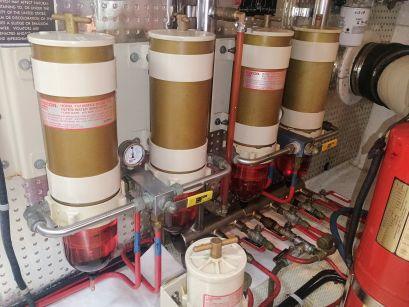 Fuel supply: restriction, contamination, drain-back, and air intrusion are checked before deeper injection work.
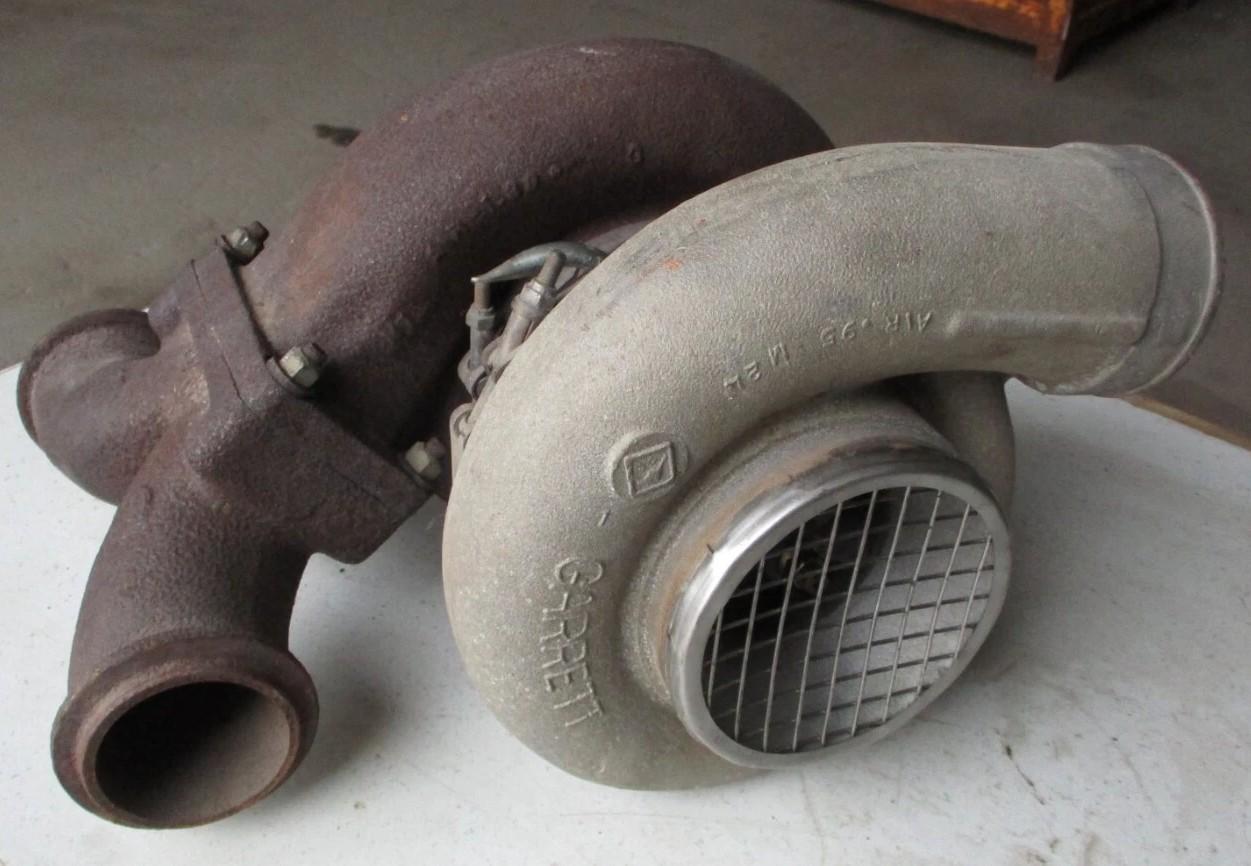 Air and boost: turbo response, charge-air leaks, intake restriction, and aftercooler condition affect load performance.
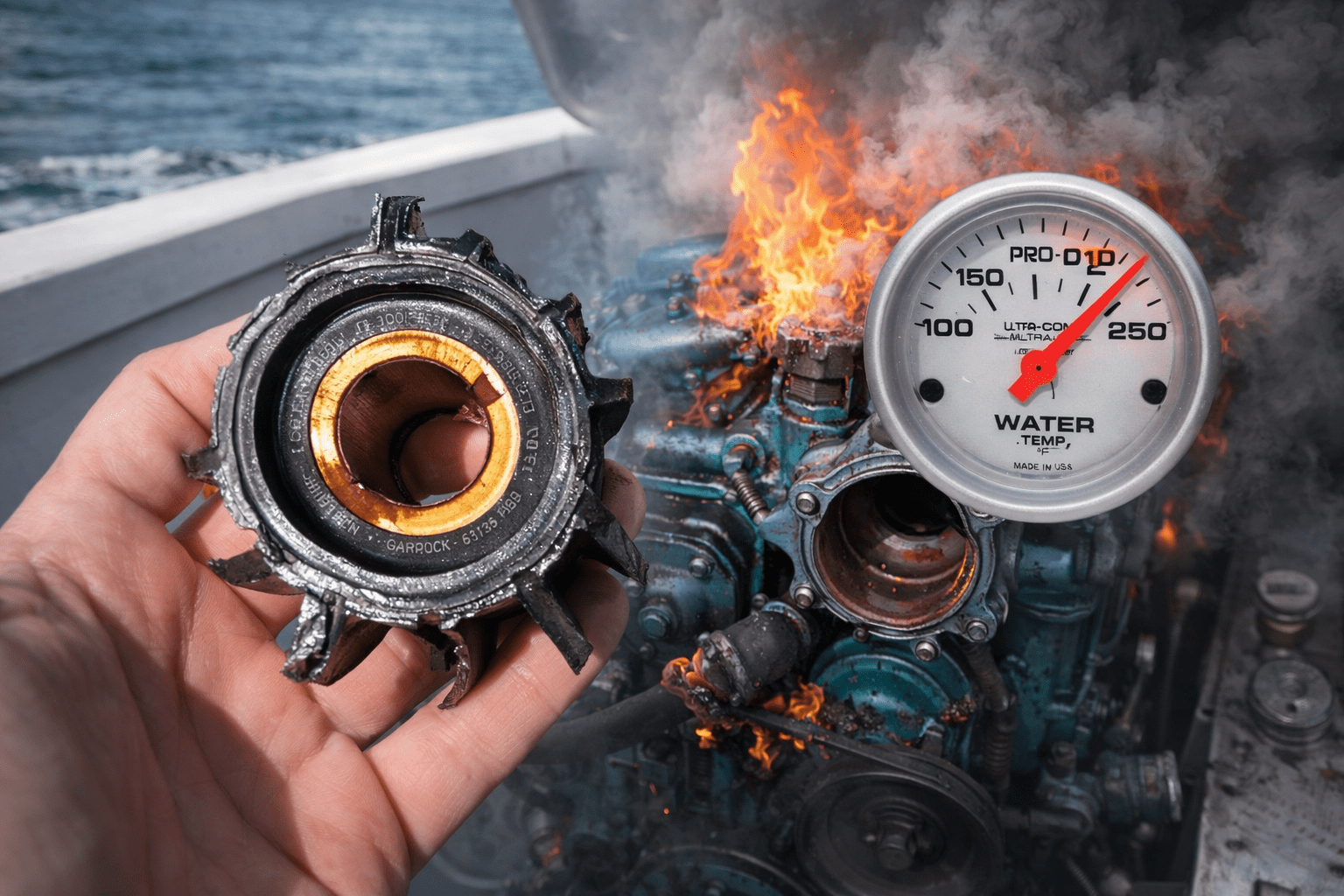 Cooling: impeller condition, raw-water volume, exchanger restriction, coolant flow, and load are tested together.
Fast Symptom Index
Use this index to move from the boat’s strongest symptom to the correct diagnostic path. This replaces guess-based troubleshooting with a cleaner sequence: observe, confirm, test, then repair.
| Primary symptom | First checks | Deeper guide |
|---|---|---|
| Engine will not start | Cranking speed, battery support, grounds, fuel delivery, shutdown circuit, air leaks | Boat Engine Won’t Start |
| Hard starting after sitting | Fuel drain-back, air in fuel, preheat support, injector spray, compression factors | Hard Starting Diagnosis |
| Starts then dies or shuts down underway | Fuel restriction, tank venting, pickup blockage, air intrusion, thermal electrical failure | Shutdown While Running |
| Loss of RPM under load | Fuel delivery, air restriction, boost pressure, cooling stress, bottom growth, prop demand | Low Power / RPM Loss |
| Overheating at idle or cruise | Raw water flow, seawater pump, exchanger restriction, thermostat, coolant condition, belts | Cooling System Diagnosis |
| Black smoke under load | Air restriction, turbo boost, aftercooler fouling, exhaust restriction, overload, fuel-air balance | Black Smoke Under Load |
| White smoke at startup | Cranking speed, cold combustion, preheat, atomization, timing, coolant stability | White Smoke at Startup |
| Blue smoke while running | Oil level, turbo seals, crankcase ventilation, ring wear, valve guides, operating pattern | Blue Smoke Diagnosis |
| Surging or unstable cruise RPM | Restriction, air intrusion, fuel pressure stability, contamination, control behavior | Surging at Cruise RPM |
| Vibration, knock, or in-gear complaint | Mounts, alignment, coupling, transmission behavior, prop load, driveline condition | Drivetrain Diagnosis |
No-Start and Hard-Start Diagnostics
A true no-start is not one problem. It can mean the engine does not crank, cranks too slowly, or cranks normally but never begins combustion. Those three versions require different tests. Separate them first, then move through electrical support, fuel delivery, shutdown controls, and cold-start or combustion factors in order.
No Crank
Starter never engages
Start with battery switch position, charge state, fuse or breaker protection, key-switch output, relay activation, neutral safety status, solenoid trigger, cable condition, and engine-block ground.
- Weak or disconnected battery bank
- Corroded cable lugs or loose grounds
- Failed relay, solenoid, key switch, fuse, or neutral safety circuit
Slow Crank
Engine turns, but not fast enough
Slow cranking can imitate injector, compression, or white-smoke problems because diesel combustion depends on cranking speed and heat generation. Voltage-drop testing on both positive and negative paths is critical.
- Battery weak under load
- Hidden resistance inside cable ends
- Starter draw or ground-path problem
Cranks But Will Not Fire
Normal crank speed, no combustion
Once cranking speed is confirmed, move to fuel delivery, air intrusion, filter fill, shutoff function, tank level accuracy, venting, priming success, and whether the problem started after filter service, fueling, storage, or rough water.
- Empty or partially empty filter housing
- Suction-side air leak or blocked pickup
- Shutdown solenoid or control issue
Hard Start
Long crank, delayed fire, uneven startup
Hard starting is often the early warning before a full no-start. Track whether it is worse cold, hot, after sitting, after fueling, after service, or after rough water. Pattern is one of the best diagnostic tools.
- Fuel drain-back or air in fuel
- Weak preheat support or poor atomization
- Battery performance or compression-related factors
Book No-Start Diagnostic Service
Engine Starts Then Dies or Shuts Down Underway
An engine that starts and dies, or shuts down underway, deserves priority because it can become a safety issue quickly. The key split is whether the engine stumbles and loses RPM before dying, or cuts instantly as if electrical power was removed. A stumble often moves fuel supply, restriction, venting, pickup blockage, air intrusion, contamination, or lift-pump performance higher on the list. An instant cut can point toward shutdown circuits, relays, harness faults, protection systems, or heat-related electrical interruption.
Questions that matter with shutdown complaints
- Does it stumble first or cut instantly?
- Does it restart immediately, after priming, or only after cooling?
- Did it begin after fuel filter service or recent fueling?
- Does it happen only under load, only after warming up, or only in rough water?
- Is there visible contamination, water, or biological debris in the filters?
- Does the tank vent flow freely under sustained demand?
Low Power, Sluggish Acceleration, and Loss of RPM
Low power is one of the easiest marine diesel symptoms to misdiagnose because the engine may be healthy while the vessel is overloaded, fouled, over-propped, dragging running gear, or fighting driveline resistance. Confirm whether the problem is true engine power loss, propulsion demand, instrumentation error, or a combination.
Start with the operating condition. Does the engine reach rated RPM in neutral but fall short in gear? Does it smoke, overheat, surge, or flatten out at the same load every time? Does it feel weak only after a warm-up period? Low power should be checked as a complete propulsion-system complaint: fuel delivery, air flow, boost pressure, aftercooler condition, exhaust restriction, cooling performance, hull condition, prop demand, and tachometer accuracy.
Fuel-Limited
Flattens out, surges, or starves
Often tied to restriction, tank venting, contamination, pickup blockage, lift-pump weakness, or suction-side air intrusion.
Air-Limited
Smokes black or feels heavily loaded
Often tied to intake restriction, boost leak, turbo inefficiency, aftercooler fouling, or exhaust backpressure.
Load-Limited
Engine works hard but boat stays slow
Often tied to bottom growth, propeller overload, shaft drag, transmission issues, or inaccurate RPM data.
Fuel Restriction vs Air Restriction
This is the most important diagnostic split for low power and smoke complaints. Fuel restriction can feel like starvation, surging, or flattening under sustained load. Air restriction usually creates a heavier overloaded feel and more obvious black smoke. Neither pattern is absolute, so both systems should be tested before parts are replaced.
Read the full Fuel Restriction vs Air Restriction Diagnosis Guide
Schedule Low Power Diagnostic Service
Overheating Diagnostics: Idle, Cruise, and Full Load
Overheating can escalate faster than almost any other marine diesel complaint. Separate the pattern before testing: idle overheat, cruise overheat, wide-open-throttle overheat, overheat after service, or overheat after a long run. Each pattern points to a different area of the cooling system.
Overheating at Idle
Temperature rises at low RPM or in the slip
Often points toward raw-water feed problems, thermostat behavior, poor coolant circulation, debris in exchangers, air trapped after service, or broader cooling imbalance.
Overheating Under Load
Temperature climbs as RPM and load increase
Usually moves raw-water volume, exchanger efficiency, seawater pump condition, belt performance, aftercooler restriction, hull condition, and prop demand to the front of the diagnostic path.
Cooling systems should be evaluated as a complete circuit. Old impeller fragments, zinc debris, scale, corrosion products, marine growth, slipping belts, worn pump components, restricted coolers, and neglected coolant can combine into repeat failures if only one part is replaced.
Book Overheating Diagnostic Service
Fuel Contamination, Air in Fuel, Surging, and Rough Idle
These symptoms are grouped together because they often share the same root paths: unstable fuel supply, contamination, air intrusion, restriction, or poor combustion quality. Repeated filter loading is one of the strongest clues that the engine is reacting to an upstream fuel-quality problem rather than a bad filter choice.
Fuel Contamination
Water, microbial growth, sludge, rust, or sediment
Contaminated diesel can cause hard starting, shutdowns, low power, smoking, repeated Racor plugging, injector wear, and failures after rough water stirs tank debris.
Air in Fuel
Suction leak without an obvious fuel drip
Air intrusion may come from filter seals, hose fittings, drain fittings, cracked hoses, pickup tubes, or O-rings. The system can pull air under suction without leaking diesel externally.
Surging
Unstable cruise RPM or hunting under load
Surging often points toward restriction, air intrusion, unstable supply pressure, contamination, or control behavior. Note whether it appears at idle, cruise, warm operation, or one narrow RPM band.
Rough Idle
Uneven running, shake, or combustion imbalance
Separate true combustion roughness from vibration transmitted through mounts, alignment, couplings, or driveline components. Smoke, hard starting, or shutdowns change the path.
Smoke Diagnostics: Read Color, Timing, and Load Together
Smoke is useful only when it is interpreted in context. A quick dark puff on acceleration is different from sustained black smoke at cruise. White smoke that clears after startup is different from white smoke that persists hot. Blue smoke at startup may not mean the same thing as blue smoke under load.
Black Smoke
Too much fuel, not enough clean air, or too much load
Common paths include restricted air intake, turbo inefficiency, boost leak, aftercooler fouling, exhaust backpressure, dirty running gear, prop overload, or fuel delivery imbalance.
White Smoke
Unburned fuel, cold combustion, timing, or coolant concern
Check whether it happens cold, hot, under load, or only at startup. Cranking speed, preheat support, fuel atomization, compression, timing, and coolant stability all matter.
Blue Smoke
Oil burning, turbo seals, breather issues, or wear
Blue smoke usually means oil is entering the combustion process or exhaust path. Check oil level, turbo seal condition, crankcase ventilation, ring wear, valve guides, and operating pattern.
Electrical, Mechanical, Drivetrain, and Advanced Diagnostic Support
Once fuel, air, cooling, and starting fundamentals are verified, deeper testing becomes more accurate. That may include charging-system evaluation, voltage-drop testing, scan-tool data, alarm history, boost-pressure testing, exhaust restriction checks, compression-related evaluation, oil analysis, coolant checks, transmission inspection, shaft alignment review, and survey-related engine assessment.
Electrical / Charging
Intermittent faults, hot failures, voltage drop, or charging instability
Many electrical failures appear only under heat, vibration, or load. Testing should confirm battery condition, cable resistance, charging output, grounds, relays, connectors, and harness behavior.
Turbo / Aftercooler
Boost loss, high EGT, black smoke, oil residue, or slow spool
Turbo and aftercooler problems often show up under load, not at the dock. Boost response, charge-air leaks, aftercooler restriction, oil leaks, and exhaust flow should be checked together.
Noise / Knock / Tick
Combustion noise, mechanical wear, mount movement, or driveline load
Engine noise should be tied to RPM, load, temperature, smoke, oil pressure, vibration, and service history before assuming internal failure.
In-Gear / Propulsion
Loss of thrust, clunking, vibration, shaft movement, or transmission behavior
If the engine runs well but propulsion feels wrong, inspect mounts, coupling, alignment, shaft condition, propeller load, transmission engagement, and driveline resistance.
When to Call a Trained Marine Diesel Technician
Some issues can be narrowed down with observation, filter checks, fluid inspection, alarm history, and symptom tracking. Professional testing becomes the safer move when symptoms include persistent smoke, repeated shutdowns, major RPM loss, overheat trends, abnormal vibration, charging instability, fuel contamination, oil-level changes, coolant loss, or more than one system acting up at the same time.
The point is not to make the symptom disappear for one trip. The point is to identify the real root cause, verify the supporting data, and make the next repair step count.
Why maintenance history changes the diagnostic path
Recent fuel filter service, impeller replacement, layup, battery work, belt replacement, coolant service, heavy weather, or fueling can completely change the order of testing. The most useful diagnostic detail is often the answer to one question: what changed right before the symptom began?
Brands and Inboard Diesel Platforms Commonly Supported
805 Marine Diesel Mechanic provides mobile diagnostic support for inboard marine diesel engines throughout Santa Barbara, Ventura, Oxnard, and Channel Islands Harbor. Typical platforms include Caterpillar, Cummins, Volvo Penta, Yanmar, Perkins, John Deere, Detroit Diesel, Lugger, MAN, MTU, Beta Marine, FPT, Scania, Ford Lehman, and Vetus.
Need Help Finding the Real Cause?
Marine diesel problems rarely get cheaper by waiting, especially when the symptom already includes overheating, shutdowns, heavy smoke, unstable starting, vibration, charging issues, or progressive power loss. The best next step is usually not replacing parts at random. It is confirming the cause in a logical order so the first repair has a real chance of solving the problem.
805 Marine Diesel Mechanic provides mobile inboard marine diesel diagnostic service in Santa Barbara, Ventura, Oxnard, and Channel Islands Harbor, including fuel delivery diagnosis, low-power troubleshooting, smoke diagnosis, cooling system testing, electrical and starting faults, drivetrain complaints, and advanced survey-related engine assessment.
805 Marine Diesel Mechanic provides mobile inboard marine diesel diagnostic service in Santa Barbara, Ventura, Oxnard, and Channel Islands Harbor. That includes troubleshooting for fuel delivery problems, low power, smoke diagnosis, cooling system issues, electrical and starting faults, advanced survey-related engine assessment, and broader symptom-based troubleshooting when more than one issue may be involved.
Schedule Marine Diesel Diagnostic Service
Marine Diesel Troubleshooting FAQ
These frequently asked questions help boat and yacht owners understand common marine diesel engine problems before scheduling professional diagnostic service in Ventura, Santa Barbara, Oxnard, or Channel Islands Harbor.
What causes a marine diesel engine not to start?
Why does my boat engine crank but not fire?
What causes hard starting on a marine diesel engine?
Why does my marine diesel engine start and then die?
What causes low power or loss of RPM in a boat engine?
How do I tell the difference between fuel restriction and air restriction?
What causes black smoke from a marine diesel engine?
What causes white smoke at startup on a marine diesel engine?
What causes blue smoke from a boat engine?
Why does my marine diesel engine overheat at cruise RPM?
Why does my marine diesel engine overheat at idle?
What are the signs of fuel contamination in a boat?
What causes air in a marine diesel fuel system?
Why does my marine diesel engine surge at cruise RPM?
What causes rough idle on a marine diesel engine?
What are the symptoms of turbocharger problems on a marine diesel engine?
Why is my boat engine knocking or making ticking noise?
What causes excessive vibration in a boat engine?
When should I call a trained marine diesel technician?
What is the best way to troubleshoot a marine diesel engine?