
Marine Diesel Turbo Lag & Slow Spool-Up (Causes + Diagnosis Guide)
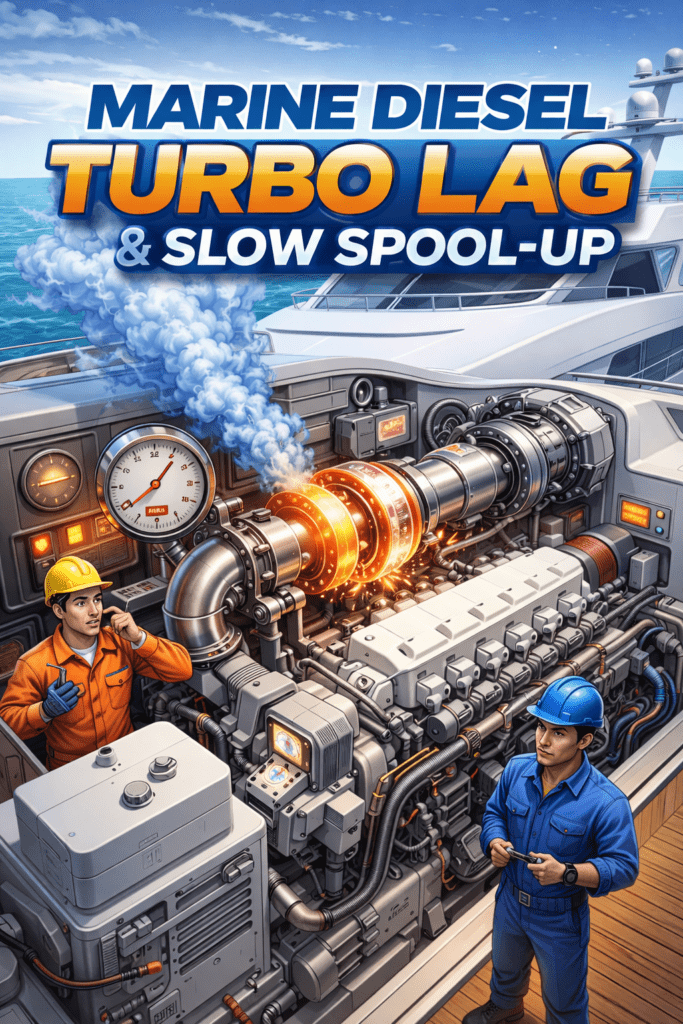
Turbo lag on a marine diesel engine is one of the most common—and most misunderstood—performance problems. It presents as delayed throttle response, slow boost buildup, black smoke before the turbo comes online, and difficulty getting onto plane. While many boat owners assume the turbocharger has failed, turbo lag is almost always caused by a system imbalance rather than a bad turbo.
At 805 Marine Diesel Mechanic, we diagnose turbo response issues across Ventura, Oxnard, Channel Islands Harbor, and Santa Barbara using real-world load testing, boost pressure tracking, and system-based diagnostic logic. In most cases, turbo lag is tied to exhaust energy loss, airflow restriction, fuel delivery limitations, or improper boost control—not turbocharger failure.
Start with the Master Marine Diesel Troubleshooting Guide →
What Is Turbo Lag on a Marine Diesel? (Real Explanation)
Turbo lag occurs when the turbocharger does not accelerate fast enough to produce boost pressure as throttle increases. Since turbochargers rely entirely on exhaust energy, any delay in exhaust flow directly delays boost development.
When operating correctly, increasing throttle increases fuel delivery, combustion energy rises, and exhaust flow rapidly spins the turbine. When something disrupts that chain—such as restricted airflow, weak combustion, or lost exhaust pressure—the turbo cannot respond quickly enough.
This relationship connects directly to diagnostics within the
Turbo System Diagnosis Center,
Exhaust Backpressure Problems, and
Wastegate Problems.
Why Turbo Lag Is Commonly Misdiagnosed
Turbo lag produces symptoms that overlap across multiple systems, which is why it is frequently misdiagnosed. Black smoke is often blamed on injectors, while low power is blamed on engine wear or propeller load. In reality, both symptoms can originate from delayed boost.
When boost builds slowly, fuel is injected without sufficient air, causing incomplete combustion and smoke. This often leads technicians toward the Fuel System Diagnosis Center when the issue is actually airflow or exhaust energy loss.
Comparing these symptoms with the
Smoke & Combustion Diagnosis Center and
Mechanical Failure Diagnostics is critical to avoid unnecessary turbo replacement.
Common Symptoms of Turbo Lag (System-Level)
- Black smoke before boost builds that clears once boost rises
- Loss of RPM under load
- Not reaching full RPM
- Power loss under load
- Surging at cruise RPM
- High exhaust gas temperature
- Delayed throttle response and slow acceleration onto plane
These symptoms often appear together and should always be evaluated as a system, not as isolated issues.
Primary Causes of Turbo Lag (Deep Breakdown)
Turbo lag is caused by anything that slows the rate at which exhaust energy reaches the turbine or reduces combustion efficiency.
Exhaust leaks upstream of the turbo reduce turbine energy and are commonly linked to
exhaust restriction and flow problems. Even a small leak can significantly delay boost under load.
Airflow restrictions through the
aftercooler or intercooler system reduce oxygen availability, slowing combustion and delaying turbine acceleration.
Fuel delivery issues diagnosed through
fuel vs air restriction testing reduce combustion energy, which directly slows turbo spool speed. Problems such as clogged filters or contamination (see Racor filter troubleshooting) are common contributors.
A wastegate stuck open, covered in the
wastegate diagnosis guide, allows exhaust gases to bypass the turbine, significantly reducing boost pressure.
Finally, turbocharger wear or oil-related issues, such as those found in
turbo oil supply problems, can reduce turbine efficiency and delay spool-up.
System Interaction (Critical for Diagnosis)
Turbo lag is rarely a single-component failure. It is the result of interactions between exhaust flow, fuel delivery, airflow, and engine load.
For example, a partially restricted intake combined with a slight exhaust leak can dramatically increase lag time. Similarly, a minor fuel restriction combined with a weak cooling system can amplify performance issues under load.
These interactions must always be evaluated alongside:
- Cooling System Diagnosis Center
- Computerized Diagnostics Center
- Engine Overload Diagnosis
- Seawater Pump Failure
- Overheating Under Load
Real-World Failure Patterns (Technician Insight)
Recognizing patterns is one of the fastest ways to diagnose turbo lag correctly.
- Black smoke followed by power recovery → delayed boost from airflow or fuel restriction
- Consistent low power → exhaust leak or wastegate issue
- Lag only under heavy load → fuel restriction or cooling limitation
- Fluctuating lag → air leak or inconsistent fuel supply
These patterns overlap with issues like
power loss under load and
RPM limitations, reinforcing the need for system-based diagnostics.
Step-by-Step Diagnostic Process (Real Method)
- Measure boost pressure rise rate under load
- Inspect exhaust manifold, riser, and clamps
- Check intake system and aftercooler airflow
- Test fuel delivery and restriction
- Verify wastegate operation
- Inspect turbo shaft play and oil condition
- Confirm results during sea trial
When Turbo Lag Leads to Engine Damage
Chronic turbo lag increases exhaust gas temperature and can lead to serious engine damage if ignored.
- Turbine overheating
- Bearing wear
- Aftercooler damage
- Piston and valve stress from high EGT
These risks are closely tied to
turbocharger failure symptoms and should be addressed early.
External References
Cummins Marine Engines |
Caterpillar Marine Systems
17 Responses