
Marine Diesel Low Power / Loss of RPM Diagnosis (Step-by-Step Guide)
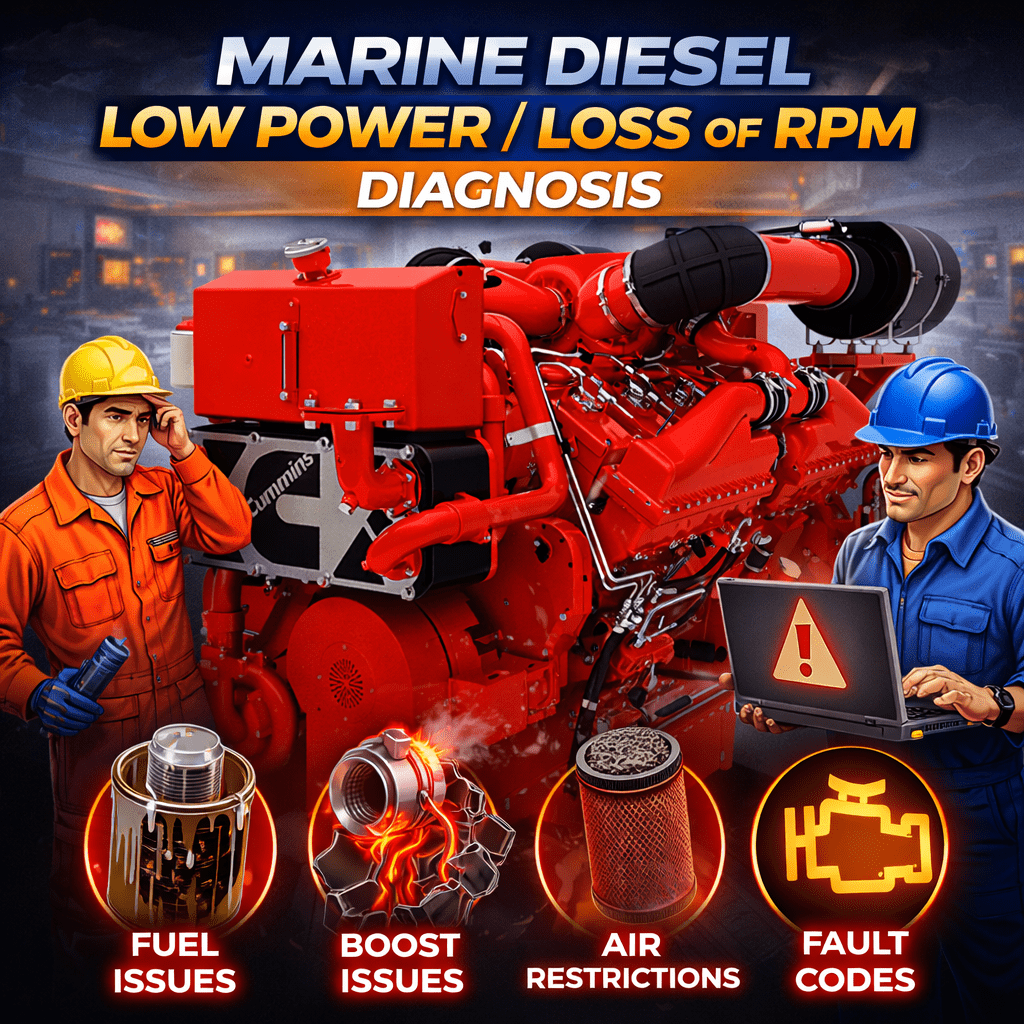
If your marine diesel engine runs normally at idle but won’t reach full RPM, struggles under load, or cannot get on plane, the issue is not random—it is a system imbalance. Low power problems are almost always tied to fuel delivery restriction, airflow limitation, turbo inefficiency, cooling system performance, exhaust restriction, or mechanical load.
At 805 Marine Diesel Mechanic, low power diagnosis across Ventura, Oxnard, Channel Islands Harbor, and Santa Barbara is performed using real load-based testing—not guesswork. This guide follows the same structured process used in the field to isolate the root cause quickly and accurately.
Confirm the Problem Before Diagnosing
Before testing systems, confirm the exact behavior of the engine. Many misdiagnoses start here.
If both engines are affected, focus on shared systems like fuel contamination or vessel load. If only one engine is affected, isolate that engine’s fuel, air, and turbo systems.
Compare symptoms to not reaching full RPM and power loss under load patterns to confirm direction.
Step-by-Step Diagnosis Process
1. Propeller Load & Hull Resistance
Overloading is one of the most overlooked causes of low RPM. Marine growth, incorrect pitch, or drivetrain drag can overload the engine.
This often creates symptoms similar to black smoke under load and reduced performance.
2. Fuel System Restriction
Fuel restriction is the most common real-world cause of low power. Engines idle fine but starve under load.
Check the entire system starting from the tank. A restricted Racor filter or contamination from diesel algae can limit flow significantly.
Compare findings with the Fuel System Diagnosis Center and Fuel vs Air Restriction Diagnosis process.
3. Air Intake Restriction
Restricted airflow reduces oxygen supply and combustion efficiency. This leads to power loss and smoke.
Inspect filters and compare symptoms with Smoke Diagnosis Center patterns.
4. Turbo & Boost Pressure
Low boost directly reduces engine power. Even small leaks or inefficiencies can cause significant loss.
Verify using boost pressure testing and compare to turbocharger failure symptoms.
Also cross-check with turbo lag diagnostics.
5. Aftercooler & Cooling System
High intake air temperature reduces air density and power output.
Evaluate cooling performance and compare with aftercooler problems and overheating under load.
6. Exhaust Restriction
Restricted exhaust flow limits turbo performance and engine breathing.
This commonly overlaps with exhaust backpressure problems and can mimic fuel restriction.
7. Fuel vs Air Diagnostic Split
Use this quick logic:
- Black smoke + low RPM = airflow problem
- No smoke + low RPM = fuel restriction
- Surging = fuel instability
Confirm direction using air in fuel system and surging diagnostics.
8. Electronic Derate (Modern Engines)
Electronic engines may reduce power due to sensor faults.
Verify using computer diagnostics.
9. Mechanical Fuel System
If restriction is ruled out, check injectors and pumps.
Compare with engine starts then dies patterns.
10. Engine Mechanical Condition
Low compression or internal wear reduces power regardless of external systems.
Evaluate using engine rebuild indicators.
System Interaction (Critical Insight)
Low power is not a single failure—it is a system imbalance.
Cross-check with:
- high exhaust temperature
- seawater pump issues
- vibration diagnosis
- clunk when shifting
- shaft spins but no movement
External Resources
BoatUS Expert Advice |
Yachting Magazine
20 Responses