
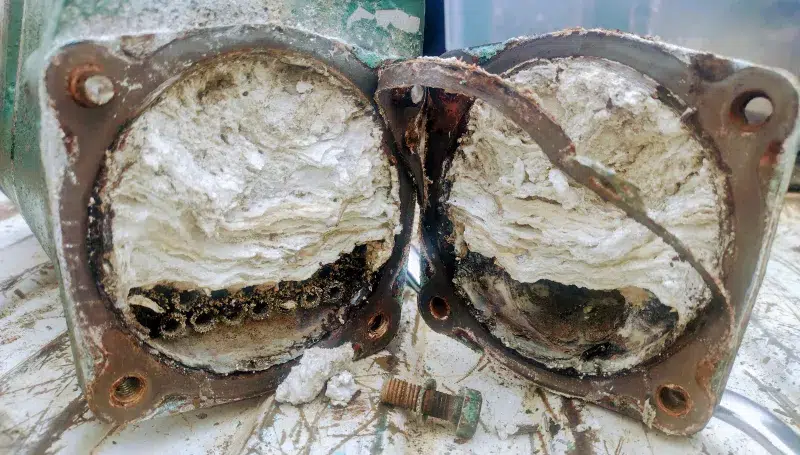
Severely corroded Volvo Penta TAMD40A lube oil cooler showing overlooked saltwater cooling system maintenance on an inboard marine diesel engine in Ventura.
If you run an inboard marine diesel engine in Santa Barbara, Ventura, Oxnard, or Channel Islands Harbor, the hidden maintenance items matter just as much as oil changes. Before chasing symptoms like overheating, low power, smoke, vibration, or hard starting, start with the Master Marine Diesel Troubleshooting Guide to separate routine maintenance neglect from true engine failure.
At 805 Marine Diesel Mechanic, many expensive repairs begin as small overlooked items: scaled heat exchangers, worn impellers, weak zinc protection, corroded electrical connections, aging exhaust elbows, fuel contamination, and shaft seal problems. These issues are especially common on local inboard diesel vessels because warm saltwater, harbor sediment, marine growth, and long slip time accelerate wear.
Why Marine Diesel Maintenance Gets Missed Locally
Inboard marine diesels are durable, but many of their failure points develop slowly. A heat exchanger may lose efficiency over months. A raw water pump may still move water at idle while failing under load. A Racor bowl may look acceptable until rough water stirs tank sludge into the pickup tube.
Southern California’s year-round boating climate can make owners think they can delay service because there is no winter freeze cycle. In reality, warm saltwater is harder on cooling systems, impellers, zincs, exhaust elbows, and fuel systems. This is why maintenance planning should be part of every local ownership routine, whether the boat is powered by Perkins, Yanmar, Volvo Penta, Cummins, Caterpillar, Detroit Diesel, Lugger, or Vetus.
The required orphan link for this post belongs naturally here: owners of smaller inboard and saildrive packages should also review this 27 HP Vetus M3.29 boat diesel engine with SP60 saildrive example, because compact diesel installations still depend on the same cooling, fuel, alignment, and corrosion-control maintenance principles.
1. Heat Exchanger Scale and Marine Growth
Heat exchangers are one of the most overlooked maintenance items on inboard marine diesel engines. They may look fine from the outside while the internal tube bundle is partially blocked by salt scale, zinc debris, impeller fragments, or marine growth.
When heat transfer drops, the engine may first show overheating under load, rising baseline temperature, or intermittent temperature spikes. These symptoms often overlap with heat exchanger clogging symptoms and overheating at idle vs cruise.
- Calcium scale inside heat exchanger tubes
- Zinc anode fragments blocking passages
- Marine growth and silt in raw-water circuits
- Reduced cooling margin under load
- High exhaust temperature after long cruise runs
If your engine has not had the heat exchanger cleaned in 2–3 years, it is worth inspecting before summer boating, offshore runs, or Channel Islands trips.
2. Raw Water Pump and Impeller Wear
Raw water pumps are often checked only after an engine overheats. That is too late. Impellers can wear gradually from sand, silt, age, and heat without fully breaking apart.
In local harbors, fine sediment from Ventura and Santa Barbara entrances can slowly reduce impeller output. The pump may still show water at the exhaust outlet, but not enough volume to cool the engine at cruise. This pattern connects closely with marine engine raw water flow problems and seawater pump failure and impeller damage.
- Weak exhaust water discharge
- Engine runs hotter at cruise than idle
- Temperature spikes after throttle changes
- Cracked, stiff, or missing impeller vanes
- Wear grooves inside pump housing or cam plate
When impeller pieces break off, they often travel downstream and lodge in the oil cooler, heat exchanger, or aftercooler. That can lead to repeat overheating even after a new impeller is installed.
3. Fuel Contamination and Filter Restriction
Fuel contamination is one of the biggest hidden causes of diesel failure around the Channel Islands. Warm coastal air, condensation, low fuel turnover, and older tanks allow water and microbial growth to develop inside the fuel system.
Fuel issues often create symptoms that look like engine power problems. A contaminated tank can cause low power and loss of RPM, surging at cruise RPM, and failure to reach full RPM. Before blaming injectors or turbochargers, compare symptoms with fuel restriction vs air restriction diagnosis.
- Dark sludge in Racor bowls
- Repeated primary filter clogging
- Loss of power after rough water
- Hard starting after sitting
- Engine shutdown under load
Useful related fuel pages include marine diesel fuel contamination, diesel algae contamination, Racor filter troubleshooting, and Racor fuel filters.
4. Electrical Corrosion From Salt-Air Exposure
Electrical corrosion is easy to miss because the engine may crank or run normally until a connection fails under load, heat, or vibration. Salt air creeps into terminals, grounds, solenoids, harness plugs, battery cables, and starter circuits.
Slow cranking, intermittent no-starts, weak charging, and random alarms may all be electrical rather than mechanical. These symptoms often overlap with electrical and starting system diagnosis, marine diesel cranks but won’t start, and engine turns over but no smoke from exhaust.
- Battery cable corrosion
- Engine ground resistance
- Starter solenoid corrosion
- Harness plug oxidation
- Loose or overheated terminals
Electrical inspections should be part of every annual inboard diesel service, especially on older boats that have had wiring added over many years.
5. Exhaust Elbows and Mixing Elbows
Mixing elbows are high-risk parts because corrosion happens internally where owners usually cannot see it. Saltwater, hot exhaust gas, carbon, and oxygen combine inside the elbow and slowly restrict flow.
A clogged or failing elbow can cause overheating, smoke, low RPM, exhaust odor, and poor turbo response. These failures are closely related to marine diesel exhaust backpressure problems, high exhaust temperature, and black smoke under load.
- Carbon buildup reducing exhaust diameter
- Internal corrosion at water injection point
- Collapsed or delaminated exhaust hose
- Steam or hot rubber smell at exhaust
- Exhaust water discharge changing over time
Mixing elbows should be inspected before they fail, not after the engine room smells hot or the exhaust hose is damaged.
6. Shaft Seals, Zincs, Cutlass Bearings, and Underwater Gear
Many owners focus on the engine and forget that the propulsion system includes shaft seals, struts, cutlass bearings, props, couplers, mounts, and zincs. These components affect vibration, alignment, corrosion protection, and drivetrain load.
Warm water accelerates galvanic activity. Boats in Ventura, Oxnard, and Santa Barbara may consume zincs faster than owners expect. If zincs are ignored, bronze parts can show dezincification, pink metal, pitting, or premature failure.
Underwater issues often show up as symptoms described in excessive engine vibration, vibration under load, clunk when shifting into gear, and shaft spins but boat does not move.
- Dry or leaking shaft seals
- Worn cutlass bearings
- Propeller damage or fouling
- Depleted zincs
- Engine mount sag and alignment shift
7. Aftercoolers, Oil Coolers, and Hidden Cooler Stacks
Many inboard diesel engines have more than one cooler. In addition to the main heat exchanger, there may be an oil cooler, transmission cooler, fuel cooler, power steering cooler, aftercooler, or intercooler.
Because these components are smaller and often hidden, they get overlooked until flow is restricted or corrosion creates a leak. Turbocharged engines are especially sensitive to aftercooler condition. Review aftercooler and intercooler problems, turbo lag and slow spool-up, and turbocharger failure symptoms if your engine smokes, lags, or lacks power.
- Oil cooler tubes blocked by impeller fragments
- Aftercooler cores restricted by salt or oil residue
- Transmission cooler corrosion
- Internal leaks between raw water and oil circuits
- Reduced air density and poor combustion
8. Engine Mounts, Alignment, and Drivetrain Load
Engine mounts compress and harden over time. Once mounts change height, shaft alignment changes. That can create vibration, coupling wear, transmission strain, and shaft seal problems.
Alignment issues are often mistaken for engine roughness. They may also combine with propeller load problems to create symptoms found in engine overload and propeller overload diagnosis and repower vs rebuild planning.
- Collapsed or oil-soaked engine mounts
- Misaligned shaft coupling
- Transmission output bearing stress
- Increased vibration at cruise
- Premature shaft seal wear
For project examples involving drivetrain restoration, see Yanmar diesel refresh with transmission rebuild and Twin Cummins 6BTA restoration project.
9. Brand-Specific Maintenance Planning
Different engines share similar maintenance principles, but each brand has its own weak points and service priorities. A compact Vetus saildrive package will need a different maintenance plan than a large Caterpillar or Detroit Diesel, but both still rely on clean fuel, corrosion control, proper cooling, and correct alignment.
For local brand support, review Perkins marine diesel service, Yanmar marine diesel service, Yanmar marine diesel FAQ, Lugger L4105 and L6105 marine diesel benefits, and Top 10 marine diesel engines for 2025.
How We Help Local Boat Owners
805 Marine Diesel Mechanic provides inboard diesel inspections, cooling system service, fuel system diagnostics, electrical checks, exhaust inspection, drivetrain evaluation, and preventative maintenance planning throughout Santa Barbara, Ventura, Oxnard, and Channel Islands Harbor.
We help owners find the hidden failure points before they become offshore failures. Whether the symptom is heat, smoke, low power, hard starting, vibration, or fuel restriction, we use a system-based inspection process instead of guessing.
For smoke and startup-related symptoms, compare with marine diesel smoke after startup, blue smoke causes, and marine diesel smoke diagnosis.
External Authority Resources
ABYC Standards |
EPA Marine Compression-Ignition Engine Standards
Overlooked Marine Diesel Maintenance — FAQ
1. What is the most overlooked marine diesel maintenance item?
2. How often should I service my inboard diesel locally?
3. How often should a heat exchanger be cleaned?
4. Why do impellers fail even if they look intact?
5. Can fuel contamination cause offshore shutdowns?
6. Why are Racor filters so important?
7. Can electrical corrosion cause no-start problems?
8. How do I know if my mixing elbow is clogged?
9. Why do zincs disappear faster in local harbors?
10. Can shaft seals be part of diesel maintenance?
11. Can vibration be caused by maintenance neglect?
12. Should I inspect the oil cooler?
13. Can aftercoolers affect engine power?
14. Why does maintenance differ for small diesels and large engines?
15. Can neglected maintenance cause smoke after startup?
16. What should be checked before a Channel Islands trip?
17. Can fresh water flushing help?
18. When should I call a technician?
19. Is annual maintenance enough?
20. What is the best maintenance approach?
805 Marine Diesel Mechanic provides inboard diesel maintenance, cooling system service, fuel system diagnosis, exhaust elbow inspection, zinc and corrosion checks, and mobile marine diesel service throughout Santa Barbara, Ventura, Oxnard, and Channel Islands Harbor.
2 Responses