
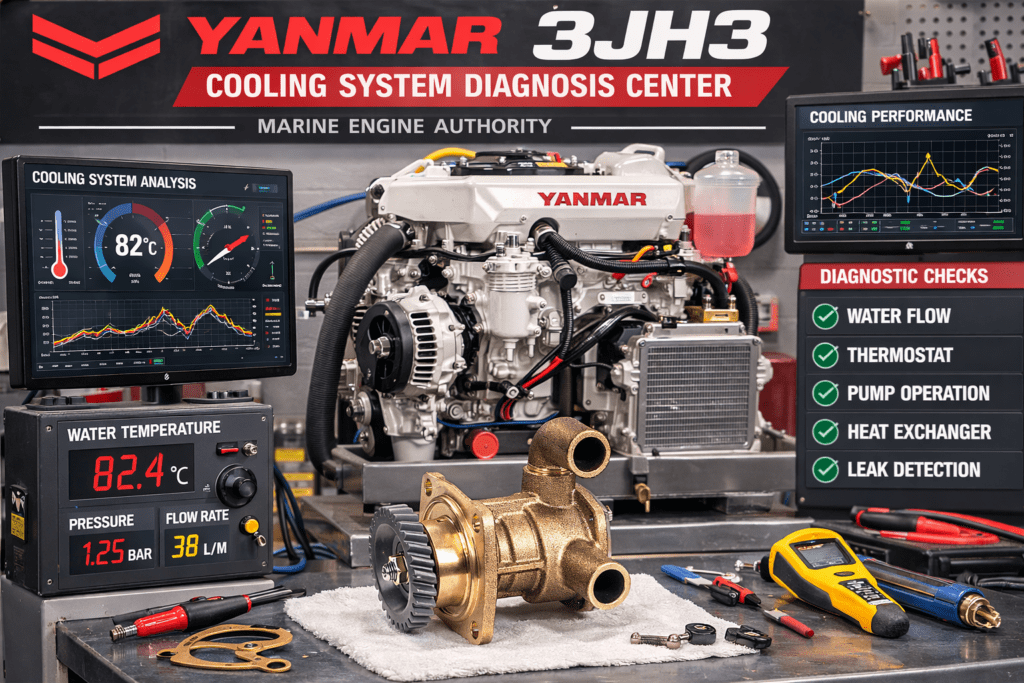
The Yanmar 3JH3 is one of the most trusted small marine diesel engines ever built, but like any auxiliary sailboat engine, it depends completely on a healthy cooling system. This guide explains how to diagnose Yanmar 3JH3 overheating, weak seawater flow, heat exchanger restriction, impeller failure, and thermostat-related temperature problems before they turn into major engine damage.
Yanmar 3JH3 Marine Diesel Cooling System Problems: Complete Overheating Diagnosis Guide
The Yanmar 3JH3 marine diesel engine is one of the most widely used auxiliary sailboat engines in the world. It is known for simplicity, reliability, and long service life, which is exactly why cooling-system problems can catch owners off guard. The engine usually behaves so predictably that when the temperature begins to climb, steam appears at the exhaust, or the overheat alarm sounds, the failure feels sudden. In reality, most cooling problems on a 3JH3 build over time through restriction, corrosion, wear, or neglected maintenance.
That matters because overheating is one of the few problems that can turn a dependable engine into an expensive repair very quickly. A small raw-water restriction can become a full overheating event. A worn impeller can scatter fragments into the heat exchanger. A partially restricted elbow or exchanger can slowly reduce cooling margin until the boat finally gets worked a little harder than usual and temperature shoots up. Good diagnosis means finding the actual bottleneck in the system instead of replacing one part and hoping the problem disappears.
At 805 Marine Diesel Mechanic, Yanmar cooling system problems are diagnosed throughout Ventura, Oxnard, Channel Islands Harbor, and Santa Barbara. With over 30 years of marine diesel experience, the goal is to determine whether the real cause is reduced seawater flow, pump inefficiency, heat exchanger fouling, thermostat problems, or a broader cooling-system failure. This page expands from your Master Marine Diesel Troubleshooting Guide and fits directly into your broader marine diesel authority structure.
How the Yanmar 3JH3 Cooling System Works
The Yanmar 3JH3 uses a two-circuit marine cooling system. One side is the freshwater coolant loop inside the engine. The other side is the raw seawater loop that removes heat through the heat exchanger. This design allows the engine to maintain proper operating temperature while using seawater only for heat removal rather than sending seawater directly through the engine block.
The system typically includes:
- Raw water intake and seacock
- Sea strainer
- Raw water pump with rubber impeller
- Heat exchanger
- Thermostat
- Freshwater coolant circuit
- Mixing elbow and exhaust water discharge path
If any part of this chain becomes restricted or fails, engine temperature rises quickly. That is why a proper Yanmar 3JH3 overheating diagnosis has to look at the entire cooling circuit, not just one visible part.
Common Yanmar 3JH3 Overheating Symptoms
Cooling system problems usually produce warning signs before catastrophic damage occurs. The key is noticing them early and understanding what they mean.
- High engine temperature gauge readings
- Steam or very hot exhaust discharge
- Reduced exhaust water flow
- Loss of engine performance
- Coolant loss or overflow
- Overheat alarms
Some of these symptoms cross over into other complaint pages such as Boat Engine Overheating, Overheating at Idle, Boat Engine Losing Power, and the Smoke & Combustion Diagnosis Center. That crossover matters because a hot engine often begins to lose power, change smoke behavior, or develop secondary running symptoms as temperature rises.
Raw Water Flow Problems
Insufficient seawater flow is one of the most common causes of overheating on the Yanmar 3JH3. Because this engine is often used in sailboats that spend long periods sitting, operating at modest RPM, or living in growth-prone harbors, raw-water restrictions are extremely common.
Common restrictions include:
- Blocked seawater intake
- Clogged sea strainers
- Collapsed intake hoses
- Marine growth inside cooling passages
- Debris trapped in the intake path
Raw-water flow problems often begin as slight temperature rise or weak exhaust discharge and then turn into full overheating when the boat is motoring hard into wind, chop, or current. This is why the intake side should always be the first place to look in a 3JH3 cooling complaint.
Raw Water Pump Impeller Failure
The seawater pump impeller is one of the most important wear items on the 3JH3. If the impeller wears, hardens, loses vanes, or is installed poorly, raw-water flow drops fast. In many real-world cases the owner sees sudden overheating and assumes the engine itself has developed a major internal problem, when the real cause is simply that the pump can no longer move enough water.
Signs of impeller failure include:
- Reduced exhaust water flow
- Sudden overheating
- Rubber impeller fragments inside the exchanger or downstream passages
- Hotter running after long periods of sitting
Routine inspection and replacement of the impeller is one of the most important preventive maintenance tasks on the Yanmar 3JH3. Related pages that fit naturally here include Seawater Pump Failure & Impeller Damage and Overheating at Idle.
Heat Exchanger Fouling
Marine heat exchangers slowly accumulate salt deposits, zinc debris, corrosion products, and marine growth. Over time, this fouling restricts water flow and reduces heat transfer efficiency. The engine may continue to run, but with less cooling margin. Eventually a day of harder operation or warmer water exposes the restriction and the engine overheats.
Heat exchanger problems may include:
- Salt buildup inside tubes
- Zinc anode debris blocking passages
- Internal corrosion
- Marine growth restriction
Because the problem often builds gradually, owners may overlook the early signs. That is why exchanger service is one of the most important medium-term maintenance jobs on older Yanmar engines. Related page: Heat Exchanger Cleaning.
Thermostat and Freshwater Coolant Circuit Problems
Not all 3JH3 overheating is caused by the raw-water side. The freshwater side matters too. If the thermostat sticks, coolant is low, the circulation path is compromised, or internal coolant flow is weak, the engine can overheat even when seawater flow looks acceptable from the transom.
Freshwater-side problems commonly include:
- Sticking thermostat
- Low coolant level
- Air trapped in the coolant circuit
- Internal coolant restriction
- Circulation inefficiency
This is why a strong-looking water discharge at the exhaust does not automatically prove the cooling system is healthy. The raw-water side may be fine while the closed-loop side is failing.
Mixing Elbow and Exhaust Restriction
On many marine diesels, and especially on older auxiliary sailboat engines, the mixing elbow becomes a hidden restriction point. Carbon, salt, corrosion, and exhaust deposits narrow the internal passage until exhaust flow and injected cooling water can no longer move freely. The result is reduced cooling performance, steam, power loss, and higher running temperature.
This problem often overlaps with your broader site content on exhaust restriction and overheating. Related pages include Mixing Elbow Restriction Diagnosis and Boat Engine Overheating.
Fuel and Power Loss Interaction
Cooling system restrictions can also contribute to engine performance issues. If the engine runs too hot, it may lose efficiency, feel weak, and begin showing symptoms that sound like a fuel problem or a low-RPM problem. On some engines, high temperature changes combustion quality enough to affect smoke, throttle response, and power delivery.
That is why cooling complaints should also be connected to:
Real diagnosis means remembering that overheating does not stay isolated for long. It starts affecting performance too.
Professional Cooling System Diagnosis
Accurate Yanmar 3JH3 cooling diagnosis requires inspecting the entire cooling circuit rather than replacing individual parts at random. Many overheating cases are cumulative. A slightly weak impeller, partially dirty strainer, and somewhat fouled heat exchanger may each seem minor by themselves, but together they remove enough cooling margin to create a real problem.
A proper diagnostic procedure typically includes:
- Seawater flow inspection
- Raw water pump testing
- Heat exchanger inspection
- Thermostat testing
- Cooling system pressure testing
- Exhaust discharge evaluation
Advanced inspection and diagnostic services are also available through the broader site network at the Computerized Marine Engine Survey Diagnostics Center.
Yanmar 3JH3 Marine Diesel Service in Ventura & Channel Islands Harbor
805 Marine Diesel Mechanic provides Yanmar cooling system diagnosis and repair services throughout:
- Ventura Harbor
- Channel Islands Harbor
- Oxnard
- Santa Barbara
If your Yanmar 3JH3 marine diesel engine is running hot, showing weak exhaust water flow, or triggering overheat alarms, professional diagnosis can quickly determine whether the root cause is intake restriction, impeller failure, exchanger fouling, thermostat problems, or a broader cooling-system issue.
Yanmar 3JH3 Cooling System FAQ
1. Why is my Yanmar 3JH3 overheating?
Common causes include restricted seawater flow, worn raw-water pump impellers, clogged heat exchangers, thermostat problems, and mixing elbow restriction.
2. How often should a marine heat exchanger be cleaned?
Many heat exchangers should be inspected and cleaned every two to three years, but heavy saltwater use, zinc debris, or growth-prone conditions may require more frequent service.
3. Can a bad impeller cause engine overheating?
Yes. If the raw-water pump impeller fails or becomes worn, seawater flow drops and the engine can overheat very quickly.
4. How is a marine cooling system professionally diagnosed?
Technicians inspect seawater intake flow, pump operation, thermostat function, heat exchanger condition, and the full cooling path instead of guessing at one part.
5. Can weak exhaust water flow mean the Yanmar 3JH3 cooling system is restricted?
Yes. Weak discharge at the exhaust is often one of the clearest signs that raw-water flow is restricted somewhere in the system.
6. Can a clogged sea strainer make the engine run hot?
Absolutely. Even partial restriction at the strainer can reduce enough flow to create overheating, especially under load.
7. Can marine growth inside the intake or hoses cause overheating?
Yes. Growth, debris, or internal hose collapse can all reduce seawater flow and create real temperature problems.
8. Can a thermostat cause overheating on a Yanmar 3JH3?
Yes. A sticking thermostat or closed-loop coolant problem can cause overheating even when seawater discharge still looks normal.
9. Why does my engine overheat more when motoring hard?
Because heat production rises under load, and any weakness in the cooling system becomes much more obvious once the engine is asked to work harder.
10. Can overheating cause power loss on a Yanmar 3JH3?
Yes. Higher temperatures reduce efficiency and can overlap with low-power complaints. Related page: Low Power Loss of RPM Diagnosis Center.
11. Can impeller pieces get stuck after an impeller fails?
Yes. Fragments often lodge downstream in coolers or exchangers, which is why overheating may continue even after a new impeller is installed.
12. Can a mixing elbow restriction make a 3JH3 overheat?
Yes. A restricted elbow can reduce cooling-water discharge and exhaust flow at the same time. Related page: Mixing Elbow Restriction Diagnosis.
13. Can coolant loss cause overheating even if raw water flow looks okay?
Yes. The freshwater side matters too, and low coolant or internal coolant-side problems can create overheating without an obvious raw-water failure.
14. Is overheating at idle a different diagnosis path?
Often, yes. Idle-only overheating may point more strongly toward weak pump efficiency or low-speed raw-water flow problems. Related page: Overheating at Idle.
15. Can heat exchanger fouling build up slowly over time?
Yes. Many exchangers become restricted gradually, which is why the engine may run only slightly hotter at first before becoming a full overheating complaint.
16. Can overheating affect smoke and combustion?
Yes. Combustion quality can change when the engine runs too hot, which is why this topic also connects to the Smoke & Combustion Diagnosis Center.
17. Is mobile diagnosis useful for Yanmar 3JH3 cooling problems?
Yes. Cooling problems are often easiest to confirm on the boat, under the same load and operating conditions where the overheating actually occurs.
18. Should I keep running the engine if it is overheating?
No. Continued overheating can cause major internal damage and should be diagnosed before operation continues.
19. When should I call a mechanic for Yanmar 3JH3 overheating?
If the engine is running hot, showing weak exhaust flow, or triggering alarms, it is time for professional diagnosis through the contact page.
20. Where should I start if I want the full Yanmar 3JH3 cooling pathway?
Start with the Master Marine Diesel Troubleshooting Guide, then move through the linked overheating, exchanger, idle-overheating, smoke, and low-power pages from there.