
If your boat engine overheats at idle but cools down when RPM comes up, that usually points to a raw water flow weakness, suction-side air leak, pump efficiency loss, or cooling system restriction. This guide explains how to diagnose the real cause before idle overheating turns into full overheating, repeated impeller damage, or expensive engine repairs.
Boat Engine Overheating at Idle – Marine Diesel Cooling System Diagnosis
Idle overheating is one of the most common marine diesel complaints on inboard boats and yachts. Owners often describe it the same way: the engine starts normally, seems acceptable underway, and may even run cooler once throttle is applied, but at idle speed the temperature begins to climb. That pattern matters. It tells you the problem is often tied to low-speed cooling efficiency rather than a full-system failure that would overheat the engine in every condition.
On marine diesels, idle exposes weaknesses that higher RPM can temporarily hide. When engine speed increases, the raw water pump moves more water, the system may overcome minor restrictions, and the temperature can drop enough to mislead the owner into thinking the issue is minor. It is not minor. An engine that overheats at idle is already warning you that something in the raw water, heat exchanger, or exhaust cooling path is losing efficiency.
With over 30 years of marine diesel experience, 805 Marine Diesel Mechanic diagnoses these problems throughout Ventura, Oxnard, Channel Islands Harbor, and Santa Barbara using real system-based logic, not guesswork. This page expands from your Master Marine Diesel Troubleshooting Guide and ties directly into the overheating and raw water flow diagnosis path.
Why Marine Diesel Engines Overheat at Idle
At idle, your engine has less pump speed, lower coolant circulation velocity on the raw water side, and less margin for restriction. That means any weakness in pump condition, impeller performance, suction integrity, sea strainer flow, heat exchanger cleanliness, or mixing elbow discharge becomes much more obvious. A system that is “barely good enough” at cruise can fail at idle because there is no surplus flow to cover up the problem.
This is why idle overheating is so often linked to:
- Worn raw water pump internals
- Partially damaged impellers
- Air leaks on the suction side
- Sea strainer or intake restriction
- Heat exchanger blockage
- Mixing elbow restriction
- Corrosion inside the cooling path
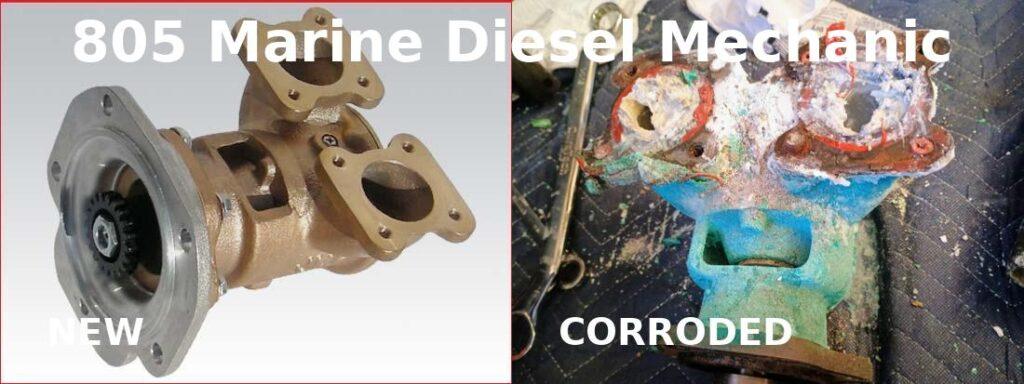
The failed raw water pump shown in your hero image is a perfect example. A pump with internal corrosion, worn housing clearances, or damaged cam surfaces may still move enough water at higher RPM to delay overheating, but at idle it cannot maintain adequate flow. That is why this symptom should always be treated as a raw water flow warning until proven otherwise.
Common Symptoms of Idle Overheating
- Temperature rises at idle but drops once throttle is applied
- Weak or inconsistent exhaust water discharge
- Steam or hot vapor at idle around the stern
- No immediate overheating at cruise RPM
- Alarm sounds after extended idling in harbor or marina
- Cooling problem worsens after sitting, storage, or neglect
These symptoms often overlap with broader complaint pages such as Boat Engine Overheating, Boat Engine Losing Power, Engine Surging, and Engine Shutting Down. That crossover matters because a cooling problem does not stay isolated forever. Once temperatures rise, power, combustion quality, and component life all begin to suffer.
Top Causes of Boat Engine Overheating at Idle
1. Raw Water Pump Wear or Internal Corrosion
This is the number one cause. On older marine diesels, the raw water pump may look acceptable from the outside while the internal housing, cover plate, cam, shaft, or cavity is badly worn. Corrosion damage and internal clearance loss reduce low-speed pumping efficiency first. At higher RPM, the pump may still move enough water to mask the problem temporarily. At idle, it fails.
This is especially common on boats used in saltwater, boats with inconsistent maintenance history, and engines that have gone too long between cooling system inspections. A worn pump is not just an inconvenience. It is often the beginning of recurring impeller failure, heat exchanger fouling, and chronic high-temperature operation.
2. Impeller Damage or Weakness
A partially damaged impeller may not be completely destroyed, but it can still be the reason the engine overheats only at idle. Missing blades, hardened vanes, incorrect installation, or a deformed impeller can all reduce flow at low speed. Once RPM rises, the pump may catch up enough to lower temperature, creating the false impression that the impeller is fine.
This is why impellers should not be judged only by whether they “still move water.” The real question is whether they move enough water under the weakest operating condition — idle.
3. Air Leaks on the Suction Side
Air leaks are one of the most overlooked cooling system problems in marine diesel diagnosis. A cracked hose, loose clamp, worn pump shaft seal, or poor gasket on the raw water side can reduce pump suction. At idle, that reduced suction matters a lot. The pump may ingest air, lose prime efficiency, or fail to hold a solid water column. At higher RPM, the increased pump speed can partially overcome the leak, making the problem seem intermittent.
4. Sea Strainer or Intake Restriction
Even partial blockage at the sea strainer, thru-hull intake, or intake hose can reduce raw water flow enough to create idle overheating. Sea grass, growth, debris, shells, or internal hose collapse can all restrict flow. The engine may seem acceptable underway until idling for long periods, where the system no longer has enough reserve cooling flow.
5. Heat Exchanger Restriction
Heat exchangers gradually lose efficiency from salt, mineral deposits, debris, and internal fouling. When enough of the exchanger is restricted, the engine may still survive higher-speed operation for a while, but idle cooling becomes weak because the heat transfer margin is already too small. This is especially common on neglected maintenance engines and on boats where the cooling system has not been serviced on schedule.
6. Mixing Elbow Restriction
The mixing elbow is another classic hidden cause. Carbon, rust, salt buildup, and exhaust scaling can narrow the elbow and reduce both exhaust flow and water discharge performance. That creates a marine-specific overheating pattern where the engine may steam, run hot at idle, and appear better at higher RPM until the problem becomes severe.
Step-by-Step Diagnosis for Idle Overheating
Step 1: Confirm the Pattern
Does the engine overheat only at idle, only after idling for several minutes, or in all conditions? Does it cool down immediately when RPM increases? Is exhaust water flow visibly weak? Pattern recognition matters because it separates a low-speed raw water issue from a thermostat, closed-loop, or full-system overheating problem.
Step 2: Inspect Raw Water Discharge
Look at the water coming from the exhaust. A weak pulse, irregular discharge, steam-heavy flow, or obviously reduced water volume points directly toward the raw water side. This is one of the fastest first checks you can make, but it should be followed by real inspection, not assumption.
Step 3: Check the Raw Water Pump
Pull the pump for proper inspection if needed. Check housing condition, cover plate wear, shaft seal integrity, cam condition, corrosion damage, and overall internal clearance. This is where many idle overheating jobs are solved. The pump may be “working,” but not working well enough.
Step 4: Inspect the Impeller and Downstream Fragments
If the impeller has shed blades, do not stop at replacing it. Missing pieces often travel downstream and lodge in the heat exchanger, oil cooler, or other cooling passages. Replacing the impeller alone without finding those fragments leads to repeat overheating and repeat frustration.
Step 5: Test for Suction Leaks
Inspect hoses, clamps, gaskets, cover plates, and pump seals on the suction side. Low-speed air leakage is a classic idle-only overheating trigger. This step is routinely skipped by people who focus only on hard blockages.
Step 6: Inspect Sea Strainer, Intake, and Flow Path
Check for debris, marine growth, hose collapse, or intake limitation. A strainer that looks only “partially dirty” can still be dirty enough to trigger idle overheating, especially on engines already running with reduced pump efficiency.
Step 7: Evaluate the Heat Exchanger and Mixing Elbow
If pump, impeller, and suction side are acceptable, the next suspects are internal restriction points. Heat exchangers and mixing elbows are common choke points that reduce cooling margin over time. This is where deeper cooling service often becomes necessary.
Why This Problem Gets Worse If Ignored
Idle overheating rarely stays an idle-only problem forever. As the system continues to degrade, you usually see the progression move like this:
- Overheats after long idle periods
- Begins steaming more often around the dock
- Starts running warmer at low cruise speeds
- Eventually overheats under load too
That progression leads to repeated impeller damage, higher cylinder head temperatures, reduced oil life, stress on exhaust components, and possible major engine damage if the problem is ignored long enough. Early diagnosis is much cheaper than late failure.
Preventing Overheating at Idle
- Inspect the raw water pump regularly, not just when it fails
- Replace the impeller on a real schedule
- Check hoses, clamps, and suction-side integrity
- Service sea strainers and intakes before flow becomes marginal
- Flush and inspect the cooling system for internal restriction
- Do not ignore early steam or weak exhaust discharge symptoms
This is also where your maintenance pages become important. Since you asked to connect the orphaned page, this post now naturally ties into your Vetus marine engine maintenance schedule. Cooling system service intervals, impeller replacement timing, inspection frequency, and preventive maintenance discipline are exactly how many idle overheating problems are avoided before they become repair jobs.
Authority reading that supports the maintenance and cooling side includes ABYC Marine Standards and Boats.com marine diesel technical how-to content.
Related Diagnostic Pages
- Master Marine Diesel Troubleshooting Guide
- Boat Engine Overheating
- Boat Engine Losing Power
- Engine Surging at Cruise RPM
- Marine Diesel Engine Shutdown Causes
- Vetus Marine Engine Maintenance Schedule
- Contact 805 Marine Diesel Mechanic
When to Call a Marine Diesel Mechanic
If your engine temperature rises at idle, if exhaust water flow is weak, or if the engine cools only after increasing RPM, it is time to diagnose the problem before it grows into a larger failure. Mobile service is often the best approach because these symptoms can be observed dockside under the same conditions where they occur.
805 Marine Diesel Mechanic provides mobile cooling system diagnosis and inboard marine diesel troubleshooting throughout Ventura, Oxnard, Channel Islands Harbor, and Santa Barbara. With over 30 years of marine engine experience, the goal is to find the real flow restriction, pump problem, or cooling weakness before unnecessary parts are replaced.
Idle Overheating FAQ
1. Why does my engine overheat only at idle?
This usually means the cooling system is weak at low raw water flow. Common causes include a worn raw water pump, impeller problem, suction-side air leak, restricted sea strainer, or internal cooling restriction. Start with the Master Marine Diesel Troubleshooting Guide for the full symptom path.
2. Can a bad impeller cause overheating only at idle?
Yes. A partially damaged or hardened impeller may move enough water at higher RPM to hide the problem, but not enough at idle.
3. Can a corroded raw water pump cause idle overheating?
Absolutely. Internal corrosion and clearance loss reduce low-speed pump efficiency first, which is why this is one of the most common real-world causes.
4. Why does the engine cool down when I raise RPM?
Because higher RPM increases pump speed and raw water flow. That extra flow can temporarily overcome a weak pump, minor restriction, or suction problem.
5. Is overheating at idle a serious issue?
Yes. It often starts as a low-speed problem, but it can develop into full overheating, repeated impeller failure, and more serious engine damage if ignored.
6. Should I keep running the engine if it overheats at idle?
No. Continued overheating can damage the engine and cooling components. It is better to diagnose the issue early than wait for a larger failure.
7. How often should I inspect my raw water pump?
At least at normal service intervals and sooner if you operate heavily in saltwater or have any sign of weak flow. Your Vetus maintenance schedule is the right place to keep that routine visible.
8. Can an air leak cause idle overheating?
Yes. Air leaks on the suction side reduce pump efficiency, especially at low RPM where the system has less margin to overcome them.
9. Can a partially blocked sea strainer cause this problem?
Yes. Even partial blockage can reduce enough water flow to trigger temperature rise at idle before it becomes obvious at higher RPM.
10. Can a heat exchanger restriction cause idle overheating?
Yes. If the heat exchanger is fouled internally, the cooling system loses efficiency and idle operation may be the first place that weakness shows up.
11. Can a mixing elbow restriction make a boat overheat at idle?
Yes. A restricted mixing elbow can reduce water discharge and disturb the normal cooling and exhaust flow pattern, especially at low speed.
12. What is the first thing I should check?
Start with exhaust water discharge, then inspect the raw water pump, impeller, sea strainer, and suction-side hoses and clamps.
13. Why is exhaust water flow weak at idle?
Weak exhaust discharge usually means the raw water side is not moving enough water. Pump wear, impeller damage, blockages, or air leaks are common suspects.
14. Can overheating at idle also cause power loss later?
Yes. As cooling performance gets worse, temperature-related issues can spread into combustion quality and power complaints. Related reading: Boat Engine Losing Power.
15. Can this problem lead to shutdown?
Yes. If temperatures climb high enough, some engines will alarm and eventually shut down, or the engine may suffer damage that leads to broader operating problems. See shutdown causes.
16. Does maintenance really prevent idle overheating?
Yes. Many idle overheating complaints come from neglected pump inspections, overdue impellers, missed cooling service, and ignored restriction buildup over time.
17. Can the engine seem fine underway but still have a serious problem?
Yes. That is exactly why idle overheating is deceptive. Higher RPM can temporarily hide a low-flow problem that is already serious.
18. Can this problem be diagnosed dockside?
Often, yes. Idle overheating is one of the better symptoms to observe under controlled dockside conditions because the temperature rise pattern usually appears without a sea trial.
19. When should I call a mechanic?
If the engine runs hotter at idle, if exhaust water looks weak, or if the symptom repeats, it is time for professional diagnosis through the contact page.
20. Where should I go for the full overheating path?
Start with Boat Engine Overheating and the Master Marine Diesel Troubleshooting Guide to connect idle overheating with the broader cooling system logic.
One Response