
Marine Diesel Smoke & Combustion Diagnosis Center
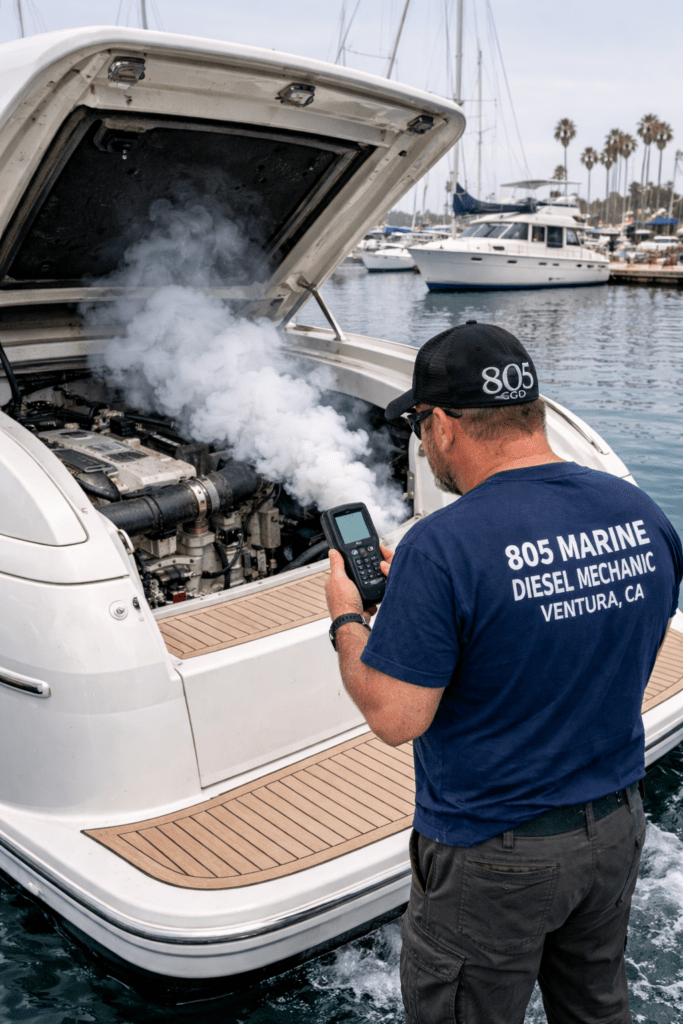
Marine diesel exhaust smoke is one of the most powerful diagnostic indicators available. When properly interpreted, smoke reveals imbalances in combustion, airflow, fuel delivery, cooling performance, and mechanical condition—often before major failures occur.
This Smoke & Combustion Diagnosis Center serves as a complete authority hub used by trained technicians at 805 Marine Diesel Mechanic throughout Ventura, Oxnard, Channel Islands Harbor, and Santa Barbara.
Return to Master Troubleshooting Guide →
Combustion Fundamentals — Why Smoke Happens
All diesel engines rely on a balance of air, fuel, and heat. When that balance is disrupted, combustion becomes incomplete and smoke appears. This imbalance often develops under load conditions, especially when airflow, fuel delivery, or cooling cannot keep up.
This is why smoke is frequently linked to high EGT, loss of RPM, and power loss under load.
Smoke Types — What They Really Mean
White Smoke: Fuel not fully burning. Often linked to startup issues, injector timing, or fuel contamination. See white smoke diagnosis.
Black Smoke: Too much fuel or not enough air. Usually caused by turbo issues, airflow restriction, or overload. See black smoke under load.
Blue Smoke: Oil entering combustion. Indicates wear or turbo seal problems. See blue smoke causes.
Cross-System Diagnosis — Where Most People Get It Wrong
Smoke is rarely a single-system issue. It is typically the result of interaction between airflow, fuel, cooling, exhaust, and engine load.
Advanced confirmation is often done through the Computerized Diagnostics Center.
Common Misdiagnosis Patterns
- Replacing injectors instead of fixing airflow
- Replacing turbo without verifying boost
- Blaming cooling instead of overload
- Ignoring exhaust restriction
Advanced Diagnostic Path
- Identify smoke color
- Identify when it occurs
- Check turbo and airflow
- Check fuel system
- Check cooling system
- Check exhaust restriction
- Verify engine load
Prevention
Routine inspection prevents combustion imbalance. This includes maintaining airflow systems, fuel quality, and cooling efficiency.
Service through Marine Diesel Engine Services helps prevent long-term damage.
Manufacturer reference:
Cummins Marine |
Caterpillar Marine
Local Marine Diagnostics
805 Marine Diesel Mechanic provides full combustion diagnostics throughout Ventura, Oxnard, Channel Islands Harbor, and Santa Barbara.
Smoke & Combustion FAQ
1. What does black smoke mean?
Black smoke indicates the engine is receiving more fuel than it can burn efficiently due to limited airflow. This condition is commonly caused by turbocharger issues, restricted air intake, or overload conditions and is often seen in black smoke under load situations.
2. What causes white smoke?
White smoke occurs when fuel does not fully combust inside the cylinder. This is often related to cold engine conditions, injector timing issues, or fuel contamination affecting combustion quality.
3. What causes blue smoke?
Blue smoke indicates oil is entering the combustion chamber and burning. This typically points to worn engine components, turbo seal failure, or excessive crankcase pressure.
4. Why does smoke appear only under load?
Under load, fuel demand increases significantly, requiring more air and cooling to maintain proper combustion. If airflow or cooling cannot keep up, smoke appears, as explained in smoke under load diagnosis.
5. Can turbo failure cause smoke?
Yes, turbo failure reduces airflow, which prevents complete combustion. This commonly results in black smoke and increased exhaust temperature.
6. Can fuel contamination cause smoke?
Contaminated fuel affects injector performance and combustion quality. This often results in white or inconsistent smoke patterns.
7. Is smoke normal at startup?
Light white smoke during cold startup can be normal, especially in cooler temperatures. However, heavy or persistent smoke indicates a deeper combustion issue.
8. Can overheating cause smoke?
Yes, elevated temperatures reduce combustion efficiency and can increase smoke output. This often overlaps with overheating under load.
9. Can airflow restriction cause smoke?
Restricted airflow prevents proper combustion by limiting oxygen supply. This leads to black smoke and reduced engine performance.
10. Can exhaust restriction cause smoke?
Yes, exhaust restriction increases backpressure and traps heat inside the engine. This reduces efficiency and contributes to increased smoke output.
11. Can engine load affect smoke?
Excessive load increases fuel demand and combustion temperature. If the system cannot compensate, smoke develops under load conditions.
12. Can diagnostics confirm smoke issues?
Yes, advanced testing through the diagnostics center can confirm airflow, fuel, and temperature issues.
13. Can smoke damage the engine?
Yes, prolonged combustion imbalance leads to carbon buildup, overheating, and premature wear of engine components.
14. Can injectors cause smoke?
Yes, worn or malfunctioning injectors can disrupt fuel atomization and timing, leading to incomplete combustion and smoke production.
15. When should I be concerned about smoke?
Persistent, heavy, or increasing smoke should always be investigated. These symptoms typically indicate developing system imbalance or failure.
16. Can cooling problems increase smoke?
Yes, higher engine temperatures reduce combustion efficiency. This leads to increased smoke output and potential damage.
17. Can poor maintenance cause smoke?
Yes, neglected filters, cooling systems, or fuel systems can lead to combustion imbalance. Routine maintenance helps prevent these issues.
18. Can smoke be intermittent?
Yes, partial restrictions or load-related issues may cause smoke only under certain conditions. These can be difficult to diagnose without testing.
19. What is the first step in diagnosing smoke?
Identify the smoke color and when it occurs. This helps isolate the system responsible for the imbalance.
20. Where should I start?
Start with the Master Troubleshooting Guide and follow a structured diagnostic process.
22 Responses