
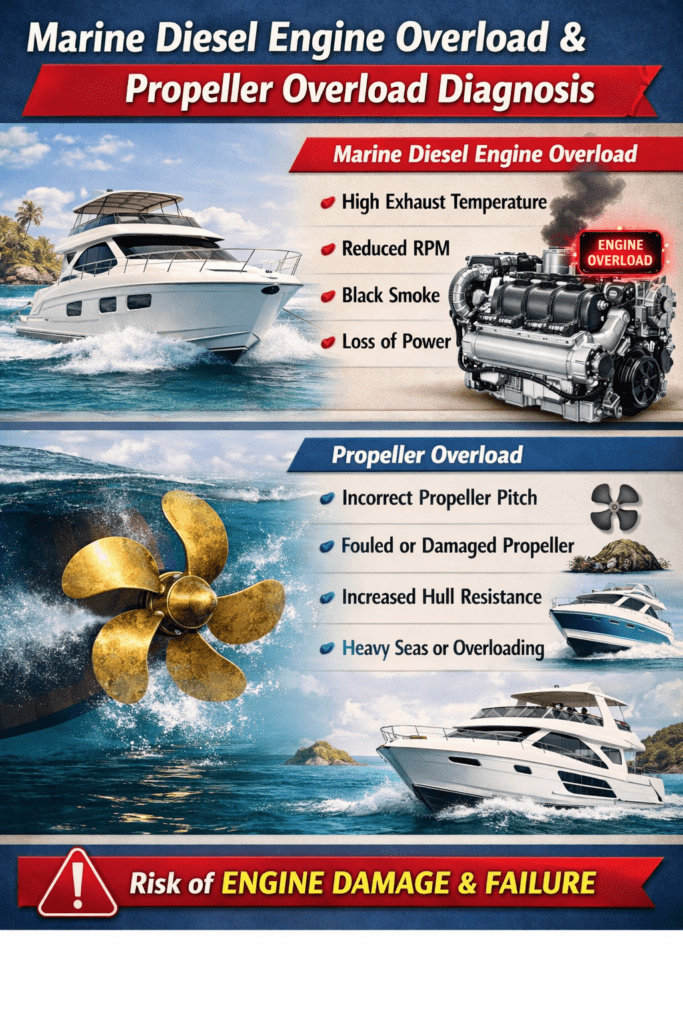
Marine Diesel Engine Overload & Propeller Overload Diagnosis
Engine overload is one of the most misunderstood causes of overheating, black smoke, high exhaust temperature, and inability to reach rated RPM in marine diesel engines. Many engines are incorrectly diagnosed with fuel or turbo problems when the real issue is excessive load placed on the engine.
At 805 Marine Diesel Mechanic, overload diagnosis is a critical part of performance troubleshooting throughout Ventura, Oxnard, Channel Islands Harbor, and Santa Barbara. In real-world marine service, overload is one of the most common reasons a healthy engine gets blamed for symptoms that are actually being caused by propeller mismatch, hull drag, added weight, or repower setup errors.
Return to Master Marine Diesel Troubleshooting Guide →
What Is Engine Overload?
Engine overload occurs when the engine must work harder than its design limits due to excessive resistance or improper setup. This increases fuel delivery and combustion heat without sufficient airflow, RPM recovery, or cooling margin to keep the engine operating efficiently.
In practical terms, overload means the engine is being asked to produce power in a range where it cannot spin freely enough to stay efficient. That is why overload so often overlaps with not reaching full RPM and loss of power under load complaints.
Unlike internal engine failure, overload is usually most obvious during acceleration, heavy cruise, or sea trial testing. At idle or neutral revving, the engine may seem completely normal.
Common Symptoms of Engine Overload
- Engine cannot reach rated RPM
- Black smoke under throttle
- High exhaust gas temperature (EGT)
- Overheating at cruise speeds
- Slow turbo spool-up
- Reduced fuel efficiency
Related guides:
These symptoms matter because overload rarely looks like overload at first. It often looks like a turbo problem, fuel restriction, or cooling issue, which is why it should also be compared with Marine Engine Black Smoke Under Load, Smoke Only Under Load, and the Low Power / Loss of RPM Diagnostics Center.
Why Overload Gets Misdiagnosed
Overload is frequently misdiagnosed because the visible symptoms appear inside the engine even when the actual cause is outside it. Black smoke looks like fueling trouble. High EGT looks like a combustion problem. Overheating looks like a cooling failure. Slow acceleration looks like a weak turbo or worn engine.
But in many cases, the engine is simply being held below its efficient operating range by propeller mismatch, excess drag, or vessel weight. That is why overload must always be separated from fuel, turbo, and cooling failures before major parts are replaced.
This is also why load complaints should be cross-checked against the Fuel Restriction vs Air Restriction Diagnosis page and the Turbo System Diagnosis Center. If the engine is being overworked, it can mimic both of those systems at once.
Common Causes of Propeller or Vessel Overload
1. Incorrect Propeller Pitch or Diameter
- Over-pitched propeller increases engine load dramatically.
A propeller that is too aggressive will keep the engine from reaching rated speed, especially under normal cruising load. That means the engine stays in a high-fuel, high-heat condition longer than intended, which often produces smoke and elevated temperatures.
2. Hull Fouling or Growth
- Marine growth increases drag and reduces efficiency.
Even moderate hull fouling can raise load enough to make a previously healthy setup begin smoking or overheating. This is one of the most common reasons a boat that “used to run fine” gradually starts feeling slow or heavy underway.
3. Added Vessel Weight
- Fuel, gear, water tanks, or structural modifications.
As displacement rises, propeller demand rises with it. That extra demand may not be obvious at the dock, but under cruise load it can push the engine into overload quickly.
4. Gear Ratio or Repower Changes
- Incorrect prop matching after repower.
This is a major issue after repower or drivetrain changes. A new engine, gear ratio, or shaft setup can easily be mismatched to the old propeller and create chronic overload even when every engine system is technically working.
How Engine Overload Causes Overheating
- Increased fuel delivery raises combustion temperature.
- Turbocharger works harder and generates more heat.
- Cooling system reaches thermal limits.
- Exhaust temperature rises rapidly.
Overload is one of the clearest examples of how performance complaints cross systems. What looks like a cooling issue may actually begin as excessive vessel resistance. What looks like a turbo issue may simply be a propeller problem forcing the engine into a smoky, high-EGT operating range.
This is why overload complaints should always be compared with the Cooling System Diagnosis Center and High Exhaust Temperature Diagnosis before assuming the core issue is inside the engine.
Fuel System Crossover — Why Overload Looks Like a Fuel Problem
Engine overload frequently gets mistaken for a fuel system issue because the visible symptom is often black smoke. Under load, fuel delivery increases significantly, and when the engine cannot match that fuel with airflow and RPM, combustion becomes incomplete.
This creates the appearance of over-fueling even when the injectors and fuel system are functioning correctly. That is why overload should always be compared with the Fuel System Diagnosis Center and the Fuel Contamination & Filtration Issues Center before replacing components.
Engines experiencing overload may also show symptoms similar to hesitation under throttle, because the engine is struggling to accelerate through a high-load condition.
Turbocharger & Air System Crossover
Overload has a direct impact on turbocharger performance. When the engine is held below its optimal RPM range, the turbo may not reach its designed boost level efficiently even though it is mechanically sound.
This results in low airflow relative to fuel delivery, which produces smoke and poor performance. It is one of the main reasons overload is often misdiagnosed as a turbo failure.
These conditions should always be verified using Boost Pressure Testing and compared with the Turbo System Diagnosis Center. If boost is normal for the RPM but the RPM itself is low, the problem is usually load-related—not turbo-related.
Exhaust Temperature & Backpressure Effects
High exhaust gas temperature is one of the clearest indicators of overload. As combustion becomes less efficient, more heat exits through the exhaust system.
At the same time, any existing exhaust restriction becomes more critical under load. Increased backpressure reduces airflow through the engine, further worsening combustion and increasing smoke.
This is why overload should also be evaluated alongside Marine Diesel Exhaust Backpressure Problems, especially when smoke and heat rise together.
Repower & Setup Mismatch — A Major Overload Cause
One of the most common sources of chronic overload is improper setup after repower. Changing engine horsepower, torque characteristics, or gear ratios without correctly matching the propeller will almost always create overload conditions.
The engine may run, idle, and even accelerate—but it will never reach proper RPM or efficiency because the propeller demand does not match the engine’s power curve. This is one reason overload complaints often show up after “upgrades” that were never truly matched as a full package.
Step-By-Step Overload Diagnosis
- Perform sea trial and record maximum RPM.
- Compare RPM against manufacturer rated speed.
- Inspect propeller size and condition.
- Check hull cleanliness.
- Measure boost pressure under load.
- Evaluate exhaust temperature trends.
Sea-trial data is critical because overload is a loaded-condition problem. Many boats will idle and rev acceptably at the dock, then fail to meet performance targets only when real resistance is applied underway.
That is also why overload diagnosis should be cross-checked with Computerized Marine Engine Survey Diagnostics Center when possible, so RPM, boost, fuel delivery, and thermal trends can all be reviewed together.
When Overload Is Misdiagnosed as Engine Failure
Common misdiagnoses include:
- Turbocharger replacement when boost is normal.
- Injector replacement without confirming load.
- Cooling system repairs that don’t solve overheating.
This is where structured diagnostics matter. If rated RPM is low because the propeller is wrong or the hull is fouled, replacing injectors or turbochargers will not solve the root problem.
In more serious cases, long-term overload can eventually create real mechanical stress, which is why the complaint should also be compared against Mechanical Failure Diagnostics if the engine has been run overloaded for a long time.
Advanced Sea Trial Diagnostics
Overload cannot be confirmed at the dock. It must be diagnosed under real operating conditions where the engine is working against actual vessel resistance.
Key data points during sea trial include maximum achievable RPM, boost pressure relative to RPM, exhaust temperature trends, smoke intensity under throttle, and acceleration response. These values help determine whether the engine is limited by fuel, air, cooling, or load.
For manufacturer reference on proper marine engine matching and application planning, see Cummins Marine and Caterpillar Marine.
Preventing Engine Overload
Preventing overload starts with proper setup and ongoing maintenance. Engines must be matched correctly to propellers, vessel weight, and intended operating conditions.
- Verify propeller pitch and diameter
- Maintain clean hull and running gear
- Avoid unnecessary weight increases
- Monitor engine performance regularly
Routine inspections through Marine Diesel Engine Services can identify early signs of overload before they develop into overheating, smoke, or performance complaints. That is especially important after repower work, drivetrain changes, or major weight changes aboard the vessel.
Local Marine Diesel Performance Analysis
805 Marine Diesel Mechanic provides advanced performance diagnostics, sea trial testing, and overload evaluation throughout Ventura County and Channel Islands Harbor. With over 30 years of experience, diagnosis focuses on identifying whether the engine is actually failing—or simply being overworked by vessel setup.
Correctly identifying overload prevents unnecessary part replacement and ensures the real problem—whether propeller, hull, gear ratio, or vessel condition—is actually corrected.
Marine Diesel Engine Overload & Propeller Overload Diagnosis FAQ
1. What is engine overload on a marine diesel?
Engine overload means the engine is being asked to work beyond its efficient operating range because of vessel resistance or incorrect setup. It usually shows up under load, not at idle, which is why sea-trial testing is so important.
2. Can a healthy engine still be overloaded?
Yes, absolutely. A healthy engine can still smoke, run hot, and miss rated RPM if the propeller, hull condition, weight, or gear ratio creates too much load.
3. What are the most common symptoms of overload?
Common signs include black smoke, high exhaust temperature, overheating at cruise, slow turbo spool, and failure to reach rated RPM. These complaints often overlap with Low Power / Loss of RPM Diagnosis because the visible problem is performance loss.
4. Can overload cause black smoke?
Yes, black smoke is one of the classic overload symptoms. The engine receives more fuel under load, but if it cannot match that with airflow and RPM, combustion becomes incomplete.
5. Can overload cause overheating?
Yes, overload increases combustion heat and raises the demand on the cooling system. That is why it often overlaps with Overheating Under Load Diagnosis rather than an idle-only overheating complaint.
6. Can the wrong propeller pitch overload an engine?
Yes, over-pitched propellers are one of the most common causes of overload. They hold the engine below rated speed and keep it working in a high-stress, high-heat range.
7. Can hull fouling cause overload?
Yes, hull growth increases drag and vessel resistance. Even if the engine itself is fine, that additional drag can create smoke, heat, and low-RPM complaints underway.
8. Why does overload get mistaken for turbo problems?
Because overloaded engines often show black smoke and slow spool-up. Those symptoms look like boost failure, which is why they should be compared with the Turbo System Diagnosis Center before parts are replaced.
9. Can overload look like a fuel problem?
Yes, because black smoke under load often looks like over-fueling. In reality, the fuel system may be fine and the engine may simply be operating under too much demand.
10. Does overload always mean the engine is damaged?
No, not at first. Overload is often a setup or vessel-resistance problem, but if ignored long enough it can eventually contribute to real engine wear and heat-related damage.
11. Can repower work create overload?
Yes, very easily. If engine power, torque curve, or gear ratio changes without correct propeller matching, the new setup can create chronic overload even though the repower itself was mechanically sound.
12. Why does overload cause high EGT?
Because the engine is being forced to work harder in a less efficient range. More combustion heat exits through the exhaust, which is why overload often overlaps with High Exhaust Temperature Diagnosis.
13. Can overload affect turbo boost readings?
Yes, but not always the way owners expect. The turbo may be functioning correctly, but if the engine cannot reach its intended RPM range, the overall boost picture can still look weak or delayed.
14. How is overload actually confirmed?
It is confirmed during a real sea trial, not at the dock. Maximum RPM, boost, smoke behavior, and temperature trends all need to be observed under true operating resistance.
15. What should be checked first if I suspect overload?
Start with maximum RPM and compare it to manufacturer-rated speed. Then inspect propeller condition, hull cleanliness, vessel weight, and related symptoms like not reaching full RPM.
16. Can overload be confused with cooling problems?
Yes, very often. The cooling system may appear to be the failure point when the real problem is extra vessel resistance forcing the engine to generate more heat than normal.
17. Can exhaust backpressure make overload symptoms worse?
Yes, because airflow becomes even more restricted when backpressure rises. That is why overload complaints sometimes need to be compared with Marine Diesel Exhaust Backpressure Problems.
18. Can overload hurt fuel economy?
Yes, badly. The engine burns more fuel to overcome resistance, but because it is operating inefficiently, that extra fuel does not translate into normal performance.
19. When should I call for diagnostics?
If the engine is smoking, running hot, missing rated RPM, or feeling heavy underway, professional overload testing is worth doing before more parts are replaced. This is especially true if recent prop, repower, or setup changes were made.
20. Where should I continue troubleshooting?
Start with the Master Marine Diesel Troubleshooting Guide. Then compare overload with fuel, turbo, cooling, and low-power pages based on what the engine does under load.
11 Responses