Schedule a Mobile Diagnostic Visit
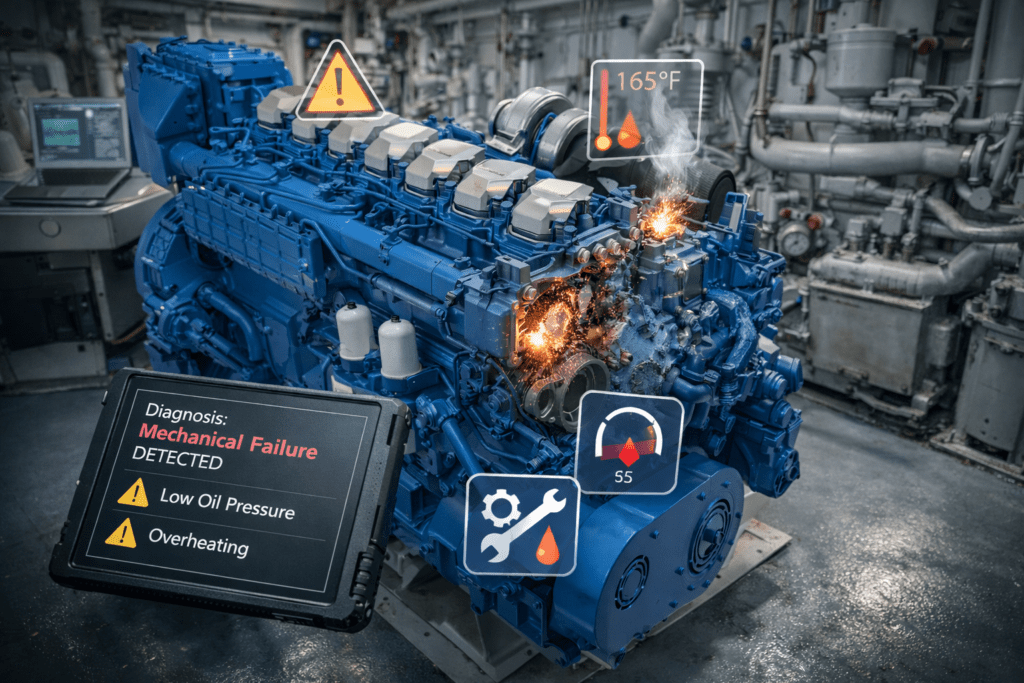
Mechanical failure is the category you never want to guess on. If your marine diesel is showing low oil pressure, overheating, knocking, sudden power loss, or abnormal smoke, the fastest path is to confirm whether the problem is a true internal mechanical failure (bearings, compression, valves) or a system issue that mimics failure (fuel restriction, cooling restriction, turbo/air problems).
Start here first: use the Master Marine Diesel Troubleshooting Guide to match your symptom to the correct diagnostic cluster.
Mechanical Failure Diagnostics (Fast Triage Checklist)
Step 1: Confirm the “Stop Now” Conditions
- Oil pressure drops suddenly (especially under load)
- Overheating that rises fast or repeats after “easy” fixes
- New hard knock, metallic rattle, or vibration that wasn’t there
- Runaway, severe smoke change, or loss of RPM that won’t recover
If any of the above are present: reduce load, idle briefly to assess, and shut down if oil pressure/temps are unsafe. Continuing to run can turn a repair into a rebuild.
Step 2: Don’t Let System Faults Masquerade as “Internal Failure”
- Low oil pressure can be caused by incorrect oil level, aeration, wrong viscosity, clogged pickup, failing relief valve, or worn bearings.
- Overheating can be caused by seawater pump/impeller damage, heat exchanger restriction, aftercooler restriction, or exhaust backpressure.
- Power loss + smoke can be fuel restriction, air restriction, turbo/boost leak, or injector issue—not always compression.
Related deep-dives: Seawater Pump Failure & Impeller Damage and Heat Exchanger Clogging Symptoms.
Step 3: Mechanical Reality Checks (What We Verify On-Site)
- Oil pressure verification (gauge validation + sender checks)
- Crankcase pressure / blow-by signs (breather output, oil mist, excessive pulsing)
- Compression indicators (hard starting, uneven idle, cylinder contribution concerns)
- Cooling efficiency (raw-water flow, temperature rise pattern, restrictions)
- Load diagnosis (prop overload vs engine issue vs air/fuel limitation)
Most Common Mechanical Failure Symptoms (And What They Usually Mean)
Low Oil Pressure (Especially Under Load)
- Oil aeration/foaming, restricted pickup, worn bearings, sticking relief valve, oil cooler restriction
- Priority: confirm with a mechanical gauge and inspect for contamination (fuel/coolant)
Overheating + Power Loss
- Raw-water flow restriction, heat exchanger blockage, aftercooler restriction, exhaust restriction
- Priority: verify raw-water discharge and rule out restriction before suspecting head gasket
Knocking, Rattle, or New Vibration
- Injector knock, misfire, loose mounts/coupler, bearing wear, timing-related issues
- Priority: identify if the noise changes with cylinder contribution/load
Sudden Smoke Change + Poor Performance
- Fuel quality/restriction, turbo failure, boost leak, aftercooler leak, injector issue, compression concern
- Priority: match smoke color and when it happens (startup vs under load)
Smoke help: Marine Diesel Smoke Diagnosis Guide and Black Smoke Under Load.
When It’s Time to Talk “Rebuild vs Repower”
If we confirm low compression across multiple cylinders, severe blow-by, repeat overheating damage, or bearing distress, the smartest move may be a major decision pathway instead of piecemeal repairs.
Professional Mobile Mechanical Diagnostics in Ventura & Channel Islands Harbor
805 Marine Diesel Mechanic provides structured, symptom-based troubleshooting and in-engine-room diagnostics throughout Ventura, Oxnard, Channel Islands Harbor, and Santa Barbara. If your engine is throwing warning signs, we’ll confirm root cause and map the repair plan before parts get replaced.
Book Mechanical Failure Diagnostics
Related Resources
- BoatUS — Expert Advice
- Yachting Magazine
- Racor — Filtration Resources
- Cummins — Maintenance & Support
Related 805 Marine Diesel Mechanic Pages
- Master Marine Diesel Troubleshooting Guide (Diagnostic Hub)
- Fresh Water Flushing Guide
- Perkins Marine Engine Service
- Yanmar Marine Service
Mechanical Failure vs System Failure – The Most Important First Split
One of the biggest mistakes in marine diesel troubleshooting is assuming every serious symptom means internal engine damage. In real-world diagnosis, many problems that look like mechanical failure are actually caused by cooling restriction, fuel supply problems, air or boost loss, exhaust restriction, injector imbalance, or electrical shutdown issues. That is why the first job is not guessing whether the engine needs a rebuild — it is separating true internal failure from system faults that mimic it.
A trained technician starts by matching the symptom to the failure pattern. If the engine has sudden low oil pressure, new metallic knocking, runaway behavior, or severe overheating that rises rapidly, internal mechanical damage moves much higher on the list. If the engine has power loss, smoke, or intermittent shutdown but oil pressure and temperature remain stable, system-side problems are often more likely. Continue using the Master Marine Diesel Troubleshooting Guide to keep the diagnosis symptom-based and structured.
Fast Mechanical Failure Decision Path
- Sudden low oil pressure: verify with a mechanical gauge before assuming bearing failure. Compare with Low Oil Pressure Diagnosis and Mechanical Failure Diagnostics.
- Overheating that returns after simple fixes: rule out seawater flow, exchanger restriction, aftercooler issues, and exhaust restriction first. Continue with Cooling System Diagnosis Center and Overheating at Idle.
- Knocking or metallic rattle: identify whether the sound changes with RPM, load, or cylinder contribution. Compare with Boat Engine Knock or Ticking Noise and Excessive Vibration Diagnosis.
- Smoke change with power loss: often fuel, turbo, or air-side related before it is truly internal. Use Smoke & Combustion Diagnosis Center and Fuel Restriction vs Air Restriction Diagnosis.
- Hard starting with blow-by or rough idle: compression and cylinder sealing become bigger concerns. Review Boat Engine Hard Starting and Marine Diesel Cranks But Won’t Start.
Why Mechanical Problems Get Misdiagnosed
Marine diesel engines operate as a complete system, so one failing subsystem can create symptoms that look much worse than they really are. A restricted heat exchanger can mimic head gasket failure. A boost leak can mimic compression loss. A contaminated fuel system can make an engine feel “dead” under load even though the rotating assembly is still healthy. Because of this, the smartest path is always measured verification before teardown.
Across Ventura, Oxnard, Channel Islands Harbor, and Santa Barbara, many of the “engine failure” calls we inspect turn out to be cooling restriction, contaminated fuel, suction-side air leaks, bad grounds, weak starting performance, or turbo/aftercooler issues. That is exactly why 805 Marine Diesel Mechanic uses a structured diagnostic process first — to confirm root cause before costly rebuild or repower decisions are made.
When Rebuild or Repower Becomes the Right Conversation
Once true internal damage is confirmed, the next question is not just “what broke?” but “what is the smartest long-term move?” If there is severe blow-by, multiple low-compression cylinders, repeated overheat damage, or bearing material showing in oil, rebuild and repower planning becomes more relevant than piecemeal repair. Compare next steps with Repower vs Rebuild Marine Diesel Engine and Signs Your Marine Diesel Engine Is Beyond Rebuild.
Marine Engine Mechanical Failure Diagnostics – FAQ
These frequently asked questions help boat and yacht owners understand when a marine diesel symptom points to true internal mechanical failure and when it is more likely a system problem that only looks mechanical.
What is considered mechanical failure in a marine diesel engine?
Can fuel or cooling problems mimic mechanical failure?
What are the most serious warning signs of engine mechanical failure?
Does sudden low oil pressure always mean worn bearings?
Can overheating cause permanent engine damage?
What does excessive blow-by mean on a marine diesel?
Can a knocking sound mean injector trouble instead of internal damage?
What if my engine vibrates more than normal?
Does black smoke mean mechanical failure?
Can white smoke point to compression loss?
What if my engine has power loss and overheating together?
Should I keep running the engine if it knocks?
Can a turbo or boost leak feel like a worn-out engine?
What are the first on-site checks a technician should do?
When does compression testing become important?
Can repeated overheating lead to rebuild or repower decisions?
How do I know if my engine is beyond rebuild?
Can a mechanical issue start as a hard-start complaint?
When should I call a marine diesel technician?
Where can I continue the full diagnostic process?
Related Mechanical, Cooling & Performance Diagnosis Guides
- Cooling System Diagnosis Center
- Why Is My Boat Engine Oil Pressure Low?
- Why Does My Boat Engine Knock or Make Ticking Noise?
- Why Does My Boat Engine Vibrate Excessively?
- Low Power / Loss of RPM Diagnostics Center
- Marine Diesel Turbo System Diagnosis Center
- Boat Engine Hard Starting – Marine Diesel Diagnosis Guide
805 Marine Diesel Mechanic provides mobile marine diesel diagnostics throughout Ventura, Oxnard, Channel Islands Harbor, and Santa Barbara, helping boat owners separate true internal engine failure from fuel, cooling, turbo, and smoke-related problems before costly parts are replaced.

9 Responses