
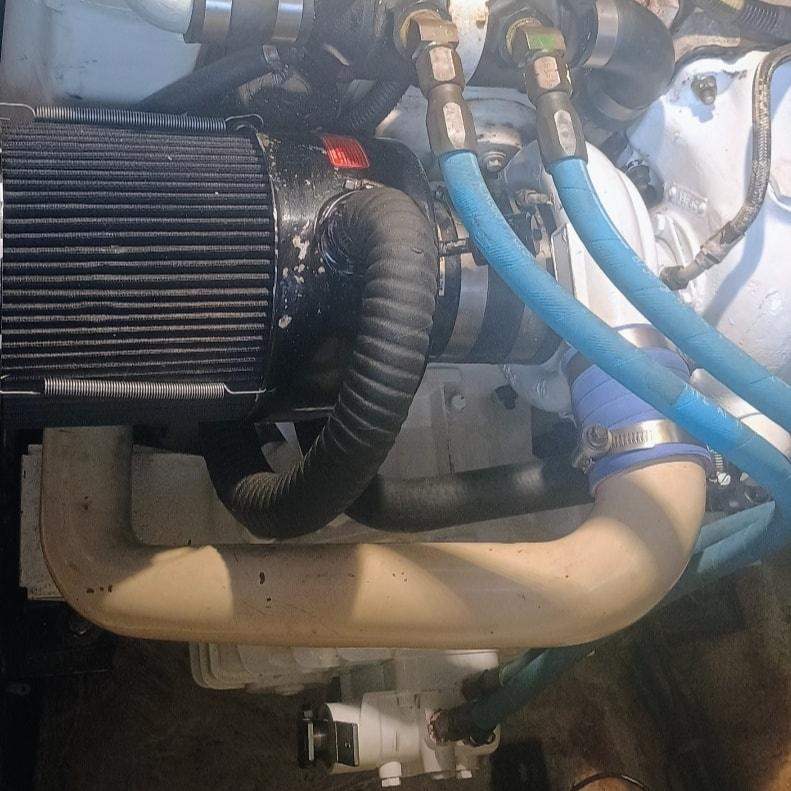
Why Does My Boat Engine Have No Smoke When Cranking? (Marine Diesel Guide)
If your marine diesel engine is cranking normally but producing absolutely no smoke from the exhaust, you’ve just been given one of the most valuable diagnostic clues possible. In real-world marine diesel troubleshooting, this symptom allows you to eliminate entire systems immediately.
After 30+ years diagnosing inboard marine diesel engines throughout Ventura, Oxnard, Channel Islands Harbor, and Santa Barbara, we can tell you this with confidence:
No smoke during cranking almost always means no fuel is reaching the combustion chamber.
This is one of the fastest ways to isolate a no-start condition without guessing or replacing parts unnecessarily.
Start with the full system here:
Marine Diesel Troubleshooting Guide
Why Smoke Matters During Cranking
In a properly functioning diesel engine, fuel is injected into the cylinder and ignites due to compression heat. Even if combustion is weak, you will typically see some level of smoke—white, gray, or even black depending on conditions.
When there is no smoke at all, it means fuel is not entering the combustion chamber in any meaningful quantity. This instantly shifts the diagnostic focus away from air, compression, or exhaust issues and directly toward the fuel delivery system.
Diesel combustion depends on precise fuel injection timing and pressure (Diesel Engine Combustion Basics). Without fuel, combustion cannot occur—period.
1. No Fuel Delivery (Primary Failure Point)
The most common cause of no smoke during cranking is a complete lack of fuel delivery. This can be as simple as an empty tank or as complex as a blocked fuel system.
In real-world diagnostics, this is always the first system checked because it is both the most likely failure and the easiest to confirm. Even a partially restricted fuel system can prevent injection during cranking conditions.
- Empty or low fuel tank
- Closed or partially closed fuel shutoff valve
- Collapsed or blocked fuel line
👉 Related: Fuel System Diagnosis Center
2. Air Intrusion in Fuel System
Air in the fuel system is one of the most common causes of no-start conditions after maintenance or filter changes. Unlike gasoline systems, diesel engines cannot compress air in the fuel system and still function.
When air is present, the injection pump cannot build the pressure required to deliver fuel to the injectors. The result is cranking with no smoke.
- Loose fuel fittings
- Improper filter installation
- Fuel system opened without proper priming
👉 Related: No Start After Filter Change
3. Clogged Fuel Filters and Restriction
Fuel filters are designed to trap contaminants, but once they become clogged, they restrict flow. Under cranking conditions, where fuel pressure is already low, even minor restriction can prevent fuel from reaching the injectors.
This is especially common in boats that have been sitting or that have contaminated fuel systems.
👉 Related: Fuel Contamination & Filtration Issues
4. Fuel Shutoff Solenoid Failure
The fuel shutoff solenoid is a critical but often overlooked component. Its job is to open and allow fuel to flow when the engine is started. If it fails or loses power, fuel flow stops completely.
This results in a perfect “no smoke” condition—because the system is physically preventing fuel from reaching the engine.
👉 Related: Electrical Diagnosis Center
5. Injection Pump Failure
The injection pump is responsible for delivering high-pressure fuel to the injectors. If it fails internally, fuel will not be delivered—even if the rest of the system is working properly.
This is less common than simple fuel supply issues but is a critical failure when it occurs.
Fuel injection systems require precise pressure and timing (Marine Diesel Fuel System Overview).
6. Injector or Injection Line Issues
If injectors are clogged, stuck, or not receiving fuel, combustion cannot occur. Even if the injection pump is working, blockages in injector lines can prevent delivery.
👉 Related: Smoke & Combustion Diagnosis Center
7. Lift Pump Failure
The lift pump supplies fuel from the tank to the injection system. If it fails, the engine will not receive sufficient fuel to begin injection.
This often shows up as intermittent starting issues before becoming a full no-start condition.
8. Fuel Tank Pickup Blockage
Debris, algae, or contamination inside the tank can block the pickup tube, preventing fuel from being drawn into the system.
This is more common in older vessels or those with poor fuel maintenance history.
9. Electronic Fuel System Issues (Modern Engines)
On electronically controlled engines, sensors and ECU commands control fuel delivery. If a critical sensor fails, the system may prevent injection entirely.
- Crankshaft position sensor failure
- ECU communication issues
- Fuel rail pressure faults
Step-by-Step Professional Diagnosis
- Verify fuel level and valve position
- Inspect and replace filters if needed
- Prime fuel system and remove air
- Check for leaks or loose fittings
- Test fuel shutoff solenoid
- Verify lift pump operation
- Test injection pump output
- Inspect injector delivery
👉 Related:
Engine Shutdown Guide
Frequently Asked Questions
1. What does no smoke during cranking mean?
It means fuel is not reaching the combustion chamber. Start with the Marine Diesel Troubleshooting Guide to isolate the issue quickly.
2. Is no smoke always a fuel issue?
In almost all cases yes, because without fuel injection there is nothing to burn or produce visible exhaust smoke.
3. Can air in the fuel system cause this?
Yes, air prevents pressure from building, stopping fuel from reaching the injectors. See this guide.
4. Can clogged filters cause no smoke?
Yes, restricted filters can completely block fuel flow during cranking conditions.
5. Can injectors cause no smoke?
Yes, if injectors are blocked or not receiving fuel, no combustion will occur.
6. Where should I start diagnosing?
Start with the Fuel System Diagnosis Center and follow a structured approach.
7. Can a bad lift pump cause this?
Yes, without supply pressure the injection system cannot operate.
8. Can ECU issues cause no smoke?
Yes, electronic systems can prevent injection entirely if faults are detected.
9. Can contaminated fuel cause no smoke?
Yes, especially if it blocks filters or prevents proper flow. See fuel contamination guide.
10. Should I keep cranking?
No, repeated cranking can damage starters and drain batteries.
11. Can timing cause no smoke?
Rarely; most no-smoke conditions are fuel delivery related rather than timing.
12. Can compression cause no smoke?
Low compression usually still produces some smoke, making fuel issues more likely.
13. Can fuel shutoff cause this?
Yes, a closed or failed solenoid will completely stop fuel flow.
14. Can blocked pickup tubes cause this?
Yes, they can stop fuel from ever reaching the system.
15. Can wiring issues cause no smoke?
Yes, especially if they affect solenoids or ECU control systems.
16. Is this a common issue?
Yes, especially after maintenance or fuel system service.
17. Can I fix this myself?
Basic checks are possible, but full diagnosis often requires professional testing.
18. What is the fastest way to diagnose?
Follow the cranks but won’t start guide for step-by-step troubleshooting.
19. Do you offer mobile service?
Yes, we service Ventura, Oxnard, Channel Islands Harbor, and Santa Barbara.
20. When should I call a mechanic?
If basic checks don’t restore fuel flow, professional diagnosis is recommended immediately.