
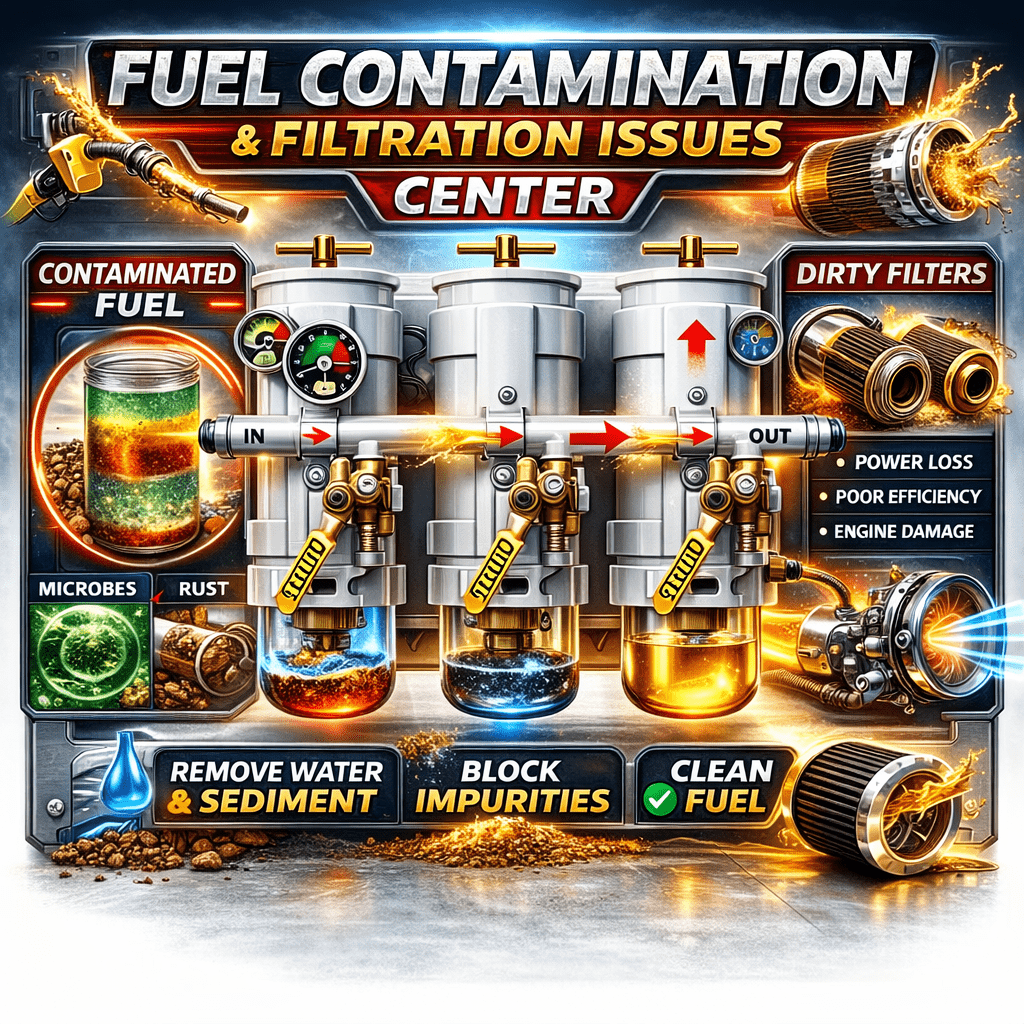
Fuel Contamination & Filtration Issues Center
Fuel contamination is one of the most common—and most destructive—problems in marine diesel engines. Unlike sudden mechanical failures, contamination builds slowly, reducing performance, clogging filters, damaging injectors, and creating symptoms that often get misdiagnosed as turbo, cooling, or engine issues.
At 805 Marine Diesel Mechanic, serving Ventura, Oxnard, Channel Islands Harbor, and Santa Barbara, fuel system diagnosis is always approached as a complete system problem. Before replacing parts, symptoms should be mapped through the Master Marine Diesel Troubleshooting Guide to identify whether contamination, restriction, or air intrusion is the root cause.
Why Fuel Contamination Becomes a Performance Problem
Marine diesel engines rely on clean, stable fuel delivery. When contaminants enter the system, filtration begins to restrict flow and injection quality deteriorates.
This is why contamination often presents as low power and RPM loss instead of obvious fuel failure.
As restriction increases, engines behave like loss of power under load, where demand exceeds supply capacity.
Primary Sources of Fuel Contamination
- Water intrusion from condensation or fueling
- Microbial growth (“diesel bug”)
- Tank sediment and debris
- Degraded hoses and fittings
- Poor filtration or maintenance practices
Water contamination is particularly damaging and leads to injector failure patterns similar to injector contamination damage.
Filtration Restriction — The Most Common Failure
Filters protect the engine but become a restriction when clogged.
This aligns with Racor filter problems, where debris limits fuel flow under load.
Engines may hesitate (hesitation under throttle) or stall (stalling in gear).
Air Intrusion vs Restriction
Air intrusion disrupts pressure and creates unstable operation.
This overlaps with air vs restriction diagnosis patterns.
Engines may behave like start then die scenarios.
Contamination Symptoms
Combustion & Turbo Impact
Contaminated fuel reduces combustion efficiency and exhaust energy.
This mimics turbo problems and can lead to black smoke.
Cooling System Stress
Reduced combustion efficiency increases heat load.
This contributes to heat exchanger restriction symptoms.
Advanced Diagnostics
Fuel vacuum, pressure testing, and live data diagnostics confirm system performance.
Advanced analysis through the Computerized Diagnostics Center identifies root cause accurately.
Prevention & Filtration Upgrades
Proper filtration and monitoring prevent contamination failures.
Systems like Racor monitoring upgrades provide early warning.
Routine service through marine diesel services ensures reliability.
FAQ
1. What causes fuel contamination?
Water intrusion, microbial growth, and debris buildup are the primary causes.
2. Can contamination cause power loss?
Yes, it often appears as power loss under load.
3. Why do my filters clog repeatedly?
This usually indicates tank contamination.
4. Can water damage injectors?
Yes, it causes corrosion and poor atomization.
5. What is diesel bug?
Microbial growth in contaminated fuel.
6. Can contamination cause smoke?
Yes, especially black smoke from poor combustion.
7. Can fuel issues mimic turbo problems?
Yes, reduced exhaust energy affects boost.
8. Why does my engine surge?
Unstable fuel delivery causes RPM fluctuation.
9. Can contamination cause hard starting?
Yes, especially with air intrusion.
10. Should I replace filters frequently?
Yes, but repeated clogging means deeper issues.
11. Can contamination damage pumps?
Yes, reduces lubrication and increases wear.
12. What is fuel polishing?
Cleaning fuel to remove contaminants.
13. Can contamination affect cooling?
Indirectly, through increased heat load.
14. How do I detect restriction?
Through vacuum testing.
15. Can hoses cause contamination?
Yes, degraded hoses introduce debris.
16. Can contamination cause shutdown?
Yes, when flow becomes unstable.
17. Should I test before replacing parts?
Always confirm the root cause first.
18. Who should diagnose?
A trained marine diesel technician.
19. Where do I start?
Start with the Master Guide.
20. What is the best prevention?
Clean fuel, proper filtration, and regular inspection.
18 Responses