
Boost Pressure Testing on Marine Diesel Engines (Accurate Turbo Diagnosis Guide)
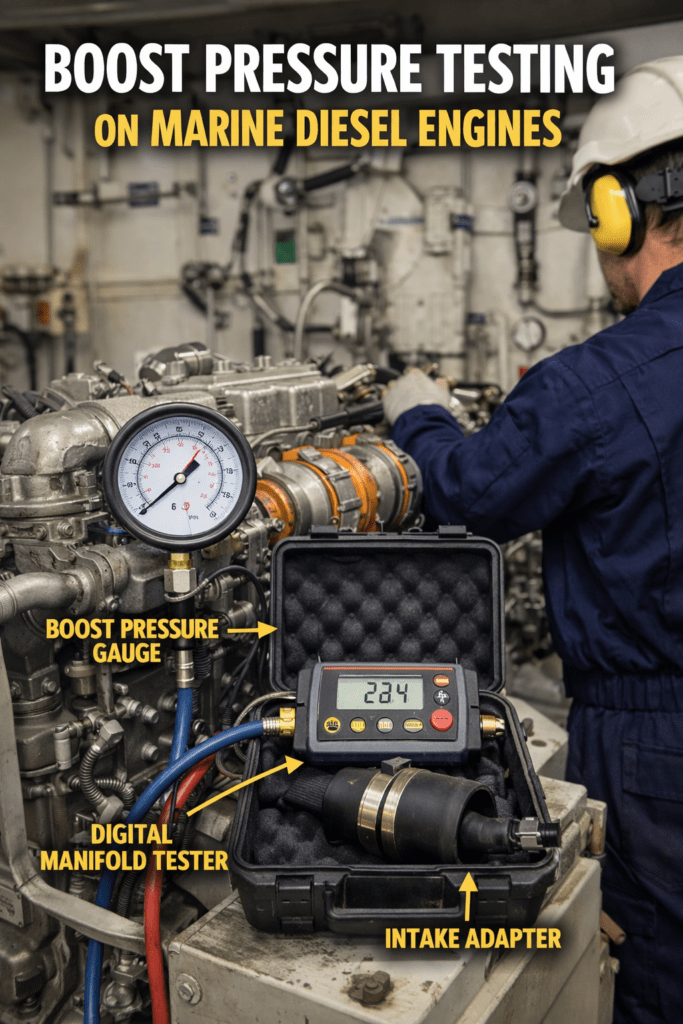
Loss of power, excessive smoke, or engines that won’t reach full RPM are often blamed on turbo failure—but guessing leads to wasted time and expensive mistakes. Proper boost pressure testing is one of the fastest and most accurate ways to diagnose real performance problems on marine diesel engines.
At 805 Marine Diesel Mechanic, boost testing is used as a “truth tool” across Ventura, Oxnard, Channel Islands Harbor, and Santa Barbara. It allows trained technicians to quickly separate turbocharger issues from airflow restriction, fuel system limitations, exhaust backpressure, and engine load problems.
Start with the Master Marine Diesel Troubleshooting Guide →
What Is Turbo Boost Pressure?
Turbo boost pressure measures how much compressed air the turbocharger is delivering into the engine intake system. This compressed air increases oxygen availability, allowing the engine to burn fuel efficiently and produce full rated power.
Boost pressure is directly tied to systems covered in the
Turbo System Diagnosis Center,
Aftercooler & Intercooler Problems, and
Exhaust Backpressure Problems.
Without proper boost, engines lose efficiency, create smoke, and cannot perform under load.
Why Boost Testing Is One of the Most Important Diagnostic Tools
Boost pressure testing works because it reflects the combined performance of multiple systems. It shows whether the engine is receiving the correct amount of air under real-world conditions.
When boost is low, the issue may not be the turbo itself. It can be caused by restricted airflow, fuel delivery problems, exhaust leaks, or improper load conditions. That’s why boost testing is used alongside:
- Fuel System Diagnosis Center
- Smoke & Combustion Diagnosis Center
- Low Power Diagnostics Center
- Computerized Diagnostics Center
Common Symptoms That Require Boost Testing
- Engine won’t reach full RPM
- Black smoke under load
- Power loss under load
- Surging at cruise RPM
- High exhaust temperature
- Slow turbo spool or delayed throttle response
These symptoms often overlap with
Turbo Lag & Slow Spool-Up and
Turbocharger Failure Symptoms.
Boost Readings Only Matter Under Load
One of the biggest diagnostic mistakes is checking boost pressure at idle or in neutral. These readings are nearly meaningless because the engine is not under load.
Proper boost testing must be performed during a sea trial where the engine is working against real resistance.
- Normal in neutral but weak in gear → airflow or load-related issue
- Low boost + black smoke → air restriction or turbo inefficiency
- Low boost + no smoke → fuel starvation or overload condition
- Fluctuating boost → leaks or unstable system behavior
Step-by-Step Boost Pressure Testing Process
- Inspect intake system (AirSep, filters, hoses)
- Install boost gauge at intake manifold
- Perform sea trial under load
- Record boost across RPM range
- Compare results to manufacturer specs
- Cross-check with fuel, air, and exhaust systems
This process prevents misdiagnosis and ensures accurate root cause identification.
What Low Boost Actually Means
Low boost rarely means the turbocharger has failed. In real-world marine diagnostics, it is more often caused by system restrictions or energy loss.
- Restricted intake airflow
- Dirty aftercooler core
- Exhaust restriction reducing turbine energy
- Fuel delivery limitations
- Charge air leaks
These conditions should always be evaluated alongside
Fuel vs Air Restriction Diagnosis and
Turbo Oil System Problems.
High or Unstable Boost Conditions
While low boost is more common, high or unstable boost readings can also provide valuable diagnostic clues.
These may indicate:
- Wastegate malfunction
- Overfueling conditions
- Boost control system failure
- Incorrect engine loading
Compare with
Wastegate Problems and
Exhaust System Restrictions.
System Interaction (Why Boost Alone Isn’t Enough)
Boost pressure is a powerful diagnostic tool, but it must always be interpreted alongside other systems. A correct boost reading does not guarantee correct performance if airflow density, fuel balance, or cooling efficiency are off.
This is why technicians evaluate boost alongside:
External References
Cummins Marine Engines |
Caterpillar Marine Systems
24 Responses