
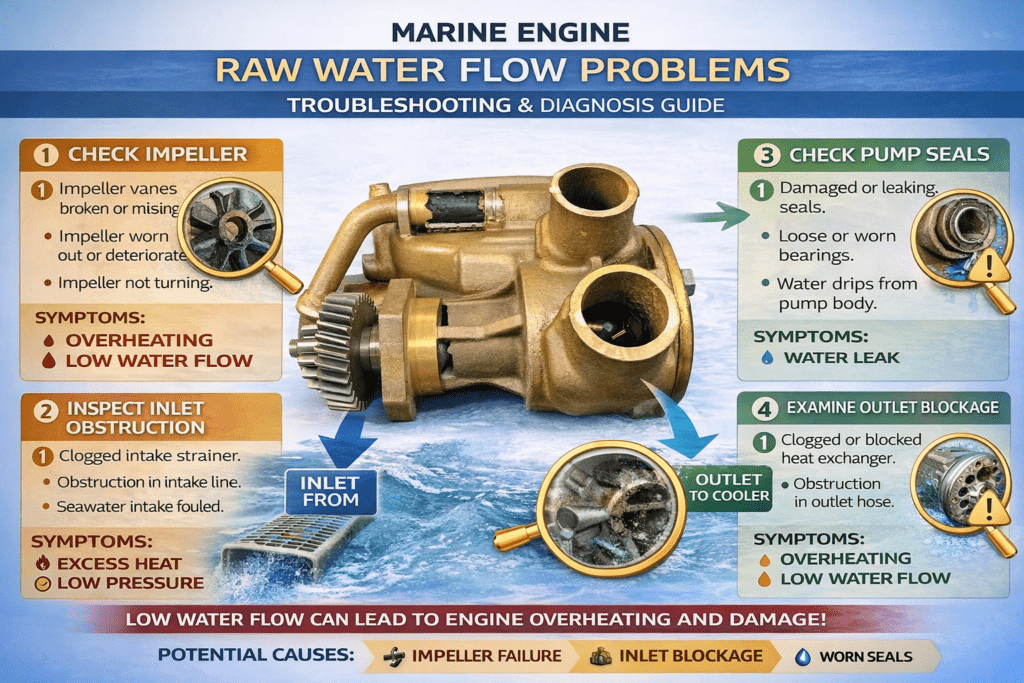
Marine diesel raw water flow problems are one of the most common root causes of overheating, high exhaust temperatures, and power loss. Before replacing pumps or tearing into major components, start with the Master Marine Diesel Troubleshooting Guide to determine whether the issue is intake restriction, pump failure, air intrusion, or downstream blockage.
At 805 Marine Diesel Mechanic, raw water flow issues are frequently misdiagnosed as overheating problems, turbo failure, or low power issues. In reality, restricted or inconsistent raw water flow is often the root cause affecting multiple systems.
What Raw Water Flow Problems Look Like
- Overheating at idle or under load
- Weak or reduced exhaust water discharge
- Intermittent temperature spikes
- Steam or hot exhaust smell
- High exhaust temperature alarms
These symptoms often overlap with combustion-related issues, making proper diagnosis critical.
Flow vs Restriction vs Air Intrusion (Critical Concept)
Technicians separate raw water problems into three categories:
- Restriction: Blockage in intake, strainer, exchanger, or exhaust
- Flow loss: Pump wear or impeller damage reducing output
- Air intrusion: Suction leaks preventing proper water pickup
This diagnostic separation prevents misdiagnosis and unnecessary repairs.
1. Seacock or Intake Restriction
The simplest problems are often overlooked:
- Closed or partially closed seacock
- Blocked intake grate (kelp, plastic)
- Marine growth restricting intake
These issues often mimic RPM loss and power loss under load.
2. Seawater Strainer Problems
A partially clogged strainer allows enough flow at idle but fails under demand.
- Debris in basket
- Cracked housing
- Leaking lid O-ring (air intrusion)
This commonly overlaps with air intrusion diagnostics concepts.
3. Suction-Side Air Leaks
Air leaks before the pump are difficult to detect because they may not leak water externally.
- Loose hose clamps
- Cracked suction hose
- Worn gaskets
These create intermittent flow loss similar to engine instability.
4. Raw Water Pump Problems
Pump efficiency drops due to wear:
- Worn cam plate
- Scored housing
- Seal leakage
This reduces flow, especially at low RPM, similar to impeller failure symptoms.
5. Damaged Impeller (Most Common)
Impellers can partially fail and still move some water.
- Missing vanes reduce flow
- Debris travels downstream
- Symptoms return quickly after replacement
Fragments often lodge in heat exchangers and aftercoolers.
6. Collapsed or Delaminated Hoses
Older hoses can collapse internally under suction.
This problem appears primarily under load, making it difficult to diagnose at idle.
7. Downstream Blockage (Coolers & Exchangers)
Debris commonly collects at restriction points:
- Oil cooler inlet
- Heat exchanger tubes
- Aftercooler passages
This often leads to combined symptoms with exhaust restriction.
8. Exhaust Mixing Elbow Restriction
Carbon buildup reduces water injection flow.
This can raise exhaust temperature and mimic turbo problems like turbo lag.
Technician Diagnostic Workflow
- Verify intake and seacock operation
- Inspect strainer and seals
- Check suction integrity
- Inspect pump and impeller
- Trace flow through cooling circuit
- Confirm discharge strength at exhaust
This workflow often integrates engine diagnostics and load testing.
External Authority Resources
Cummins Marine Engines |
Caterpillar Marine Systems
18 Responses