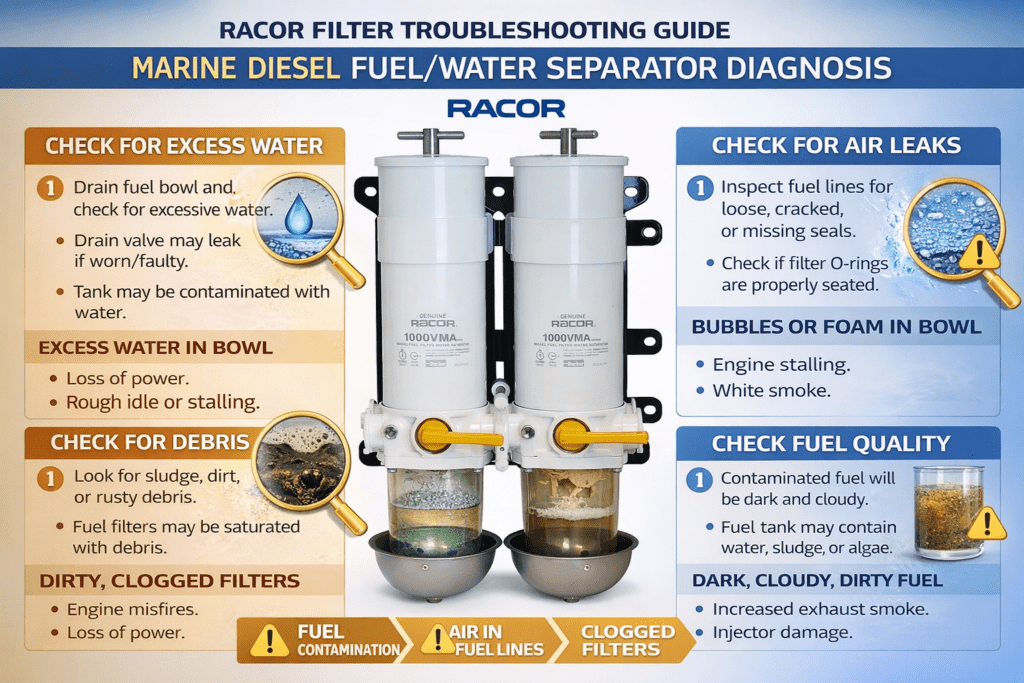
Racor fuel filter problems are one of the most common—and most misdiagnosed—causes of marine diesel engine issues. Before replacing injectors, chasing turbo failures, or assuming major engine damage, start with the Master Marine Diesel Troubleshooting Guide to confirm whether the root problem is actually fuel restriction, contamination, or air intrusion.
At 805 Marine Diesel Mechanic, Racor-related failures are frequently mistaken for turbocharger failure symptoms, injector issues, or low power mechanical faults. In reality, the Racor system is often revealing a deeper upstream problem such as diesel fuel contamination, air intrusion, or fuel restriction vs air imbalance.
What a Racor Filter Actually Does
The Racor fuel/water separator is the primary filtration stage protecting your marine diesel engine. It removes water and debris before fuel reaches sensitive components like the lift pump, injection pump, and injectors.
However, the Racor is only a filter—it cannot fix underlying problems. If you have tank contamination, collapsing pickup hoses, or a clogged vent, the Racor will simply become the first visible failure point. This is why repeated filter clogging should always trigger deeper investigation through the Fuel System Diagnosis Center.
Common Racor Failure Symptoms
Racor issues usually show up under load, but can also affect starting and idle quality depending on severity.
These symptoms overlap with smoke diagnosis patterns and high exhaust temperature issues, which is why technicians must confirm fuel restriction before moving on to other systems.
Problem #1 — Clogged Racor Element (Fuel Restriction)
This is the most common issue. The filter becomes overloaded with debris or microbial sludge and begins restricting fuel flow.
Restriction typically appears under load and mimics power loss under load or RPM limitation.
- Engine runs normally at idle
- Power drops as throttle increases
- New filters clog quickly after replacement
If restriction returns quickly, the issue is not the filter—it is upstream contamination, often confirmed through fuel contamination diagnostics.
Problem #2 — Water in Fuel
Water is one of the most damaging contaminants in a diesel fuel system. It enters through condensation, bad fuel, or leaking deck fittings.
This condition often leads to issues seen in no-start after filter changes and priming problems.
- Visible water layer in Racor bowl
- Water alarm activation
- Rough running or misfire
Problem #3 — Air Leaks in Fuel System
Air leaks are often overlooked because they do not produce visible fuel leaks. Even a small suction-side air leak can disrupt fuel delivery.
This frequently mimics stalling conditions and hard starting issues.
Problem #4 — Tank Pickup or Vent Restriction
Sometimes the Racor is blamed when the real issue is upstream in the fuel tank system.
- Clogged pickup tube
- Collapsed suction hose
- Blocked tank vent causing vacuum
These problems can mimic exhaust restriction or turbo lag, which leads to misdiagnosis.
Technician Diagnostic Process
Accurate diagnosis requires measuring, not guessing.
- Inspect Racor bowl for water or sludge
- Measure vacuum under load
- Check for air leaks in fittings
- Inspect tank and pickup condition
- Confirm fuel delivery stability
This is often paired with boost pressure testing and engine diagnostics to confirm full system performance.
External Authority Resources
Cummins Marine Engines |
Caterpillar Marine Systems
1. Why does my Racor filter keep clogging?
Repeated Racor clogging usually means the fuel tank has contamination, sludge, microbial growth, or debris feeding into the filter. Replacing the element may temporarily restore fuel flow, but the problem will return if the source is not corrected. A proper diagnosis includes inspecting the fuel, tank pickup, and filter bowl.
2. Why won’t my marine diesel start after changing the Racor filter?
A no-start after a Racor filter change is usually caused by air trapped in the fuel system or a suction-side leak at the lid, bowl, T-handle, or fittings. Even a small air leak can stop fuel from reaching the injection system. The system must be properly primed and checked for seal problems.
3. What causes a Racor water alarm?
A Racor water alarm is triggered when water collects in the separator bowl. Water usually enters from condensation, contaminated fuel, leaking deck fills, or tank vent problems. The bowl should be drained, the element inspected, and the water source located before injector damage occurs.
4. Can a clogged Racor cause loss of RPM?
Yes, a clogged Racor can restrict fuel flow enough to prevent the engine from reaching rated RPM. The engine may idle normally but lose power when throttle and fuel demand increase. This is one of the most common fuel restriction patterns on marine diesel engines.
5. Can a Racor problem cause surging at cruise RPM?
Yes, surging at cruise can happen when fuel flow becomes unstable because of restriction, air intrusion, or contamination. The engine receives inconsistent fuel volume and begins hunting or fluctuating. Racor vacuum testing and filter inspection help confirm the fuel-side cause.
6. What does black sludge in a Racor filter mean?
Black sludge often indicates microbial contamination, commonly called diesel algae. This material can quickly clog filter elements and continue returning until the tank is cleaned or fuel is polished. Repeated sludge in the Racor should never be treated as a simple filter issue.
7. Can air leaks at the Racor cause hard starting?
Yes, air leaks at the Racor lid, T-handle, bowl seal, drain plug, or fittings can cause hard starting. These leaks usually occur on the suction side, so they may pull air in without leaking fuel out. The result is loss of prime, extended cranking, or stalling after startup.
8. Why does my engine start and then die?
An engine that starts and then dies may be using the small amount of fuel available before restriction or air intrusion stops delivery. A Racor air leak, clogged element, or blocked tank pickup can all cause this pattern. The fuel system should be inspected from the tank to the engine-mounted filter.
9. How do I know if my Racor is restricted?
The best way to confirm Racor restriction is with a vacuum gauge under load. If vacuum rises as throttle increases, the engine is pulling against a fuel restriction. Visual signs such as dirty elements, sludge, or water in the bowl also support the diagnosis.
10. What does a high Racor vacuum reading mean?
A high vacuum reading means the engine is struggling to pull fuel through the primary filter or upstream fuel supply. This can be caused by a clogged element, dirty tank, blocked pickup tube, collapsed hose, or closed valve. High vacuum under load is a strong fuel restriction indicator.
11. Can a wrong micron filter cause fuel restriction?
Yes, using a filter element that is too fine for the primary stage can create restriction earlier than expected. On many marine diesel systems, the Racor acts as the primary filter while the engine-mounted filter handles finer filtration. The correct micron rating depends on the engine and system layout.
12. Can a clogged tank vent mimic a Racor problem?
Yes, a blocked tank vent can create vacuum inside the fuel tank and starve the engine. The symptoms may feel like a clogged Racor because fuel flow becomes restricted under load. If the problem improves after sitting, tank vent restriction should be checked.
13. Can the tank pickup tube cause repeated Racor issues?
Yes, a clogged pickup tube or screen can restrict fuel before it reaches the Racor. A cracked pickup tube can also suck air when the fuel level drops. These upstream problems often get blamed on the Racor when the real issue is inside the tank.
14. Should I replace the Racor element every time water is found?
If water is found in the bowl, the element should be inspected and replaced if contaminated or saturated. Draining the bowl alone may not be enough if water or debris has already reached the filter media. The larger issue is identifying why water entered the fuel system.
15. Can Racor problems damage injectors?
Yes, if water or debris passes beyond the Racor, it can damage injectors, injection pumps, and other fuel components. The Racor is designed to protect these parts, but it cannot overcome severe contamination indefinitely. Repeated water or sludge findings should be handled quickly.
16. Why does a new Racor filter clog quickly?
A new Racor filter that clogs quickly usually means contamination is still present in the tank or fuel lines. The new filter is doing its job by catching debris, but it is being overwhelmed. Tank cleaning, fuel polishing, or contamination treatment may be needed.
17. Are dual Racor systems worth it?
Dual Racor systems are valuable because they allow filter changeover without shutting down the engine. This is especially useful on larger boats, long runs, or vessels with known fuel contamination risk. They also make diagnosis easier because switching filters can confirm restriction quickly.
18. Can a Racor issue cause black smoke?
A Racor issue usually causes fuel starvation, which may produce low power without heavy black smoke. However, unstable fuel delivery can create poor combustion and smoke changes in some cases. If black smoke is heavy under throttle, air restriction or boost problems should also be checked.
19. When should I call a marine diesel technician for Racor problems?
You should call a technician when filters keep clogging, the engine loses RPM under load, water alarms return, or the engine will not start after filter service. These symptoms often require fuel vacuum testing, air leak checks, and tank-side inspection. Guessing can lead to repeated failures.
20. What is the fastest way to diagnose a Racor fuel problem?
The fastest method is to inspect the bowl, check the filter element, and measure fuel vacuum under load. If vacuum rises or contamination is visible, the fuel side is the likely problem. A complete diagnosis also checks air leaks, tank pickup, venting, and fuel quality.
805 Marine Diesel Mechanic provides mobile Racor troubleshooting, marine diesel fuel restriction testing, contamination diagnosis, and fuel system service throughout Ventura, Oxnard, Channel Islands Harbor, and Santa Barbara.

17 Responses