
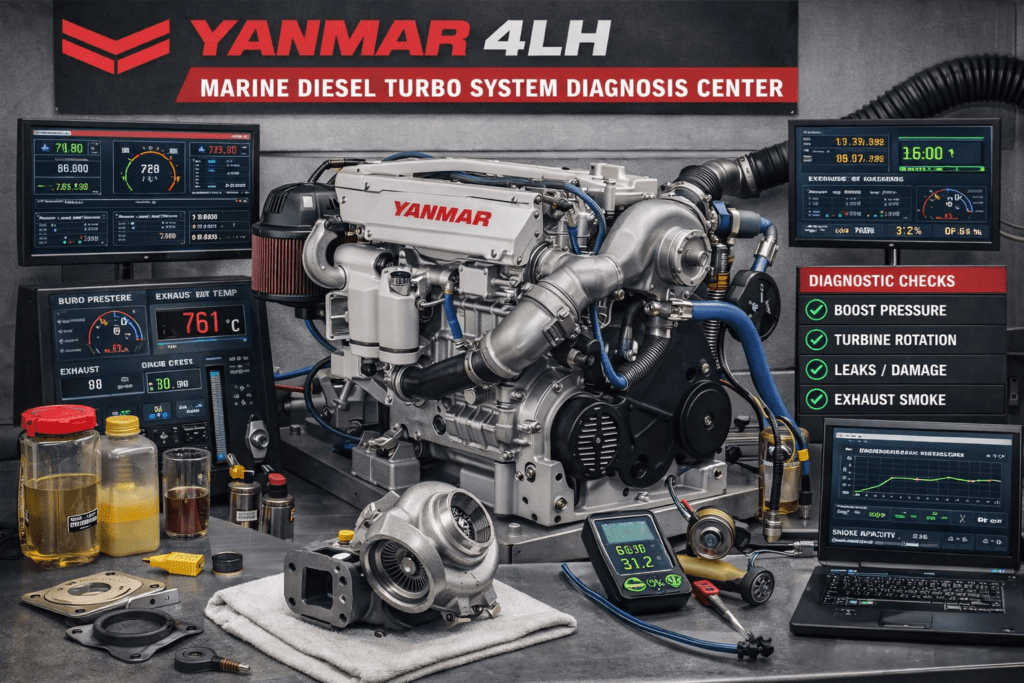
The Yanmar 4LH is a proven turbocharged marine diesel platform, but when turbocharger or intake-side problems begin, performance can fall off quickly. This guide explains how to diagnose low boost, black smoke, slow acceleration, reduced RPM, and turbo noise on Yanmar 4LH engines using real system-based logic so you can separate turbocharger failure from air restriction, fuel imbalance, exhaust backpressure, and load-related performance problems.
Yanmar 4LH Marine Diesel Turbocharger Problems: Complete Turbo System Diagnosis Guide
The Yanmar 4LH marine diesel engine is widely used in sportfishing boats, cruising boats, and commercial marine applications because it delivers strong output from a relatively compact package. A major reason it performs so well is the turbocharger system. By forcing additional air into the engine, the turbo allows the 4LH to burn more fuel efficiently and produce significantly more horsepower than a naturally aspirated engine of similar size.
When the turbocharger system develops problems, the symptoms usually show up fast. The engine may lose power, fall short of rated RPM, smoke black under load, accelerate slowly, or sound different than normal. Because the turbo sits at the intersection of airflow, exhaust energy, fuel balance, and heat management, turbocharger diagnosis should never stop at “the turbo must be bad.” In many cases, the problem is in the surrounding system rather than the turbocharger itself.
At 805 Marine Diesel Mechanic, Yanmar turbocharger and air intake system problems are diagnosed throughout Ventura, Oxnard, Channel Islands Harbor, and Santa Barbara. With over 30 years of marine diesel experience, the goal is to identify whether the true issue is boost loss, air restriction, oil-related turbo damage, exhaust restriction, cooling-related heat stress, or fuel imbalance. This page is part of your complete site authority structure and expands from the Master Marine Diesel Troubleshooting Guide.
How Marine Diesel Turbochargers Work
A turbocharger uses exhaust gas energy to spin a turbine wheel. That turbine is connected to a compressor wheel on the intake side. As the compressor spins, it forces additional air into the engine. More air allows more fuel to burn efficiently, which increases power and helps the engine reach its designed output under load.
On the Yanmar 4LH, the turbo system typically includes:
- Exhaust-driven turbocharger
- Compressor housing
- Charge-air plumbing
- Intercooler or aftercooler depending on configuration
- Air intake filtration and ducting
- Exhaust-side path feeding turbine energy
If any part of that chain becomes restricted, leaking, damaged, or overheated, performance suffers. That is why turbocharger diagnosis is really turbo-system diagnosis. The turbocharger itself may be fine while the engine still behaves like it has a turbo problem.
Common Yanmar 4LH Turbocharger Symptoms
Turbo system problems usually produce very recognizable performance complaints.
- Loss of engine power
- Reduced maximum RPM
- Black exhaust smoke
- Whistling or abnormal turbo noise
- Slow acceleration
- Weak response under load
These symptoms often overlap with deeper site pages such as Low Power / Loss of RPM Diagnosis Center, Boat Engine Losing Power, Boat Engine Won’t Reach Full RPM, and Black Smoke Under Load. That crossover matters because many owners first notice the symptom as “it feels slow” rather than recognizing it as a turbo or airflow problem.
Boost Pressure Loss
Turbochargers must generate adequate boost pressure for proper engine performance. If boost pressure drops, the engine gets insufficient airflow for the amount of fuel being delivered. The result is weaker combustion, less power, more smoke, and slower RPM gain.
Common causes of boost loss include:
- Worn turbocharger bearings
- Air leaks in charge-air hoses
- Loose intake connections
- Intercooler or aftercooler restriction
- Exhaust-side inefficiency reducing turbine energy
Low boost pressure almost always results in power loss, but diagnosing the reason for low boost is where the real work begins. A leaking hose and a worn turbo can produce similar symptoms, but the repair path is completely different.
Air Intake Restrictions
Restricted airflow entering the turbocharger reduces its ability to supply the engine with clean, pressurized air. That can make a healthy turbocharger look weak when the real issue is before the compressor ever gets the air it needs.
Common intake restrictions include:
- Clogged air filters
- Blocked intake ducts
- Collapsed intake hoses
- Debris entering the intake path
This is one of the easiest categories to overlook because intake restrictions may not be dramatic at idle. The problem often shows up only when the engine is asked to accelerate or hold load for a sustained period.
Turbocharger Mechanical Failure
Turbochargers live in a harsh environment of very high speed and very high heat. Over time, bearings wear, shafts loosen, seals fail, and internal damage develops. If the turbocharger itself is failing mechanically, the symptoms often include obvious power loss, smoke, abnormal noise, and oil contamination on the air side.
Signs of turbocharger failure include:
- Excessive shaft play
- Oil leakage into the intake system
- Metal debris inside the compressor housing
- Unusual turbocharger whine or grinding
- Persistent black or blue smoke
If the turbo fails completely, the engine may lose most of its power and become almost unusable under load. Related pages that help widen the diagnostic path include Marine Diesel Turbocharger Failure Symptoms and Boat Engine Blowing Blue Smoke.
Fuel System Interaction with Turbo Performance
Turbocharger performance and fuel delivery have to stay in balance. If fuel delivery exceeds available airflow, combustion becomes incomplete and the engine may smoke heavily or feel lazy. If fuel delivery is restricted, the engine may also underperform, making it easy to blame the turbo unfairly.
That is why turbocharger diagnosis should always include some fuel-side thinking. Related pages include:
- Fuel System Diagnosis Center
- Marine Diesel Fuel Contamination
- Marine Diesel Air in Fuel System
- Racor Filter Troubleshooting Guide
In real-world diagnostics, many “turbo problems” turn out to be a combination of airflow weakness and fuel system instability rather than one single bad part.
Cooling System Influence on Turbocharger Health
Turbochargers operate under extreme heat, and cooling system health plays a major role in how long they survive. If the engine runs hot, exhaust temperatures rise, oil gets stressed harder, and the turbocharger lives a much tougher life. Heat-related damage often shows up gradually as weakening boost, rising smoke output, or growing oil leakage.
Cooling-related pages that connect naturally to this topic include:
This is especially important on Yanmar engines that have seen heavy service or inconsistent maintenance. Turbocharger problems are often the symptom that finally appears, while the underlying stress was thermal.
Professional Turbo System Diagnosis
Diagnosing turbocharger problems correctly means inspecting both the airflow side and the fuel side while also considering exhaust restriction and engine load. The turbocharger does not operate by itself. It is a response device. It reacts to exhaust energy, intake condition, load, and combustion balance.
A proper diagnostic process typically includes:
- Boost pressure measurement
- Turbo shaft play inspection
- Air intake restriction testing
- Charge-air leak inspection
- Exhaust temperature analysis
- Smoke pattern analysis under load
Advanced diagnostic services are also tied into the broader site network through the Computerized Marine Engine Survey Diagnostics Center.
Yanmar 4LH Marine Diesel Service in Ventura & Channel Islands Harbor
805 Marine Diesel Mechanic provides Yanmar turbocharger diagnostics and repair services throughout:
- Ventura Harbor
- Channel Islands Harbor
- Oxnard
- Santa Barbara
If your Yanmar 4LH marine diesel engine is experiencing loss of boost pressure, excessive smoke, turbo noise, slow acceleration, or reduced RPM, professional diagnostics can quickly determine whether the root cause is the turbocharger itself, intake restriction, charge-air leakage, exhaust backpressure, or a related system problem.
Yanmar 4LH Turbocharger FAQ
1. What causes turbocharger failure on marine diesel engines?
Turbocharger failure is often caused by oil starvation, excessive heat, contaminated intake systems, overspeed conditions, or normal mechanical wear over time.
2. How can I tell if my Yanmar 4LH turbocharger is failing?
Common signs include power loss, black smoke, abnormal turbo noises, oil leakage, and reduced boost pressure under load.
3. Can turbocharger problems cause engine smoke?
Yes. If the turbo cannot provide adequate airflow, incomplete combustion may produce black smoke. If turbo oil seals fail, blue smoke may also appear.
4. How are turbocharger problems diagnosed?
Technicians inspect boost pressure, intake restrictions, shaft condition, charge-air leaks, smoke behavior, and exhaust temperatures to isolate the real problem.
5. Can a charge-air hose leak cause low power?
Absolutely. A leaking hose or loose intake connection can bleed off boost and make the engine feel weak even if the turbocharger itself is still healthy.
6. Does black smoke always mean the turbo is bad?
No. Black smoke can also come from dirty intake filters, exhaust restriction, overloading, injector issues, or fuel-air imbalance. Related page: Black Smoke Under Load.
7. Can a dirty air filter make a Yanmar 4LH feel like it has turbo problems?
Yes. Severe intake restriction can limit airflow enough to create many of the same symptoms as a weak turbocharger.
8. Can a bad turbo reduce maximum RPM?
Yes. When airflow drops, combustion efficiency drops too, and the engine often falls short of rated RPM. Related page: Boat Engine Won’t Reach Full RPM.
9. Can turbo problems cause slow acceleration?
Yes. Weak boost response often shows up first as sluggish throttle response and poor acceleration under load.
10. What does excessive shaft play mean?
Excessive shaft play usually means internal turbo wear and can be a strong warning that the bearings or rotating assembly are nearing failure.
11. Can fuel system problems mimic turbocharger problems?
Yes. Fuel restriction, contamination, or air intrusion can all reduce engine output and make the engine feel weak even when the turbo is not the true cause. Related page: Fuel System Diagnosis Center.
12. Can cooling problems damage a turbocharger?
Yes. Overheating and elevated exhaust temperatures can shorten turbo life and accelerate wear. Related page: Boat Engine Overheating.
13. Can a Yanmar 4LH turbo fail gradually instead of all at once?
Yes. Many turbos weaken slowly, showing early signs like reduced boost, more smoke, and slower response before complete failure occurs.
14. Does turbo noise always mean turbo damage?
No. Some whistle is normal, but changes in sound, grinding, or abnormal surge noise deserve inspection because they may indicate air leaks or internal wear.
15. Can exhaust restriction affect turbo performance?
Yes. Restricted exhaust flow changes turbine energy and can hurt turbo response and overall engine breathing. Related page: Mixing Elbow and Exhaust Restriction Diagnosis.
16. Can a bad turbo also cause low power loss of RPM symptoms?
Yes. Turbo weakness is one of the major causes behind low-power and loss-of-RPM complaints. Related page: Low Power Loss of RPM Diagnosis Center.
17. When should blue smoke make me suspect turbo seals?
Blue smoke becomes suspicious for turbo oil seal problems when it appears under boost, is paired with oil residue in the intake path, or comes with declining performance.
18. Is mobile diagnosis useful for turbo problems?
Yes. Turbo symptoms often show up best under real load conditions on the boat, making mobile diagnosis very useful for confirming boost, smoke, and performance behavior.
19. When should I call a mechanic for Yanmar 4LH turbo problems?
If the engine is losing power, smoking heavily, sounding abnormal, or falling short of normal RPM, it is time for professional diagnosis through the contact page.
20. Where should I start if I want the full Yanmar turbo pathway?
Start with the Master Marine Diesel Troubleshooting Guide, then move through the linked low-power, smoke, fuel, cooling, and diagnostics-center pages from there.
One Response