
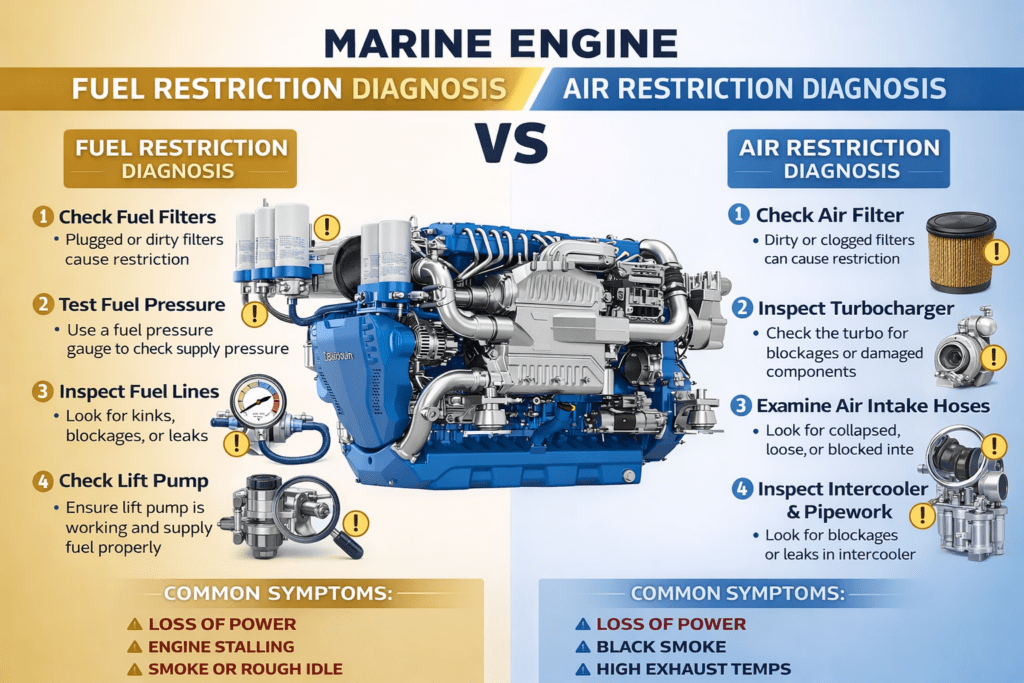
When a marine diesel engine won’t reach full RPM, surges at cruise, smokes under throttle, or loses power under load, the fastest way to diagnose the problem is to separate two look-alike failures: fuel restriction and air restriction. Before replacing injectors, turbos, pumps, or filters repeatedly, start with the Master Marine Diesel Troubleshooting Guide so the diagnostic path begins in the correct order.
At 805 Marine Diesel Mechanic, this fuel-versus-air split is one of the most important real-world diagnostic steps used across Ventura, Oxnard, Channel Islands Harbor, and Santa Barbara. A restricted fuel supply and a restricted air/boost system can both cause low power, but they leave different clues when tested under load.
Fuel Restriction vs Air Restriction — The Core Difference
Fuel restriction means the engine cannot receive enough fuel volume under load. Air restriction means the engine cannot get enough clean air, boost pressure, or charge-air flow to burn the fuel efficiently.
Both failures can cause low power and loss of RPM, surging at cruise RPM, or a boat engine that won’t reach full RPM, but the repair path is completely different.
The goal is to decide which side of the system is failing before parts are replaced. That saves time, protects the engine, and prevents repeat failures.
Fuel Restriction Symptoms
Fuel restriction usually appears when the engine is asked to work. At idle, fuel demand is low, so the engine may sound normal. Under load, fuel demand rises and the restriction becomes obvious.
A restricted Racor filter, diesel algae contamination, air in the fuel system, or a weak lift pump can all make the engine feel like it is starving for fuel.
- Engine runs fine at idle but falls off under load
- RPM drops as throttle demand increases
- Power improves temporarily after changing filters
- Surging or hunting appears at cruise speed
- Engine may stall after filter service or lose prime
If the problem appeared after filter service, compare the symptoms with no start after fuel filter change and how to prime a marine diesel fuel system.
Air Restriction Symptoms
Air restriction usually shows up as poor combustion. The engine receives fuel, but there is not enough oxygen or boost to burn it cleanly.
That is why air restriction often creates black smoke under load, slow throttle response, and symptoms that overlap with turbo lag and slow spool-up.
- Black smoke increases as throttle increases
- Turbo response feels slow or lazy
- Power feels soft across the RPM range
- Boost pressure is low or unstable
- Engine runs hotter under load
Air-side problems commonly involve aftercooler and intercooler restriction, exhaust backpressure problems, or issues in the marine diesel turbo system diagnosis center.
Fuel Restriction Diagnostics — Fast Checks
The fuel side should be tested with restriction data, not guessing. A vacuum gauge on the Racor or suction side is one of the fastest truth tools because it shows whether the engine is pulling against a restriction.
If vacuum rises rapidly under load, the problem is usually on the fuel side. Confirm the result with the Fuel System Diagnosis Center and the Fuel Contamination and Filtration Issues Center.
- Inspect Racor bowls for water, sludge, or dark fuel.
- Measure fuel vacuum under load.
- Check primary and secondary filters.
- Inspect suction-side hoses for collapse or loose fittings.
- Verify lift pump output and fuel delivery stability.
Air Restriction Diagnostics — Fast Checks
The air side should be inspected from the filter to the intake manifold. A dirty AirSep, collapsed intake hose, leaking charge-air boot, restricted aftercooler, or exhaust restriction can all reduce available air.
Use boost pressure testing to confirm whether the turbo is producing enough air under load. Then compare smoke patterns with the Marine Diesel Smoke Diagnosis Guide.
- Inspect air filter or AirSep condition.
- Check charge-air hoses, clamps, and boots.
- Look for oil mist tracks around boost joints.
- Inspect aftercooler and intercooler condition.
- Check exhaust restriction and turbo response.
The Quick “Fork in the Road” Test
This is the field shortcut used by trained technicians:
- Improves after filter change: fuel restriction is likely.
- Black smoke increases with throttle: air restriction is likely.
- Low boost with black smoke: air/boost/turbo path needs testing.
- No smoke with low RPM: fuel restriction or derate is more likely.
- Surging at cruise: fuel instability or air intrusion is likely.
If the symptom includes overheating, compare with high exhaust temperature diagnosis, Cooling System Diagnosis Center, seawater pump failure and impeller damage, and overheating under load but not at idle.
Common Misdiagnosis Traps
Fuel restriction and air restriction are often confused because both reduce power. The mistake is replacing expensive components before confirming the failing side of the system.
A clogged fuel filter can mimic turbocharger failure symptoms. A leaking charge-air boot can mimic fuel starvation. A dirty aftercooler can create smoke that looks like injector overfueling. A vessel load problem can make a healthy engine look weak, especially when compared with engine overload and propeller overload diagnosis.
When symptoms include starting problems, compare the restriction pattern with hard starting cold vs warm diagnosis, cranks but won’t start, and engine starts then dies.
System Interaction: Why Both Problems Can Happen Together
Older boats often have more than one restriction at the same time. A slightly clogged Racor combined with a dirty AirSep can make the engine feel weak across the whole RPM range.
A dirty aftercooler combined with exhaust restriction can create black smoke, high EGT, and low boost. If the boat also has running gear problems, symptoms may overlap with excessive vibration diagnosis, clunk when shifting into gear, or shaft spins but boat does not move properly.
For electronic engines, live data from the Computerized Marine Engine Survey Diagnostics Center helps compare boost, fuel command, sensor values, and derate conditions under load.
When to Call a Technician
If you have changed filters, inspected valves, checked visible intake plumbing, and still cannot separate fuel restriction from air restriction, instrumentation is needed. A trained technician can measure fuel vacuum, fuel pressure, boost pressure, and charge-air behavior during the same load test.
That test prevents unnecessary turbo replacement, injector work, and repeated filter changes that do not fix the root problem.
External Authority Resources
Cummins Marine Engines |
Caterpillar Marine Systems
Fuel Restriction vs Air Restriction — FAQ
1. What is fuel restriction on a marine diesel engine?
2. What is air restriction on a marine diesel engine?
3. How do I quickly tell fuel restriction from air restriction?
4. Why does fuel restriction usually show up under load?
5. Why does air restriction cause black smoke?
6. Can a clogged Racor filter cause low RPM?
7. Can air leaks in fuel lines mimic fuel restriction?
8. Can diesel algae cause repeated restriction?
9. Can a dirty AirSep cause power loss?
10. Can boost leaks act like air restriction?
11. Why does my engine idle fine but lose power under load?
12. Why does power loss feel soft across the whole RPM range?
13. Can a weak lift pump mimic clogged filters?
14. What does a rising Racor vacuum gauge mean?
15. Can aftercooler problems look like air restriction?
16. Can exhaust restriction reduce air flow?
17. Can prop load mimic fuel or air restriction?
18. Can both fuel restriction and air restriction happen together?
19. When should I call a marine diesel technician?
20. What is the fastest way to diagnose fuel vs air restriction?
805 Marine Diesel Mechanic provides mobile marine diesel fuel restriction, air restriction, low power, smoke, turbo, and boost diagnostics throughout Ventura, Oxnard, Channel Islands Harbor, and Santa Barbara.
31 Responses