
Marine Engine Black Smoke Under Load
Black smoke under load is one of the most common marine diesel engine complaints — and one of the most misunderstood. If your engine runs clean at idle but produces heavy black smoke when accelerating or pushing to cruising RPM, the engine is receiving too much fuel for the amount of air available. Black smoke = over-fueling or restricted air supply.
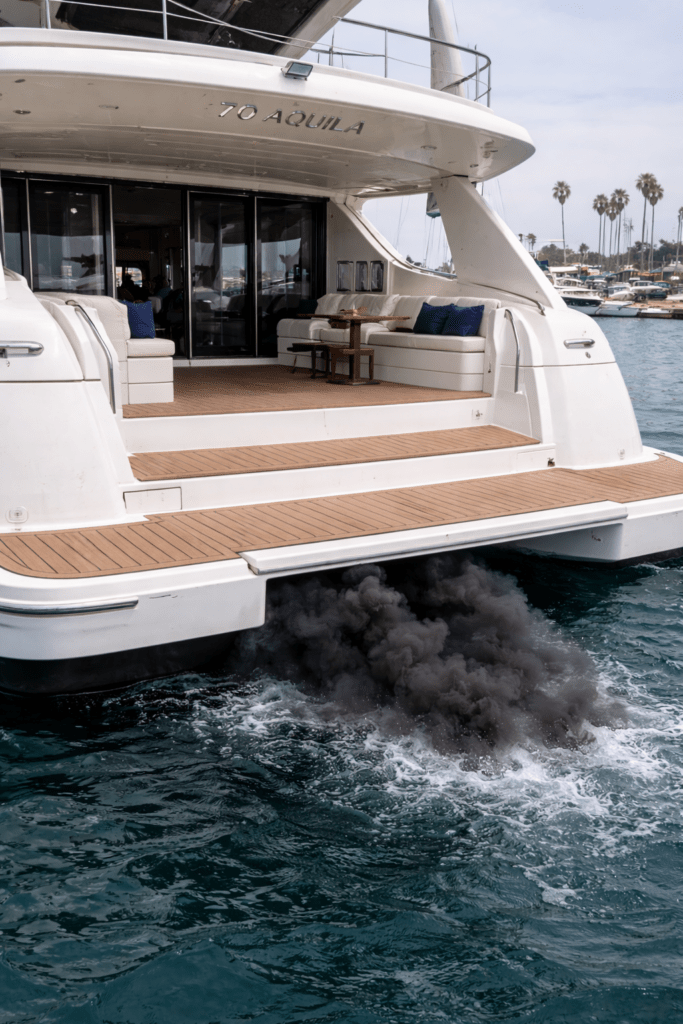
At 805 Marine Diesel Mechanic, serving Ventura, Oxnard, Channel Islands Harbor, and Santa Barbara, black smoke is never treated as a stand-alone symptom. It is a system imbalance problem involving air supply, fuel delivery, turbo efficiency, cooling load, and vessel resistance. Before replacing injectors or blaming the turbocharger, the symptom should be traced through the Master Marine Diesel Troubleshooting Guide and then narrowed down using a structured, load-based diagnostic process.
What Black Smoke Means
When a diesel engine cannot burn all injected fuel completely, unburned carbon exits through the exhaust as thick black smoke. This condition usually appears:
- During acceleration
- Under heavy load
- At wide open throttle (WOT)
- When climbing onto plane
- When pushing against wind or tide
Ignoring black smoke can lead to turbocharger damage, carbon buildup, elevated exhaust temperatures, and reduced engine life. In real-world diagnosis, black smoke nearly always overlaps with loss of power under load or not reaching full RPM, because the engine is being asked to make power it cannot efficiently support.
Air-to-Fuel Imbalance — The Core Rule
Black smoke is almost always an air-to-fuel imbalance problem, not just a fuel system issue. The engine either has too much fuel, not enough air, or an external load condition that makes the available air insufficient for the fuel being delivered.
This is why smoke diagnosis should never be separated from the Smoke & Combustion Diagnosis Center, the Marine Diesel Turbo System Diagnosis Center, and the Low Power / Loss of RPM Diagnostics Center. Black smoke is a symptom cluster, not a one-part diagnosis.
1. Restricted Air Intake (Most Common)
Restricted air intake is one of the most common real-world causes of black smoke under load. If the engine cannot get enough clean air, combustion becomes incomplete and soot output rises quickly under acceleration.
- Dirty air filter
- Collapsed intake hose
- Blocked intake system
- Turbo not spooling properly
No air = incomplete combustion. This is why engines that feel lazy when accelerating should be compared with hesitation when throttling up, especially when smoke appears at the same time.
2. Turbocharger Issues
Turbochargers are responsible for supplying compressed air under load. If the turbo is not building boost, the engine may still receive normal fueling but not enough oxygen to burn that fuel efficiently. The result is black smoke, reduced acceleration, and lower top-end RPM.
- Worn turbo bearings
- Sticking wastegate
- Boost leak
- Oil contamination inside turbo
These problems should always be confirmed with boost pressure testing and compared against the full turbo diagnosis path. Slow spool-up may also match turbo lag and slow spool-up conditions rather than true engine weakness.
3. Over-Fueling
Black smoke can also come from too much fuel being injected. This may be caused by faulty injectors, injection timing issues, ECU fueling faults, or mechanical rack problems on older systems. In these situations, the air side may be normal, but fuel quantity or atomization is incorrect.
- Faulty injectors
- Incorrect injector timing
- Electronic ECU fueling faults
- Mechanical injection rack issues
These conditions often overlap with injector contamination and damage and may also appear with high fuel consumption.
4. Aftercooler / Intercooler Fouling
Salt buildup, oil contamination, or internal fouling inside the aftercooler reduces airflow density and oxygen delivery — a very common issue on coastal vessels. The turbo may be working, but the air reaching the engine is hotter and less dense, which reduces combustion efficiency.
This is why black smoke under load should always be compared with aftercooler and intercooler problems, especially on boats operating heavily in Ventura, Channel Islands Harbor, and Santa Barbara conditions.
5. Engine Overload
Engine overload is one of the most overlooked causes of black smoke. In these cases, the engine may be healthy, but the vessel is asking for more power than the air/fuel system can support efficiently.
- Fouled hull or prop
- Incorrect prop pitch
- Water intrusion or excessive weight
- Engine unable to reach rated RPM
These conditions commonly align with not reaching rated RPM and low power / loss of RPM. A mechanically healthy engine can still smoke heavily if it is overloaded enough.
Fuel Contamination and Filtration Restriction
Contaminated fuel or progressive filtration restriction can also create black smoke by disrupting stable fuel delivery and combustion efficiency. While these issues often show up first as low power or hesitation, they may also create smoke once the engine is placed under load.
This is why the symptom should be cross-checked with the Fuel Contamination & Filtration Issues Center and the Fuel System Diagnosis Center. Engines with contamination may also show start-then-die behavior or unstable running before smoke becomes the main complaint.
Cooling System and High EGT Crossover
Black smoke often goes hand in hand with elevated exhaust gas temperature. If fuel is not burning efficiently in the cylinder, excess heat travels into the turbocharger and exhaust system. This can stress cooling components and worsen existing heat exchanger or aftercooler problems.
That is why smoke conditions should be compared with the Cooling System Diagnosis Center and, where applicable, heat exchanger clogging symptoms. If the engine is both smoking and running hot, it is often a crossover problem, not two unrelated failures.
Quick Diagnostic Checklist
- Confirm engine reaches rated WOT RPM
- Inspect air filter and intake plumbing
- Check turbo boost pressure
- Inspect aftercooler condition
- Verify fuel system health
- Check for hull fouling or overload conditions
- Inspect exhaust restriction and backpressure symptoms
Professional diagnostics may include boost testing, fuel vacuum and pressure testing, injector balance testing, and live-data review through the Computerized Diagnostics Center.
Why Black Smoke Gets Misdiagnosed
Black smoke is frequently blamed on injectors first, but in practice the root cause is often airflow restriction, aftercooler fouling, overload, or turbo inefficiency. Replacing injectors without verifying air, boost, and load conditions is one of the most common wasted-repair paths.
That is why the correct diagnostic approach is not “replace the fuel parts first.” It is to determine whether the engine is air-limited, over-fueled, overloaded, or suffering from multiple smaller restrictions at the same time.
When to Call for Professional Diagnostics
- Persistent thick smoke
- Increasing smoke over time
- Power loss under load
- High exhaust temperature
- Failure to reach rated RPM
If the vessel is producing repeat black smoke, professional diagnostics are recommended before continued operation damages the turbocharger, exhaust system, or aftercooler.
Bottom Line
Black smoke under load is your engine’s way of saying: “I’m getting more fuel than air.” Start by checking the air system first, then verify proper fueling, then confirm the engine is not overloaded. Early diagnosis prevents costly turbocharger, exhaust, and combustion damage.
With over 30 years of real-world marine diesel experience, 805 Marine Diesel Mechanic provides mobile diagnostics throughout Ventura, Oxnard, Channel Islands Harbor, and Santa Barbara to separate true root cause from symptom overlap.
Marine Engine Black Smoke Under Load FAQ
1. What does black smoke under load mean?
It usually means the engine is receiving more fuel than the available air can burn efficiently. That can be caused by restricted airflow, low boost, over-fueling, or overload.
2. Is black smoke always a fuel problem?
No. Black smoke is often an air-side or boost-related problem first, which is why it should be compared against the Turbo System Diagnosis Center and not just the fuel system.
3. Can a dirty air filter really cause heavy black smoke?
Yes. If airflow is restricted enough, combustion becomes incomplete and soot output rises quickly, especially under acceleration and at high load.
4. Can turbocharger problems cause black smoke?
Yes. Low boost from turbo wear, a sticking wastegate, or a boost leak can cause major black smoke because the engine no longer has enough compressed air for the amount of fuel being delivered.
5. What role does an aftercooler play in black smoke?
A fouled aftercooler reduces air density and oxygen delivery. This commonly creates a smoke-under-load condition even when the turbo itself is still functioning.
6. Can engine overload create black smoke?
Absolutely. A fouled hull, over-pitched propeller, or excessive vessel weight can hold the engine below rated RPM and create heavy smoke. That is why these symptoms often overlap with not reaching full RPM.
7. Why does my engine smoke only when accelerating?
Acceleration increases fueling demand immediately. If airflow, boost, or load capacity cannot keep up, black smoke appears during the transition before the engine stabilizes.
8. Can fuel contamination cause black smoke?
Yes. Contaminated fuel can disrupt atomization and combustion quality. That is why smoke complaints should be cross-checked with the Fuel Contamination & Filtration Issues Center.
9. Can bad injectors cause black smoke?
Yes. Leaking, worn, or poorly atomizing injectors can over-fuel the cylinder and create soot. These conditions often overlap with injector damage from water and debris.
10. Why does black smoke often come with low power?
Because the same air/fuel imbalance that creates smoke also reduces combustion efficiency. That is why smoke complaints frequently track with loss of power under load.
11. Can cooling problems contribute to black smoke?
Yes. Elevated engine and intake temperatures reduce combustion efficiency and can worsen smoke. If heat is also part of the complaint, compare it with the Cooling System Diagnosis Center.
12. Is black smoke dangerous if the engine still runs?
Yes. Persistent black smoke raises exhaust temperatures, creates carbon buildup, and can damage the turbocharger, exhaust components, and aftercooler over time.
13. What is the first thing to check when a diesel smokes black?
Start with the air side: filter, intake plumbing, boost integrity, and aftercooler condition. Air restriction is the most common real-world cause.
14. Can a vessel smoke black because the propeller is wrong?
Yes. If the propeller is over-pitched or the hull is badly fouled, the engine may never reach rated RPM and will stay in an overloaded condition that produces black smoke.
15. Should I replace injectors first if I see black smoke?
No. Injectors should be tested only after airflow, boost, load, and contamination have been checked. Replacing injectors first is one of the most common misdiagnosis paths.
16. Can black smoke turn into turbo damage?
Yes. Prolonged soot and elevated exhaust temperature can damage turbocharger components and reduce efficiency further, making the smoke problem worse over time.
17. Why does my engine smoke more when pushing into wind or tide?
Because external resistance increases load. If the engine is already marginal on air, fuel, or boost, added load will often push it into visible black smoke.
18. When should I call for professional diagnostics?
If the smoke is persistent, increasing, paired with power loss, or accompanied by high exhaust temperature, professional diagnostics should be done before further engine damage occurs.
19. What tests usually confirm the cause?
Boost pressure testing, intake inspection, fuel vacuum and pressure testing, injector analysis, and live-data diagnostics are the most common confirmation methods.
20. Where should I continue the full troubleshooting process?
Start with the Master Marine Diesel Troubleshooting Guide, then branch into smoke, turbo, fuel, cooling, or low-power pages based on the symptom pattern.
31 Responses