
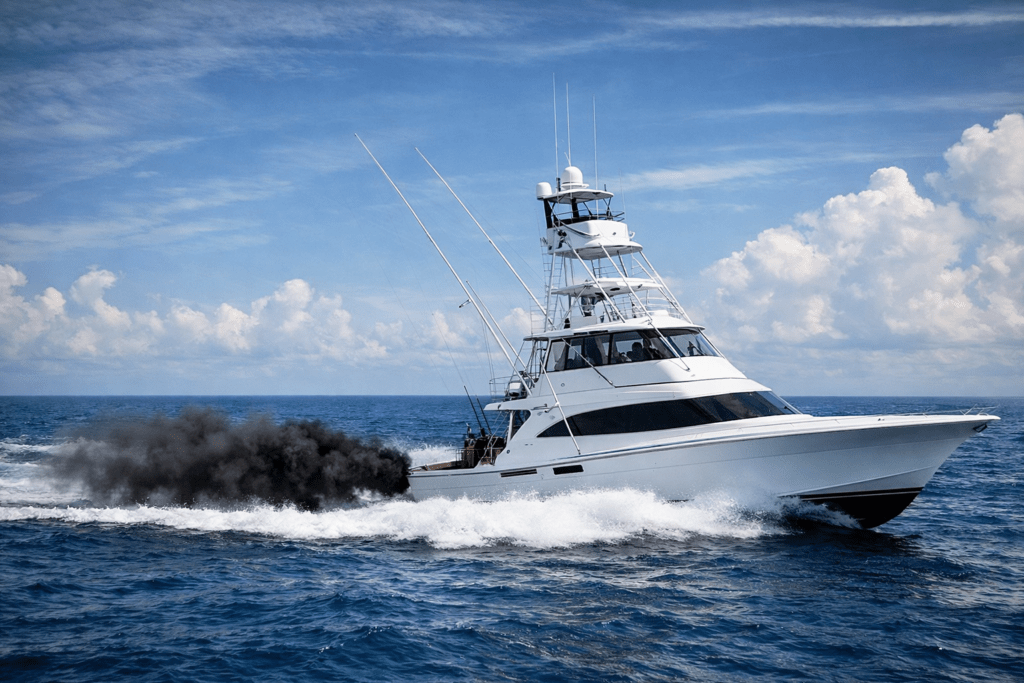
What Causes Black Smoke From a Boat Engine Under Load? (Marine Diesel Guide)
Black smoke under load is one of the clearest signs that your marine diesel engine is not burning fuel efficiently. When you advance the throttle and the exhaust turns dark, the engine is receiving more fuel than it has the air or combustion conditions to burn.
After 30+ years working on inboard marine diesel engines throughout Ventura, Oxnard, Channel Islands Harbor, and Santa Barbara, we can tell you this is rarely a single-component failure. It’s almost always a system imbalance between fuel delivery, airflow, turbo performance, and engine load.
Black smoke is not the problem—it’s the symptom of imbalance.
Start with full system diagnosis:
Marine Diesel Troubleshooting Guide
What Black Smoke Really Means (Combustion Imbalance)
Black smoke is unburned fuel. In a properly operating diesel engine, nearly all injected fuel is burned during combustion. When black smoke appears, it means fuel is exiting the exhaust system before it has been fully combusted.
This happens when the air-to-fuel ratio is out of balance. Either too much fuel is being injected, or not enough air is available to support combustion.
Diesel engines rely on precise fuel atomization and air density (diesel combustion fundamentals) and proper injection control (fuel injection system design).
When one of those systems falls behind, the result is visible smoke.
1. Restricted Air Intake (Most Common Cause)
Airflow is critical in diesel combustion. If the engine cannot get enough air, it cannot burn the fuel efficiently, resulting in a rich condition and black smoke.
This is one of the most overlooked causes because it often develops slowly over time.
- Clogged or dirty air filters
- Collapsed intake hoses
- Restricted intake silencers
👉 Related: Fuel vs Air Restriction Diagnosis
2. Turbocharger or Boost Loss
The turbocharger supplies the additional air needed under load. If boost pressure is low, the engine continues injecting fuel but does not receive enough air to burn it.
This creates immediate black smoke under throttle.
- Worn turbo bearings
- Boost leaks
- Wastegate issues
👉 Related: Turbo Systems Diagnosis Center
3. Over Fueling (Fuel System Imbalance)
If the engine is delivering too much fuel, even a healthy air system will not be able to keep up. Over fueling is often tied to injector wear, fuel rack issues, or electronic control faults.
Instead of producing power, the excess fuel exits as black smoke.
👉 Related: Smoke & Combustion Diagnosis Center
4. Injector Performance Issues
Injectors must atomize fuel into a fine mist. If they drip, clog, or spray unevenly, combustion becomes incomplete.
This leads to both black smoke and poor fuel efficiency.
5. Aftercooler / Intake Air Temperature Problems
Aftercoolers increase air density by cooling intake air. If they are fouled or restricted, air density drops and combustion efficiency decreases.
This is extremely common in saltwater environments where buildup occurs over time.
6. Exhaust Restriction
Restricted exhaust flow prevents proper engine breathing. This increases backpressure and reduces combustion efficiency.
- Clogged mixing elbow
- Carbon buildup
- Collapsed exhaust hose
7. Engine Overloading
If the engine is overloaded, it demands more fuel than it can efficiently burn. This is common with prop issues or hull fouling.
👉 Related: Engine Losing Power Under Load
8. Fuel Quality and Contamination
Contaminated fuel affects combustion and can contribute to smoke production.
👉 Related: Fuel System Diagnosis Center
⚠️ Related System Failure You Should Check
Black smoke combined with rising engine temperature often indicates cooling system inefficiency.
👉 Related:
Caterpillar Cooling System Failures
Step-by-Step Professional Diagnosis
Diagnosing black smoke correctly requires evaluating the entire system under load—not just at idle.
- Inspect air intake system
- Test turbo boost pressure
- Check injector performance
- Inspect aftercooler condition
- Check exhaust restriction
- Evaluate vessel load and prop setup
👉 Advanced diagnostics:
Mechanical Failure Diagnostics
Frequently Asked Questions
1. What does black smoke mean?
It means fuel is not being fully burned due to air or combustion imbalance. Start with the troubleshooting guide.
2. Is black smoke dangerous?
Yes, it indicates inefficiency and can lead to long-term engine damage.
3. Can turbo issues cause black smoke?
Yes, low boost is one of the most common causes. See Turbo Diagnosis Center.
4. Can clogged air filters cause this?
Yes, restricted airflow leads directly to incomplete combustion.
5. Can injectors cause black smoke?
Yes, poor atomization results in unburned fuel.
6. Can fuel contamination cause this?
Yes, it affects combustion quality. See Fuel System Diagnosis.
7. Can overload cause black smoke?
Yes, excessive load forces the engine to over fuel.
8. Where should I start diagnosing?
Start with the Combustion Diagnosis Center.
9. Can exhaust restriction cause smoke?
Yes, it reduces engine efficiency and increases soot.
10. Is this common?
Yes, especially under load conditions.
11. Can aftercooler issues cause this?
Yes, reduced air density impacts combustion.
12. Can cooling issues relate?
Yes, see Cooling System Failures.
13. Can this damage the engine?
Yes, long-term soot buildup causes wear.
14. Should I keep running?
No, diagnosis is recommended.
15. Can turbo cleaning fix this?
Sometimes, depending on condition.
16. Can load changes fix it?
Reducing load may reduce smoke temporarily.
17. Can fuel additives help?
Only in minor contamination cases.
18. Do you offer mobile service?
Yes, throughout Ventura and surrounding areas.
19. What is fastest diagnosis?
Follow structured system testing.
20. When should I call a mechanic?
If smoke persists under load, professional diagnosis is needed.
5 Responses