
Diagnose Caterpillar marine diesel overheating problems fast using a proven, system-based process built from over 30 years of real-world experience in Ventura, Oxnard, Channel Islands Harbor, and Santa Barbara.
Caterpillar Marine Diesel Cooling System Failures: Complete Overheating Diagnosis Authority Guide
Schedule Caterpillar Cooling System Diagnosis
Cooling system failures are one of the most serious problems that can occur in a Caterpillar marine diesel engine. Engines such as the CAT 3116, 3126, C7, C9, C12, C18, and C32 depend on strong raw water flow, clean heat transfer surfaces, and proper coolant circulation to stay within a safe operating temperature range. When those systems begin to fail, engine temperatures rise quickly, power drops off, and the risk of major internal damage increases.
At 805 Marine Diesel Mechanic, we diagnose Caterpillar marine diesel cooling problems throughout Ventura, Oxnard, Channel Islands Harbor, and Santa Barbara. With more than 30 years of marine diesel experience, we use a structured troubleshooting process to identify the real cause of overheating instead of guessing and replacing parts unnecessarily.
This page is part of our larger diagnostic authority system:
Master Marine Diesel Troubleshooting Guide
How Caterpillar Marine Cooling Systems Actually Work
Caterpillar marine engines use a two-stage cooling system made up of a raw water circuit and a closed-loop coolant circuit. The raw water side brings seawater into the system through the intake and pushes it through the strainer, raw water pump, heat exchanger, and often the aftercooler before discharging it overboard. The coolant side circulates engine coolant through the block, cylinder head, thermostats, and heat exchanger to remove internal engine heat.
Key components typically include:
- Raw water intake and seacock
- Seawater strainer
- Raw water pump
- Heat exchanger
- Aftercooler
- Coolant circulation pump
- Thermostats
- Coolant expansion tank and hoses
Any restriction, corrosion, marine growth, or component wear in this chain can reduce cooling efficiency and begin an overheating cycle. In many cases the failure starts small and gets worse over time, especially in saltwater applications.
For a broader step-by-step diagnostic approach, visit our Marine Diesel Troubleshooting Guide.
Why Caterpillar Engines Often Overheat Under Load First
One of the most important clues in marine diesel diagnosis is when the engine overheats. If a Caterpillar engine runs at an acceptable temperature at idle but overheats at cruise RPM, that usually points to a restriction problem rather than a complete failure. At low RPM, the engine produces less heat and needs less cooling capacity. At higher RPM and under propeller load, heat production rises sharply. If the cooling system cannot keep up, the temperature gauge starts climbing.
This is why high-RPM overheating commonly points toward:
- Restricted raw water flow
- Partially clogged heat exchanger tubes
- Aftercooler restriction
- Worn or damaged raw water pump
- Intake or strainer blockage
Loss of power and reduced RPM often show up with the same problem pattern. See also: Low Power Loss of RPM Diagnosis Center.
Common Caterpillar Cooling System Symptoms
Cooling system failures usually provide warning signs before they become catastrophic. Those warning signs should never be ignored, especially on engines operating under heavy load for long periods.
- High engine temperature alarm
- Rising temperature at cruise speed
- Steam or unusually hot exhaust discharge
- Loss of engine power
- Coolant loss
- Overheating under load
- Repeated alarm resets with no permanent fix
When overheating is ignored, the result can be warped cylinder heads, damaged exhaust components, failed head gaskets, aftercooler damage, or complete internal engine failure.
Overheating-related shutdown conditions are also discussed here: Marine Diesel Engine Shutdown Causes.
Raw Water Pump Failures
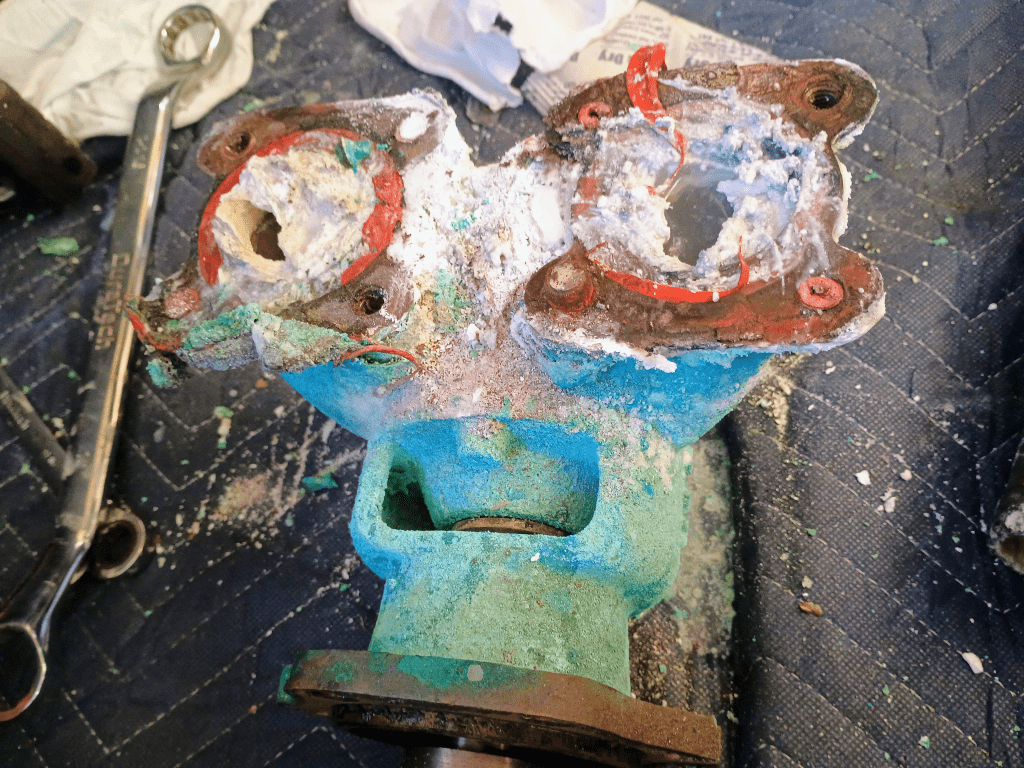
The raw water pump is one of the most common root causes of Caterpillar overheating problems. The image above shows a severely corroded seawater pump housing that reduced water flow and caused repeated temperature problems. This type of failure is common in saltwater environments where corrosion slowly eats away pump housings, backing plates, shafts, and seals.
Common raw water pump failures include:
- Impeller blade damage or missing vanes
- Internal corrosion of pump housing
- Worn shaft bearings or shaft wobble
- Seal leakage
- Reduced pumping efficiency under load
A weak pump may still move enough water at idle to appear acceptable, but once the engine is pushed harder the reduced flow shows up as a temperature rise. This is why a quick visual inspection alone is not enough. The pump has to be evaluated as part of the full system.
Related overheating diagnosis: Boat Engine Overheating Marine Diesel Diagnosis Guide.
Heat Exchanger Restrictions
The heat exchanger removes engine heat by transferring it from coolant to the raw water circuit. On Caterpillar marine engines, heat exchanger restriction is one of the most common causes of overheating at higher RPM. Over time, internal passages collect salt deposits, scale, zinc fragments, corrosion debris, and marine growth. Even partial blockage can reduce heat transfer enough to create a serious problem under load.
Common causes of restriction include:
- Salt buildup
- Zinc debris
- Marine growth
- Scale and mineral deposits
- Internal corrosion products
When the exchanger becomes restricted, coolant heat cannot be removed efficiently. The operator may notice that the engine seems normal at idle but slowly climbs hot at cruise speed. That pattern is a major clue. Proper diagnosis often involves opening and inspecting the exchanger instead of assuming the thermostat is at fault.
Need Help Finding the Real Cause? Contact 805 Marine Diesel Mechanic
Aftercooler Fouling and Air-Side Performance Loss
The aftercooler cools compressed intake air from the turbocharger before it enters the engine. When aftercoolers become restricted internally or externally, intake temperatures rise, combustion efficiency drops, and engine performance suffers. In many cases, overheating and low-power complaints overlap because the cooling and air systems are working together under load.
Common aftercooler problems include:
- Salt buildup
- Restricted cooling passages
- Internal corrosion
- Reduced heat transfer efficiency
Aftercooler problems are sometimes missed because the operator focuses only on engine coolant temperature. In reality, an air-side cooling issue can increase stress on the entire engine and contribute to poor performance, smoke, or elevated operating temperatures.
Related diagnosis center: Marine Diesel Turbo & Air System Diagnosis Center.
Thermostat and Closed-Loop Coolant Problems
The closed-loop coolant side regulates internal engine temperature using coolant, thermostats, and the circulation pump. Although raw water restrictions are often the main issue, coolant-side problems can also cause serious overheating and need to be ruled out during diagnosis.
Common coolant system failures include:
- Thermostats stuck closed or partially opening
- Coolant circulation pump wear
- Low coolant level
- Air pockets trapped in the system
- Deteriorated hoses or coolant leaks
If overheating begins very quickly after startup, the coolant side deserves close attention. A stuck thermostat or circulation problem can prevent the engine from distributing heat properly even if the raw water side appears normal.
Cold start, shutdown, and related engine behavior can overlap with these issues. See: Engine Starts Then Dies – Marine Diesel Diagnosis.
Step-by-Step Caterpillar Cooling System Diagnosis
At 805 Marine Diesel Mechanic, we use a structured troubleshooting process instead of guessing. That diagnostic path typically includes:
- Verify whether overheating occurs at idle, under load, or all the time
- Inspect raw water intake, seacock, and strainer
- Check raw water discharge flow
- Inspect raw water pump condition and impeller
- Evaluate heat exchanger cleanliness and restriction
- Inspect aftercooler condition
- Confirm thermostat operation
- Check coolant level and coolant circulation
- Monitor engine temperature trends during operation
This process helps isolate the true cause of overheating before expensive parts are replaced. It also prevents repeated failures caused by treating the symptom instead of the restriction or flow problem behind it.
Advanced inspection services are available through our Computerized Marine Engine Survey Diagnostics Center.
Why Cooling System Failures Get Misdiagnosed
Marine diesel cooling failures are often misdiagnosed because the symptoms overlap. An engine may show elevated temperature, low power, smoke, or intermittent alarms, and it is easy to blame one part without testing the full system. Thermostats get replaced when the real problem is raw water flow. Impellers get changed when the exchanger is packed with scale. Operators clear alarms and keep running instead of tracking the temperature trend.
The result is wasted money, repeated overheating, and sometimes major engine damage that could have been prevented. The key is to think in terms of flow, restriction, heat transfer, and load instead of jumping straight to parts replacement.
Related symptom pages that often cross over include:
- Boat Engine Losing Power Under Load
- Boat Engine Not Reaching Full RPM
- Black Smoke Under Load Marine Diesel Engine
- Marine Diesel Engine Overheating at High RPM
Preventing Caterpillar Cooling System Failures
Routine maintenance is the best defense against overheating. In saltwater service especially, cooling components slowly degrade even when the engine still seems to be running acceptably.
Recommended preventive maintenance includes:
- Regular raw water pump inspection
- Impeller replacement on schedule
- Heat exchanger cleaning and inspection
- Aftercooler servicing
- Cooling system flushing when appropriate
- Coolant condition and level checks
- Watching temperature trends instead of waiting for alarms
Preventive maintenance is far less expensive than cylinder head damage, repeated shutdowns, or major overhaul work caused by an overheating event.
Maintenance-related crossover page: Fresh Water Flushing Marine Diesel Engine.
Caterpillar Marine Diesel Service in Ventura, Oxnard, Channel Islands Harbor, and Santa Barbara
805 Marine Diesel Mechanic provides Caterpillar cooling system inspection, troubleshooting, and repair throughout:
- Ventura Harbor
- Channel Islands Harbor
- Oxnard
- Santa Barbara
If your Caterpillar marine diesel is running hot, overheating at cruise, showing reduced raw water flow, or losing power under load, a professional diagnostic approach can identify the real cause before major engine damage occurs.
With over 30 years of marine diesel experience, we provide mobile dockside diagnostic service focused on real-world results.
Book Caterpillar Cooling System Inspection
Caterpillar Cooling System FAQ
Overheating is usually caused by restricted raw water flow, heat exchanger blockage, aftercooler fouling, thermostat issues, or raw water pump failure. The best starting point is a structured diagnostic approach through our Master Marine Diesel Troubleshooting Guide.
This usually means the cooling system can barely keep up at idle but fails under load. Partial restrictions in the raw water circuit or heat exchanger commonly cause this pattern.
Yes. A damaged impeller reduces seawater flow and can cause overheating, especially under load. Missing impeller pieces can also travel farther into the cooling system and create secondary restrictions.
A weak pump may still move some water at idle but fail under load. Reduced exhaust discharge, internal corrosion, shaft wear, and poor performance at cruise speed are major warning signs.
A clogged heat exchanger reduces heat transfer and causes engine temperature to rise, especially as RPM increases. Salt, zinc fragments, and marine growth are common causes of restriction.
Yes. Aftercooler fouling can reduce intake air cooling and hurt engine efficiency. It can also overlap with low-power complaints. Related air-system diagnosis is covered in our Turbo & Air System Diagnosis Center.
Yes. A thermostat that is stuck closed or not opening fully can restrict coolant circulation and cause rapid overheating, especially soon after startup.
Continuing to run an overheating engine can lead to warped cylinder heads, gasket failure, exhaust damage, aftercooler damage, and severe internal engine problems.
As temperature rises, engine efficiency drops and protective behavior may occur. Overheating often overlaps with loss of power, especially under load. See also Boat Engine Losing Power Under Load.
Yes. A restricted strainer can choke off water supply to the raw water pump and lead to reduced flow throughout the entire cooling circuit.
Service intervals depend on usage, water quality, and engine hours, but regular inspection is important. Saltwater engines usually need more frequent attention than lightly used freshwater engines.
Yes. Internal corrosion can reduce pump efficiency, damage sealing surfaces, and lower water flow enough to create overheating under load.
That usually points to a progressive restriction rather than a complete failure. The engine can sometimes cope briefly, but as heat load builds the cooling system falls behind.
Yes. Low coolant reduces the system’s ability to carry heat away from the engine and can also introduce air pockets that hurt circulation.
The first step is identifying when the overheating occurs: idle, cruise, or all conditions. That clue helps separate restriction, flow, and coolant-side issues. Our Boat Engine Overheating Diagnosis Guide explains this pattern in more detail.
Yes. Some engines will alarm first and others may enter shutdown protection. Shutdown-related overheating symptoms are covered at Marine Diesel Engine Shutdown Causes.
This often indicates a restriction or load-related problem. Cooling issues, air-system restriction, or general power loss patterns can overlap. See Boat Engine Not Reaching Full RPM.
Absolutely. Saltwater accelerates corrosion, scale formation, and deposit buildup in pumps, exchangers, and aftercoolers if maintenance is neglected.
In many applications it can help reduce salt accumulation and internal corrosion. Learn more here: Fresh Water Flushing Marine Diesel Engine.
If the engine keeps running hot, overheats under load, loses power, or shows repeated alarm conditions after basic checks, professional diagnosis can prevent costly damage. Contact 805 Marine Diesel Mechanic for dockside service in Ventura, Oxnard, Channel Islands Harbor, and Santa Barbara.
Authority Resources
Caterpillar Marine Engines |
Marine Engine Cooling System Overview
One Response