
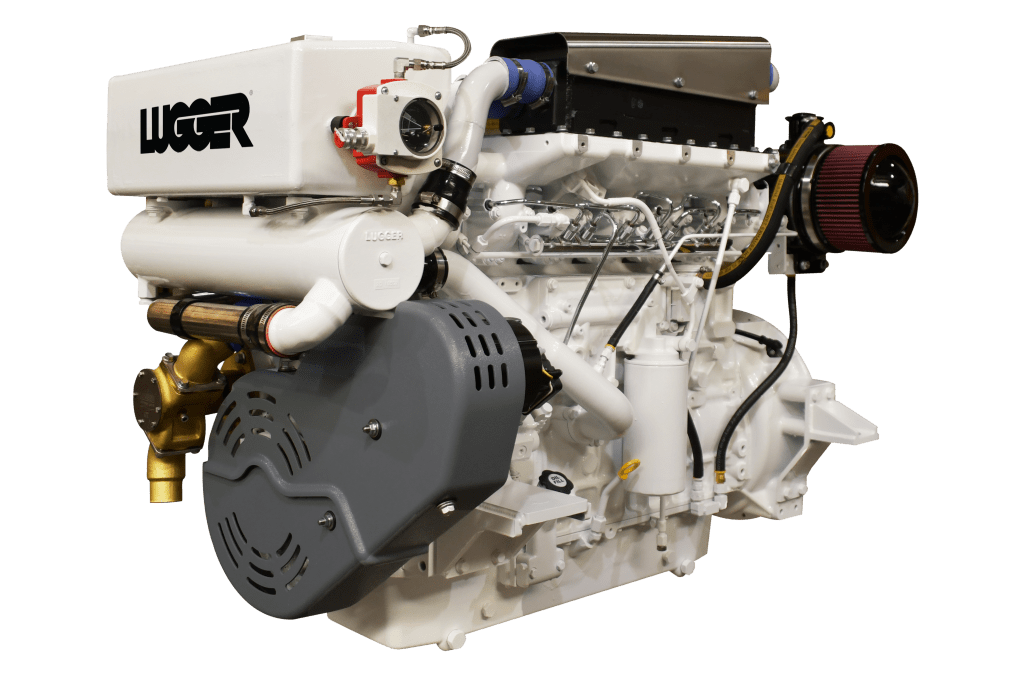
Lugger marine diesel cooling system failures can quickly lead to overheating, shutdown, power loss, and expensive internal damage. This guide explains how to diagnose Lugger cooling problems by separating raw-water restriction, impeller damage, heat exchanger fouling, aftercooler blockage, coolant circulation failure, and exhaust-side restriction before the engine is pushed into a dangerous temperature range.
Lugger Marine Cooling System Diagnosis: Overheating, Raw Water & Heat Exchanger Failure Guide
Lugger marine diesel engines are engineered for long service life and commercial-grade durability, but cooling-system failure remains one of the most common causes of power loss, shutdown, and internal engine damage. On Lugger platforms such as the 6105, 6108, and 6125 series, overheating is rarely random. In real-world diagnosis it is almost always caused by restriction in the raw-water circuit, heat exchanger fouling, aftercooler blockage, coolant circulation failure, or exhaust-side restriction that is interfering with normal heat removal.
What makes cooling problems so serious is that the engine may seem only “a little hotter than normal” at first. Then the boat gets worked harder, water temperature rises, or the engine is held at cruise longer than usual, and the system runs out of cooling margin. At that point temperatures spike, alarms sound, power falls off, and the engine may shut down or suffer major internal damage if it keeps running.
At 805 Marine Diesel Mechanic, Lugger cooling-system problems are diagnosed throughout Ventura, Channel Islands Harbor, Oxnard, and Santa Barbara using the same structured troubleshooting process built into your recent Caterpillar and Cummins overheating, low-power, smoke, and shutdown posts. With over 30 years of hands-on marine diesel troubleshooting experience, the process always starts by separating raw-water-side failures from coolant-side failures so the real bottleneck is identified before expensive parts are replaced. Start with our Master Marine Diesel Troubleshooting Guide.
Common Lugger Cooling System Problems
1) Overheating Under Load
- Raw-water restriction
- Heat exchanger scale buildup
- Aftercooler fouling
- Exhaust elbow blockage
2) Temperature Spike at Cruise RPM
- Impeller blade loss
- Collapsed suction hose
- Partially blocked sea strainer
- Restricted pickup or intake
3) Coolant Loss or Overflow
- Pressure-cap failure
- Heat exchanger tube leak
- Internal coolant leak
- Coolant circulation issues
These symptoms often overlap with power-loss, shutdown, and smoke complaints, which is why cooling diagnosis belongs directly beside the pages you’ve recently rebuilt, including Caterpillar Marine Diesel Cooling System Failures, Cummins Marine Diesel Cooling System Failures, and Marine Diesel Engine Shutdown Causes.
How the Lugger Cooling System Works
Lugger cooling systems use both a raw-water side and a closed-loop coolant side. The raw-water side removes heat through the heat exchanger and often supports aftercooler performance as well. The coolant side circulates treated coolant through the block, cylinder head, and thermostat-controlled passages to stabilize internal engine temperature.
- Sea strainer and raw-water intake
- Suction hose and raw-water pump
- Heat exchanger core
- Aftercooler core where equipped
- Thermostat and coolant circulation path
- Discharge and exhaust-side water injection path
If any one of these sections becomes restricted, the engine may still look fine at idle while running dangerously close to overheating once load increases. That is why Lugger cooling complaints have to be diagnosed as a complete system rather than guessing based on one temperature event.
Raw Water Circuit Diagnosis
The raw-water side is the most common failure point on Lugger engines. It is also the most overlooked because many owners assume that “some water out the exhaust” means the raw-water side is fine. In reality, a Lugger can still discharge water and still not have enough flow to stay cool under real operating load.
- Sea strainer inspection
- Suction hose collapse check
- Impeller inspection
- Raw-water pump wear plate evaluation
- Flow verification at discharge
Restricted raw-water flow often shows up first as a temperature rise only at cruise, which makes owners think the problem is load-related rather than flow-related. In practice, those two are often the same issue. If the engine is moved from light throttle to sustained load and temperature rises sharply, the raw-water side should be near the top of the suspect list.
Heat Exchanger & Aftercooler Fouling
Saltwater deposits, zinc debris, rust scale, and biological growth reduce heat-transfer efficiency over time. Heat exchanger tubes can slowly narrow until the system loses its cooling margin. Aftercooler cores can foul internally and externally, reducing both air density and cooling performance. This is one of the most common reasons a Lugger begins running hotter while also losing power or making more smoke.
- Tube bundle removal and cleaning
- Zinc inspection program
- Pressure testing
- Aftercooler core servicing
Air restriction crossover should be checked in our Turbo System Diagnosis Center. This also ties directly to recent rebuilds like Lugger Turbo & Air System Problems, Caterpillar Marine Diesel Turbocharger Failures, and Cummins 6BTA Turbocharger Problems.
Coolant Circulation System
The coolant side matters just as much as the raw-water side. A Lugger with good raw-water flow can still run hot if coolant circulation is poor, the thermostat is sticking, the coolant pump is weak, or the coolant itself has degraded enough to cause corrosion and poor heat transfer.
- Coolant pump inspection
- Thermostat testing
- Coolant condition analysis
- Hose integrity inspection
- Pressure-cap verification
Improper coolant chemistry accelerates corrosion inside Lugger heat exchangers and cooling passages. That is why coolant condition should always be treated as a real diagnostic factor rather than just a maintenance note.
Why Overheating Must Be Diagnosed Immediately
Overheating should never be treated as a “watch it and see” issue. Lugger engines are tough, but any marine diesel run hot enough and long enough will eventually suffer internal damage. By the time a full shutdown occurs, damage may already be underway.
- Cylinder head warping
- Head gasket failure
- Injector damage from heat stress
- Piston scoring
- Turbocharger stress and failure
- Complete engine shutdown
This is also why overheating complaints frequently overlap with recently rebuilt smoke and shutdown pages. Engines running too hot often change combustion behavior and can start smoking differently at the same time.
How Cooling Problems Cause Power Loss
Cooling problems do not just make the temperature gauge climb. They also reduce engine performance. As temperatures rise, combustion quality changes, intake-air cooling may fall off, and the engine may feel heavier, slower, and less responsive. On some installations, the operator first notices the engine will not hold normal cruise RPM or the boat feels lazy before realizing temperature is also trending upward.
This is why cooling diagnosis belongs beside low-power pages, including Lugger Low Power & Loss of RPM, Cummins Marine Diesel Low Power & RPM Loss, and Low Power Loss of RPM Diagnosis Center.
How Cooling Problems Affect Smoke and Combustion
Cooling problems often change combustion behavior. An engine running too hot may begin producing darker smoke under load because intake-air density and combustion balance change. An engine running too cool may create persistent white smoke because combustion temperature never stabilizes where it should.
This is why Lugger cooling-system diagnosis also overlaps with smoke pages like Lugger smoke and combustion-related content, Caterpillar Marine Diesel Smoke Problems, and Cummins QSM11 Smoke & Combustion Problems. When the engine is hot and smoky, the cooling system must stay high on the suspect list.
Professional Lugger Cooling Diagnostic Process
Structured testing is the only reliable way to diagnose overheating. Guessing at one component often misses the deeper problem because many Lugger cooling complaints are cumulative. A slightly weak impeller, somewhat dirty exchanger, and partially fouled aftercooler can stack together until the engine overheats only under real vessel load.
- Infrared temperature mapping
- Raw-water flow verification
- Pressure testing of the heat exchanger core
- Aftercooler inspection
- Coolant pressure and circulation testing
- Exhaust backpressure check
Advanced performance logging and deeper system review are available through the Computerized Marine Engine Survey Diagnostics Center.
Preventative Cooling System Upgrades
Preventive maintenance is one of the best ways to avoid catastrophic offshore cooling failures. Lugger engines in commercial or long-range service especially benefit from regular cooling-system intervals rather than waiting for symptoms to appear.
- Scheduled heat exchanger cleaning intervals
- Zinc management program
- Upgraded marine-grade hoses
- Coolant chemistry monitoring
- Flow monitoring installation
- Routine aftercooler service planning
With 30+ years of marine diesel service experience, we emphasize preventive cooling system maintenance to avoid shutdowns, smoke changes, and major engine damage offshore.
Ventura & Channel Islands Harbor Lugger Cooling Specialist
805 Marine Diesel Mechanic provides mobile Lugger cooling diagnostics throughout:
- Ventura Harbor
- Channel Islands Harbor
- Oxnard
- Santa Barbara
If your Lugger is running hot, losing power at cruise, triggering temperature alarms, or showing signs of raw-water or heat-exchanger restriction, professional diagnosis can quickly identify the real failure point before overheating becomes engine damage.
Lugger Cooling System FAQ
1. Why is my Lugger overheating under load?
Raw-water restriction, heat exchanger fouling, aftercooler blockage, or exhaust-side restriction are some of the most common causes.
2. How often should a heat exchanger be serviced?
Inspection is recommended annually, with cleaning intervals depending on saltwater exposure, zinc debris, and operating hours.
3. Can zinc debris block cooling passages?
Yes. Excess zinc breakdown can restrict heat exchanger tubes and reduce cooling efficiency significantly.
4. Should aftercoolers be cleaned periodically?
Yes. Fouled aftercoolers reduce air density, increase engine temperature, and can cause both low power and smoke under load.
5. Can a bad impeller cause overheating only at cruise?
Yes. A weakened impeller may move enough water at light load but fall short once the engine is asked to maintain higher RPM for longer periods.
6. Can a collapsed suction hose mimic other cooling problems?
Absolutely. A collapsing hose can restrict raw-water flow enough to create overheating that seems random or load-related.
7. Can cooling problems also cause power loss?
Yes. Overheating and poor charge-air cooling often make the engine feel weak and unable to maintain normal cruise RPM.
8. Can a Lugger run hot even if water still comes out the exhaust?
Yes. Visible discharge does not prove there is enough flow under real load. Partial restriction is very common.
9. Can coolant issues cause overheating even if the raw-water side is okay?
Yes. A weak coolant pump, thermostat issue, bad pressure cap, or poor coolant condition can all create overheating independently of the raw-water side.
10. Can overheating change smoke color?
Yes. Cooling problems often affect combustion balance, which can change smoke behavior under load or at startup.
11. Why does my temperature spike only at cruise RPM?
That usually means the system has enough cooling margin at idle or light throttle but not enough flow or heat transfer once demand rises.
12. Can exhaust restrictions contribute to overheating?
Yes. Exhaust backpressure can reduce overall thermal efficiency and interfere with how the cooling and turbo systems perform together.
13. Can aftercooler restriction feel like a turbo or low-power problem?
Yes. That is why cooling problems often overlap with Lugger turbo and low-power complaints.
14. Can this overlap with the recent Caterpillar and Cummins cooling posts?
Yes. The same overheating logic overlaps directly with Caterpillar cooling failures and Cummins cooling failures.
15. Can poor coolant chemistry damage a Lugger over time?
Yes. Bad coolant accelerates internal corrosion, weakens heat transfer, and shortens the life of cooling-system components.
16. Is overheating at idle different from overheating under load?
Often, yes. Idle-only overheating may point more toward circulation or low-speed pump efficiency, while load-related overheating often points toward raw-water or heat-transfer restriction.
17. Is mobile diagnosis useful for Lugger cooling problems?
Yes. Cooling problems are often easiest to confirm under real vessel load where flow, temperature, smoke, and RPM behavior can all be seen together.
18. Should I keep running the engine if it is overheating?
No. Continued overheating can quickly turn a service issue into expensive internal engine damage.
19. When should I call a mechanic for Lugger cooling problems?
If the engine is running hot, pushing coolant, losing power, or triggering alarms, it is time for professional diagnosis through the contact page.
20. Where should I start if I want the full Lugger cooling pathway?
Start with the Master Marine Diesel Troubleshooting Guide, then move through the linked turbo, low-power, shutdown, and smoke pages from there.
3 Responses