
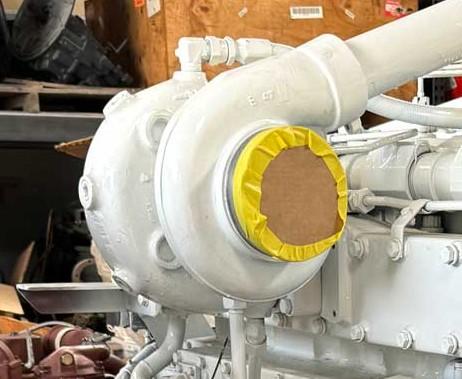
When a Lugger marine diesel loses boost, smokes under load, or will not reach rated RPM, the root cause is often in the turbocharger and charge-air system rather than the fuel system. This guide explains how to diagnose Lugger turbo and air system problems by separating boost leaks, aftercooler fouling, turbo inefficiency, intake restriction, and exhaust backpressure before expensive parts get replaced unnecessarily.
Lugger Turbo & Air System Problems: Boost Leaks, Aftercooler Fouling & Power Loss Diagnosis
Lugger marine diesel engines are built for long service life, strong torque, and dependable continuous-duty performance, but even a rugged engine will lose power quickly when the airflow side of the system begins to fail. A Lugger that cannot build normal boost pressure, cannot cool compressed intake air properly, or cannot move exhaust energy through the turbo efficiently will often begin smoking black, running hotter, and falling short of rated RPM under load. Those symptoms are often blamed on injectors or fuel delivery first, but in real-world diagnosis the airflow side is frequently where the problem begins.
That matters because turbo and charge-air failures are rarely random. A split boost boot, dirty aftercooler core, corroded clamp, restricted intake path, or exhaust restriction can quietly rob horsepower over time until the boat finally feels lazy, overloaded, or smoky enough to get attention. By then, exhaust temperature may already be elevated and the engine may be operating in a less efficient, less healthy range. Good diagnosis means isolating the actual restriction or loss of boost rather than throwing parts at the fuel side first.
At 805 Marine Diesel Mechanic, Lugger turbo and airflow problems are diagnosed throughout Ventura, Channel Islands Harbor, Oxnard, and Santa Barbara using the same system-based process that has been built into your recent Caterpillar and Cummins authority pages. With over 30 years of hands-on marine diesel troubleshooting experience, the focus is always on measuring airflow integrity, boost performance, aftercooler condition, and load behavior before major components are replaced. Start with our Master Marine Diesel Troubleshooting Guide to follow the correct diagnostic path.
How the Lugger Turbo & Charge-Air System Works
Your turbocharger compresses intake air to increase oxygen density. That compressed air is then cooled by the aftercooler or charge-air cooler before entering the intake manifold. Cooler, denser air allows the engine to burn more fuel efficiently and make more torque without excessive smoke. If any part of that airflow path leaks, becomes restricted, or loses cooling efficiency, combustion quality drops immediately.
- Air filter and intake silencer
- Turbocharger compressor and turbine
- Charge-air piping, boots, and clamps
- Aftercooler or charge-air cooler core
- Intake manifold
- Exhaust manifold and exhaust path
Any restriction, leak, or cooling failure reduces air density and causes incomplete combustion. That is why turbo complaints usually overlap with smoke and low-power complaints rather than existing by themselves. Manufacturer references and technical resources are available through Lugger Marine Engines and diesel air-handling fundamentals via Bosch Diesel Systems.
Top Symptoms of Lugger Turbo & Air System Problems
- Loss of RPM under load or inability to reach rated RPM
- Black smoke at cruise from over-fueling relative to available air
- High exhaust temperature or hot smell under load
- Whistling or hissing indicating a possible boost leak
- Slow spool or lazy acceleration
- Oil residue inside charge-air piping, which may indicate turbo seal issues
If your Lugger is losing RPM at cruise, cross-check this with your Lugger Low Power & Loss of RPM Guide. This topic also intentionally ties into recent rebuilds such as Caterpillar Marine Diesel Turbocharger Failures, Cummins 6BTA Marine Diesel Turbocharger Problems, and Cummins Marine Diesel Low Power & RPM Loss because the same airflow logic applies across brands.
Most Common Root Causes
1) Boost Leaks in Boots, Clamps, or Piping
A small leak can cause major power loss. Under load, boost pressure rises and the leak becomes worse, causing smoke, extra heat, and reduced torque at cruise. This is one of the most common reasons a Lugger feels weak only when the boat is worked harder.
- Split silicone boot
- Loose clamp
- Cracked charge-air pipe
- Aftercooler end-cap leak
Boost leaks are especially deceptive because the turbo may still spin and make some pressure, but not enough of that air actually reaches the cylinders. That is why a simple visual check is rarely enough on its own.
2) Aftercooler or Charge-Air Cooler Fouling
Fouled aftercoolers reduce cooling efficiency and raise intake air temperature. Hot intake air means less oxygen density, higher exhaust temperature, and less power. The engine may still run smoothly, but it will feel weaker, smoke more heavily, and often struggle to hold normal cruise load.
- Salt deposits in raw-water-cooled cores
- Oil film from turbo seepage collecting dirt
- Internal core restriction
3) Air Intake Restriction
A clogged or oil-soaked intake element can mimic turbo failure. If the turbo cannot get enough air in, it cannot provide enough air out.
- Dirty air filter
- Collapsed intake hose
- Obstructed intake silencer
4) Turbocharger Inefficiency
Not all turbo issues are fully “blown turbos.” Many are efficiency failures where the unit still spins but does not spool or flow correctly.
- Worn bearings causing slow spool
- Damaged compressor wheel
- Carbon buildup on turbine side
- Wastegate or actuator issues where equipped
5) Exhaust Restriction
Backpressure can choke the turbo and reduce airflow. Common culprits include carbon buildup, restricted mixing elbows where applicable, or collapsed downstream exhaust components.
Don’t Misdiagnose Fuel as Air — or Air as Fuel
Air problems often look like fuel problems. Smoke, power loss, hesitation, and failure to reach rated RPM are all symptoms that can push owners toward injectors, timing, or fuel contamination first. Before replacing injectors or touching pump timing, confirm airflow and boost integrity.
Fuel-side cross-checks live in your Fuel System Diagnosis Center and contamination issues in the Fuel Contamination & Filtration Issues Center. This also connects directly to recent redo pages such as Caterpillar Fuel Contamination & Filtration Problems and Cummins Fuel Contamination & Filtration Problems.
How Turbo & Air Problems Affect Smoke and Combustion
A Lugger that cannot move enough air will often produce black smoke because the engine is still receiving fuel but no longer has enough oxygen to burn it cleanly. This is why smoke and turbo complaints belong together. Black smoke under load is one of the strongest clues that airflow has fallen behind fuel demand.
This diagnostic path belongs directly beside your smoke authority content, including Lugger smoke and combustion-related content, Caterpillar Marine Diesel Smoke Problems, and Cummins QSM11 Smoke & Combustion Problems. Airflow loss changes combustion quality immediately, and combustion changes show up in the exhaust.
Cooling Cross-Over: Why Aftercooler and Raw-Water Health Matter
Cooling cross-over matters because raw-water restriction can reduce aftercooler and heat exchanger performance at the same time. On some Lugger installations, an engine may first appear to have an air-side problem when in reality the cooling side is reducing charge-air cooling efficiency. That means airflow density falls, exhaust temperatures rise, and the engine loses power while also running hotter than it should.
Cooling-related overlap should always be checked against the Cooling System Diagnosis Center. It also links directly to recent rebuilds such as Caterpillar Marine Diesel Cooling System Failures and Cummins Marine Diesel Cooling System Failures.
Professional Lugger Turbo & Air Diagnostic Process
Structured diagnosis prevents expensive mistakes. A weak-running Lugger should not get a turbocharger automatically just because the boat is down on power. Real testing is what separates boost leaks, aftercooler fouling, intake restriction, and true turbocharger wear.
- Boost inspection of hoses, boots, clamps, and piping
- Charge-air leak test to locate leaks
- Aftercooler inspection and cleaning plan
- Air restriction check on filter and intake path
- Exhaust backpressure evaluation
- Thermal checks for hot spots and abnormal temperature rise
For deeper performance logging and system review where applicable, use the Computerized Marine Engine Survey Diagnostics Center.
Newest Upgrades & Prevention
High-value reliability improvements can prevent many Lugger turbo and air complaints before they become severe enough to create smoke and loss of RPM.
- Upgraded silicone charge-air boots and marine-grade clamps
- Scheduled aftercooler removal and cleaning programs
- Improved air filtration and intake routing
- Boost leak inspection intervals before long trips
- Exhaust elbow inspection and backpressure checks
These upgrades are especially valuable on commercial vessels, trawlers, and long-range cruisers where power consistency matters and small airflow losses can become expensive quickly.
Ventura & Channel Islands Harbor Lugger Turbo Specialist
805 Marine Diesel Mechanic provides mobile Lugger turbo and airflow diagnostics throughout Ventura Harbor, Channel Islands Harbor, Oxnard, and Santa Barbara. We focus exclusively on marine diesel engines and apply more than 30 years of real-world diagnostic experience to isolate airflow problems quickly and accurately.
Lugger Turbo & Air System FAQ
1. Why is my Lugger blowing black smoke and losing RPM under load?
Common causes include boost leaks, aftercooler fouling, restricted air intake, or exhaust restriction. Airflow loss reduces oxygen and creates incomplete combustion under load.
2. Can a small boost leak really cause major power loss?
Yes. A small split boot or loose clamp can leak much more as boost rises, causing smoke, higher exhaust temperature, and reduced torque at cruise.
3. How do I know if the aftercooler is restricted?
Symptoms include reduced power under load, elevated exhaust temperature, black smoke, and poor response at higher throttle settings. Inspection and pressure testing confirm restriction or leakage.
4. Should I replace the turbo first if I have low boost?
No. Always rule out air filter restriction, charge-air leaks, aftercooler problems, and exhaust backpressure first. Many “bad turbo” diagnoses are actually leaks or restrictions.
5. Can a dirty air filter really make the engine feel turbocharged wrong?
Yes. If the compressor cannot pull in enough air, the entire boost side underperforms even when the turbo itself is mechanically sound.
6. Can turbo issues reduce full-throttle RPM?
Absolutely. Lugger engines with weak boost often fall short of rated RPM and feel lazy under heavier vessel load.
7. Can a bad aftercooler make the engine smoke?
Yes. Reduced charge-air cooling lowers air density and often creates black smoke and reduced combustion efficiency.
8. Can exhaust restriction make it seem like the turbo is bad?
Yes. Exhaust backpressure reduces turbine efficiency and can create the same low-boost, low-power symptoms as a failing turbocharger.
9. Can fuel problems look like air problems too?
Yes. Smoke, hesitation, and power loss can cross over between systems, which is why airflow should be verified before blaming injectors or pump timing.
10. Can a Lugger with turbo problems also overheat?
Yes. Airflow loss can raise exhaust temperature and overload the cooling side, especially if aftercooler efficiency is already compromised.
11. Can boost leaks be intermittent?
Yes. Some leaks only open up significantly under higher pressure, which is why the engine may feel acceptable at light load and weak at cruise.
12. Can oil in the charge-air piping mean turbo seal trouble?
Yes. Oil residue in the charge-air path can be a sign of turbo oil-seal leakage or excessive crankcase carryover.
13. Can aftercooler fouling build slowly over time?
Yes. Many aftercooler problems develop gradually, which is why the engine may feel only slightly weaker at first before the complaint becomes obvious.
14. Is black smoke always caused by too much fuel?
Not always. It often means there is too much fuel for the available air, which can be caused by airflow restriction rather than injector over-fueling alone.
15. Can this overlap with the recent Caterpillar and Cummins turbo posts?
Yes. The same airflow and boost logic overlaps directly with Caterpillar turbocharger failures and Cummins 6BTA turbocharger problems.
16. Can turbo and air problems raise fuel consumption?
Yes. Poor air delivery forces the engine to run less efficiently, which often increases fuel use for the same workload.
17. Is mobile diagnosis useful for Lugger turbo complaints?
Yes. Turbo symptoms are often easiest to confirm under real vessel load where smoke, RPM, boost behavior, and heat can all be seen together.
18. Can low power and smoke from turbo issues mimic the recent low-power pages we rebuilt?
Yes. This topic directly overlaps with Lugger low power, Cummins low power, and Caterpillar smoke diagnosis.
19. When should I call a mechanic for Lugger turbo and air problems?
If the engine is blowing black smoke, losing RPM, running hot under load, or failing to make expected power, it is time for professional diagnosis through the contact page.
20. Where should I start if I want the full Lugger turbo pathway?
Start with the Master Marine Diesel Troubleshooting Guide, then move through the linked turbo, low-power, fuel, smoke, and cooling pages from there.
2 Responses