
Fuel contamination is one of the most common reasons Caterpillar marine diesel engines lose power, start hard, surge, smoke, or shut down under load. This guide explains how to diagnose Caterpillar fuel contamination and filtration problems by separating water intrusion, microbial growth, sediment, clogged Racor filters, secondary-filter restriction, injector exposure, and tank contamination before expensive engine components are damaged.
Caterpillar Marine Diesel Fuel Contamination & Filtration Problems: Complete Diagnosis Authority Guide
Fuel contamination is one of the most common causes of marine diesel engine problems because Caterpillar engines such as the CAT 3116, 3126, C7, C9, C12, C18, and C32 rely on extremely clean diesel fuel to maintain proper injector operation, consistent combustion, and full engine performance. When fuel becomes contaminated with water, microbial growth, sediment, or rust, the entire system is affected. Filters clog quickly, injectors can become damaged, fuel pressure drops, and engine performance declines fast under real load.
The mistake many owners make is changing a dirty filter and assuming the problem is solved. Sometimes that gives temporary improvement, but it does not answer the real question: why did the filter clog in the first place? A contaminated Racor bowl, recurring sludge, or repeated filter restriction is evidence that the upstream side of the system has a bigger problem. That usually means the tank, venting, storage conditions, fuel supply, or water separation side needs attention too.
At 805 Marine Diesel Mechanic, Caterpillar fuel contamination issues are diagnosed throughout Ventura, Oxnard, Channel Islands Harbor, and Santa Barbara. With more than 30 years of marine diesel experience, the process is always systematic: inspect the fuel, inspect the filters, inspect the tank side, and inspect how the engine responds under load so the real source of contamination is identified before major engine damage occurs. This page is part of your full diagnostic system and expands from the Master Marine Diesel Troubleshooting Guide.
How Marine Diesel Fuel Contamination Occurs
Marine diesel fuel systems are exposed to several contamination sources that can degrade fuel quality over time. Boats sit for long periods, tanks breathe through vents, moisture condenses inside partially filled tanks, and diesel fuel often remains onboard much longer than automotive fuel. That makes the marine environment ideal for water intrusion, biological growth, and sediment accumulation.
The most common causes of contaminated diesel fuel include:
- Water intrusion through fuel tank vents
- Condensation inside partially filled fuel tanks
- Microbial growth, often called diesel algae
- Sediment from aging fuel tanks
- Contaminated fuel during refueling
- Rust and loosened deposits stirred up by vessel motion
These contaminants accumulate in the fuel system and eventually restrict fuel flow to the engine. Fuel system performance problems can also be explored here: Fuel System Diagnosis Center. For direct crossover from the recent redo batch, this page also ties into Cummins Marine Diesel Fuel Contamination & Filtration Problems, because the contamination logic is nearly identical even when the engine brand changes.
Signs of Fuel Contamination
Fuel contamination often causes noticeable engine performance problems before anyone opens the filter bowl and sees what is inside. In many cases the owner first notices that the engine feels weak, starts hard, smokes differently, or stumbles under throttle.
- Loss of engine power
- Frequent fuel filter clogging
- Engine surging or hesitation
- Hard starting
- Engine shutdown under load
- Smoke changes under throttle
- Reduced full-throttle RPM
Many of these symptoms occur when fuel flow becomes restricted by clogged filters or unstable fuel quality. Power-loss symptoms are discussed here: Low Power Loss of RPM Diagnosis Center. This also intentionally links into recently rebuilt pages such as Cummins Marine Diesel Low Power & RPM Loss and Cummins 6BTA Turbocharger Problems, because contaminated fuel and low-power complaints regularly overlap.
Primary Fuel Filtration Systems
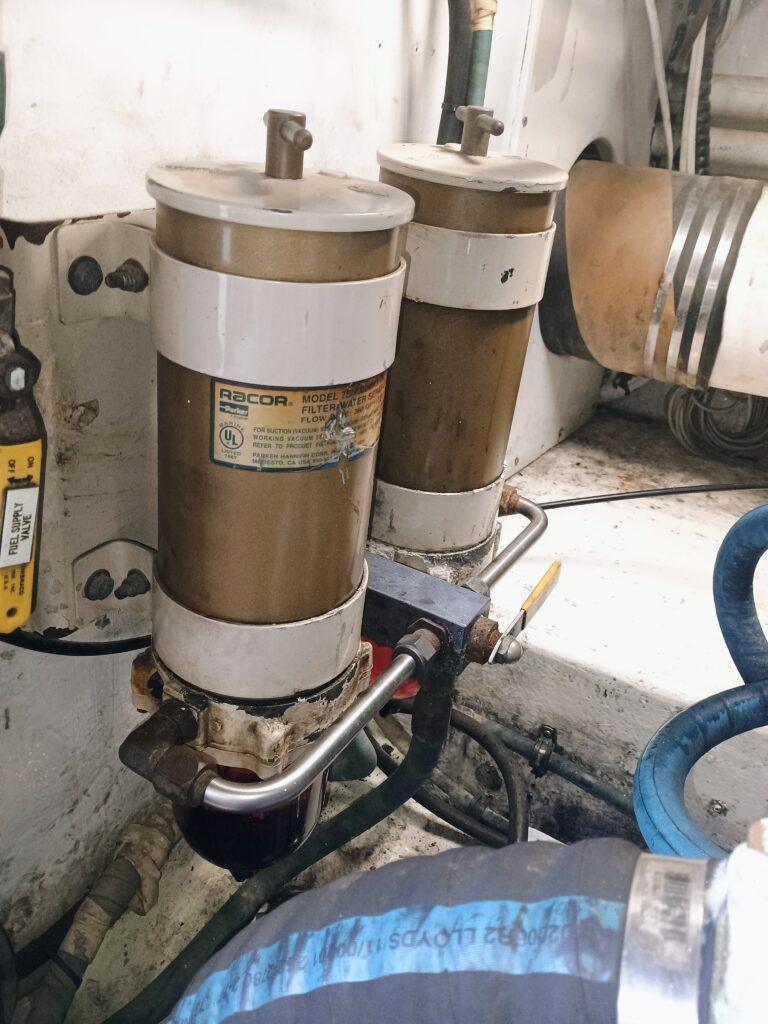
Most marine diesel engines use a two-stage fuel filtration system. Primary fuel filters remove large contaminants and water before fuel reaches the engine. The image above shows Racor marine fuel filters commonly used with Caterpillar engines, and it is exactly this primary separation stage that often reveals the real condition of the fuel supply.
Primary filtration systems typically remove:
- Water contamination
- Rust particles
- Sediment
- Microbial growth debris
Water separators are especially important because water can quickly damage injection components. If the primary stage is overloaded, the rest of the fuel system begins to suffer. This is why a dirty Racor should never be treated as a minor issue. It is an early warning that the tank and fuel quality need attention.
Secondary Engine Fuel Filters
After primary filtration, fuel passes through the engine’s secondary fuel filters before reaching the injectors. These filters provide extremely fine filtration to protect the injection system. If secondary filters become clogged, the engine may still idle or start, but fuel pressure and flow can fall off badly under load.
If secondary filters become clogged, engines may experience:
- Reduced fuel pressure
- Loss of engine power
- Rough running
- Engine stalling
- Difficulty reaching rated RPM
These conditions are often diagnosed through the fuel system troubleshooting process, but they also overlap directly with recently redone pages like Cummins low power / RPM loss because restricted filters and weak fuel delivery produce very similar symptoms across multiple engine brands.
Injector Damage from Contaminated Fuel
Caterpillar injectors operate at extremely high pressures and require clean fuel to function correctly. Contaminated fuel can damage injector nozzles, disrupt spray pattern, reduce fuel atomization, and create combustion inefficiency that quickly shows up as smoke, rough running, and reduced engine output.
Contaminated fuel can cause:
- Injector nozzle clogging
- Poor fuel atomization
- Combustion inefficiency
- Excessive exhaust smoke
- Hard starting and unstable idle
Combustion problems related to injector issues can be found here: Smoke & Combustion Diagnosis Center. This also ties directly to the recent redo batch through Caterpillar Marine Diesel Smoke Problems and Cummins QSM11 Smoke & Combustion Problems.
Fuel Tank Contamination
Over time, marine fuel tanks may accumulate water and sediment that eventually enters the fuel system. This is one of the biggest reasons filters keep clogging even after replacement. If the tank remains dirty, new filters simply become the next collection point for the same contamination.
Fuel tank contamination often leads to:
- Repeated filter clogging
- Injector wear
- Fuel pump damage
- Recurring shutdown complaints
- Recurring hard-start and low-power issues
Regular fuel tank inspections and polishing can help prevent these issues, but once the tank becomes heavily contaminated, the problem usually keeps returning until the upstream source is addressed properly.
When Fuel Contamination Looks Like Something Else
Fuel contamination often gets misdiagnosed because the symptoms overlap with other systems. A contaminated Caterpillar can feel like it has a turbo problem because the engine loses power. It can feel like an electrical problem because it starts and then dies. It can look like a smoke problem because combustion quality deteriorates. It can even look like a shutdown problem because fuel starvation under load causes the engine to quit unexpectedly.
That is why this page also belongs with:
- Caterpillar Marine Diesel Turbocharger Failures
- Caterpillar Marine Diesel Electrical & Starting Problems
- Engine Starts Then Dies
- Marine Diesel Engine Shutdown Causes
This is the same structured crossover logic we’ve been building into the recent 20-post redo cluster.
Professional Fuel Contamination Diagnosis
Diagnosing contaminated fuel systems requires a systematic inspection of the entire fuel system. The filter tells you what the engine has been exposed to, but it does not always tell you how far the contamination has already traveled or whether the injectors and pumps have already been affected.
Our diagnostic process typically includes:
- Fuel filter inspection
- Water separation analysis
- Fuel quality inspection
- Injector performance testing
- Fuel pressure testing
- Tank-side contamination assessment
Advanced inspection services are also available through: Computerized Marine Engine Survey Diagnostics Center.
Preventing Marine Diesel Fuel Contamination
Preventive maintenance helps reduce the risk of contaminated fuel entering the engine. Once contamination reaches injectors and pumps, the repair cost rises quickly, so prevention is always cheaper than reactive repair.
Recommended maintenance includes:
- Regular fuel filter replacement
- Fuel tank inspections
- Monitoring water separators
- Maintaining clean fuel storage
- Periodic fuel polishing
- Keeping tanks fuller when practical to reduce condensation
These practices help maintain fuel quality and protect sensitive injection components. They also reduce the odds that a fuel issue will cascade into smoke, turbo, or power-loss complaints later.
Caterpillar Marine Diesel Service in Ventura & Channel Islands Harbor
805 Marine Diesel Mechanic provides professional Caterpillar marine diesel fuel system diagnosis and repair throughout:
- Ventura Harbor
- Channel Islands Harbor
- Oxnard
- Santa Barbara
If your Caterpillar marine diesel engine is experiencing fuel contamination or filtration problems, professional diagnosis can identify the cause quickly before contaminated fuel damages injectors, pumps, turbocharger response, or engine combustion quality.
Caterpillar Fuel Contamination FAQ
1. What causes diesel fuel contamination in boats?
Fuel contamination is commonly caused by water intrusion, condensation in fuel tanks, microbial growth, dirty refueling sources, and sediment buildup.
2. Why do marine diesel fuel filters clog quickly?
Frequent filter clogging usually indicates contaminated fuel, sediment in fuel tanks, or microbial growth in the diesel supply.
3. Can contaminated fuel damage Caterpillar injectors?
Yes. Water and debris in diesel fuel can damage injector components and reduce fuel atomization very quickly.
4. How can fuel contamination be prevented?
Regular filter maintenance, monitoring water separators, fuel tank inspection, and clean storage habits help prevent contamination.
5. Can water in the fuel make a Caterpillar hard to start?
Yes. Water contamination can destabilize fuel delivery and create hard-start, rough-start, and no-start complaints.
6. What does black sludge in a Racor usually mean?
Black sludge often suggests microbial growth or severe contamination inside the fuel tank and separator system.
7. Can contaminated fuel cause low power?
Absolutely. Restricted fuel flow is one of the most common causes of power loss and reduced RPM under load. See Low Power Loss of RPM Diagnosis Center.
8. Can dirty fuel create smoke problems?
Yes. Poor fuel quality affects combustion and can create smoke complaints. See Caterpillar smoke diagnosis.
9. Can contaminated fuel make the engine surge?
Yes. Unstable fuel flow often causes hesitation and surge-type behavior, especially at cruise RPM.
10. Is changing the filter enough to fix contaminated fuel?
Not usually. A new filter may restore flow temporarily, but if the tank still contains contamination the symptom often returns.
11. Can microbial growth damage fuel pumps too?
Yes. Biological contamination can shorten the life of pumps and other precision fuel-system parts, not just the injectors.
12. Can tank contamination keep causing repeat breakdowns?
Yes. A dirty tank is one of the most common reasons the same filter-clogging or low-power complaint keeps returning.
13. Can fuel contamination look like turbocharger failure?
Yes. Restricted fuel delivery can create weak power and smoke symptoms that overlap with turbo complaints. See Caterpillar turbocharger failures.
14. Can contaminated fuel lead to shutdown under load?
Yes. Severe restriction can starve the engine of fuel and cause stall or shutdown behavior under higher demand.
15. Can air in the fuel system be confused with contamination?
Yes. Both can cause rough running, surging, and hard starting, which is why they need to be separated during diagnosis.
16. Why does the engine run better right after a filter change?
Because fresh filters temporarily restore fuel flow. If the source contamination remains upstream, the new filters eventually load up too.
17. Is mobile diagnosis useful for fuel contamination problems?
Yes. On-boat diagnosis makes it easier to inspect the actual tank, Racor setup, filter condition, and running behavior in the same environment where the complaint occurs.
18. Can fuel contamination overlap with recently rebuilt Cummins pages too?
Yes. The same logic overlaps directly with Cummins fuel contamination and Cummins smoke and combustion because bad fuel creates the same chain of damage.
19. When should I call a mechanic for Caterpillar fuel contamination symptoms?
If filters keep clogging, the engine loses power, surges, shuts down, or starts hard repeatedly, it is time for professional diagnosis through the contact page.
20. Where should I start if I want the full Caterpillar fuel contamination pathway?
Start with the Master Marine Diesel Troubleshooting Guide, then move through the linked fuel, smoke, power-loss, turbo, and shutdown pages from there.
3 Responses