
Why Is My Boat Engine Surging at Cruise Speed? (Marine Diesel Diagnosis Guide)
If your marine diesel engine is fluctuating RPM at a steady throttle, you’re dealing with a classic instability problem—not a random issue. Surging happens when the engine is constantly trying to correct an imbalance in fuel delivery, air supply, or load, but can’t stabilize.
After 30+ years diagnosing marine diesel engines throughout Ventura, Oxnard, Channel Islands Harbor, and Santa Barbara, this condition almost always traces back to unstable fuel pressure, air intrusion, or injector imbalance.
The engine is hunting for equilibrium—and something is preventing it from finding it.
Start with full system diagnosis:
Marine Diesel Troubleshooting Guide
What Engine Surging Really Means (System Imbalance)
Surging is not a single failure—it’s a reaction. The governor system is trying to maintain a steady RPM, but something is causing fuel delivery or combustion output to fluctuate. The governor responds by adding or reducing fuel, but because the root cause is still present, it overshoots repeatedly.
This creates the “pulse” effect where RPM rises and falls in cycles.
Diesel engines depend on stable combustion conditions, including consistent fuel pressure and air supply (diesel combustion principles) and properly balanced injection systems (marine diesel fuel system fundamentals).
When one of these becomes unstable—even slightly—the entire system begins oscillating.
1. Air Intrusion in the Fuel System (Primary Cause)
Air entering the fuel system is the number one cause of surging. Unlike fuel, air compresses, which disrupts injection pressure and timing. The result is inconsistent fuel delivery to the cylinders.
At cruise RPM, where fuel demand is steady, even a small air leak creates a repeating pattern: pressure drops, power drops, governor compensates, pressure spikes, and the cycle repeats.
- Loose fittings or clamps
- Cracked or aging fuel lines
- Improperly sealed fuel filters
👉 Related: Fuel System Diagnosis Center
2. Fuel Restriction or Intermittent Supply
Fuel restrictions create inconsistent supply under load. At idle, the engine may run fine, but at cruise RPM, the system cannot keep up with demand.
This causes the engine to lose power momentarily, then recover, creating a surge cycle.
- Clogged primary or secondary filters
- Restricted pickup tube
- Contaminated fuel
👉 Related: No Power After Fuel Filter Change
3. Governor or Fuel Rack Instability
The governor controls fuel delivery based on engine speed. If it sticks, reacts slowly, or becomes worn, it will overcorrect instead of stabilizing RPM.
This is especially common on older mechanical systems where linkage wear or contamination affects smooth movement.
The result is a constant oscillation between under-fueling and over-fueling.
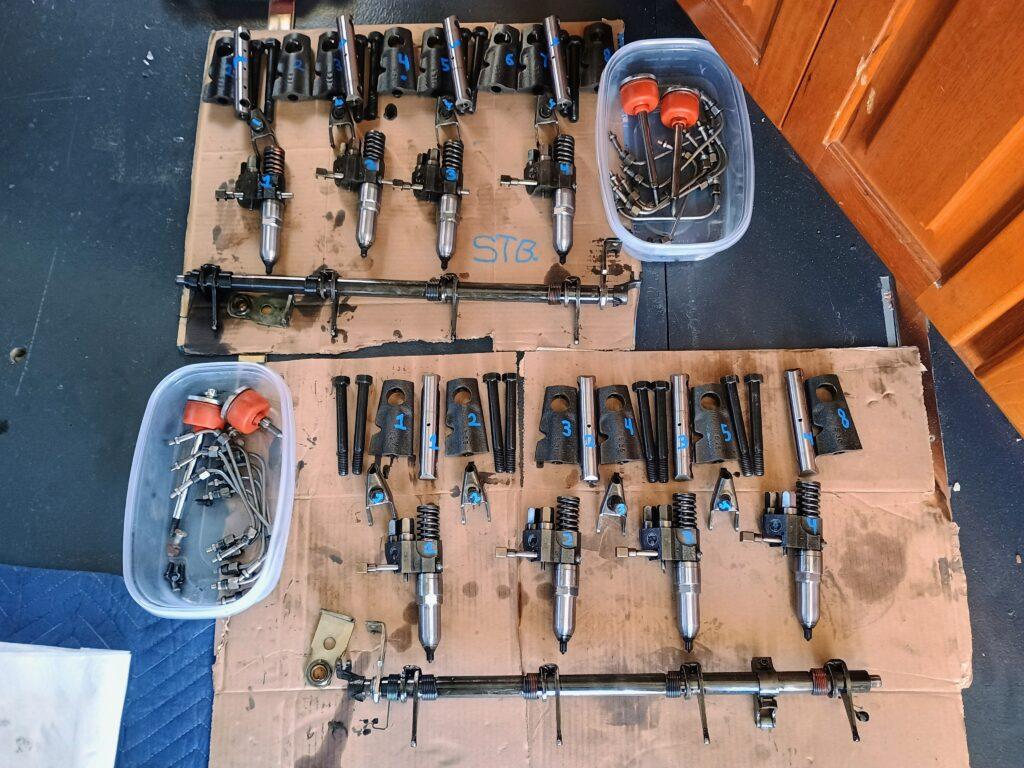
4. Injector Imbalance or Poor Atomization
Each cylinder must produce equal power. If injectors are uneven, one cylinder may fire stronger or weaker than others, creating imbalance.
This forces the engine to constantly adjust output, which results in surging.
👉 Related: Smoke & Combustion Diagnosis Center
5. Air Intake or Turbo Instability
Turbocharged engines depend on consistent boost pressure. If boost fluctuates due to leaks, restriction, or turbo inefficiency, combustion becomes unstable.
This directly affects power output and contributes to surging.
👉 Related: Turbo Systems Diagnosis Center
6. Fuel Pressure Instability
Fuel pressure must remain steady under load. A failing lift pump or air leak can cause pressure fluctuations, which directly affect injection timing and volume.
This creates a repeating cycle of power gain and loss.
7. Electrical or Sensor Instability (Modern Engines)
On electronically controlled engines, unstable sensor signals can cause fluctuating fuel commands. This includes throttle position sensors, ECU inputs, and wiring issues.
👉 Related: Electrical Diagnosis Center
8. Load Variations and Propeller Issues
Changes in load can amplify surging. A damaged prop, marine growth, or drivetrain imbalance can cause fluctuating resistance, forcing the engine to constantly adjust output.
👉 Related: Engine Losing Power Under Load
⚠️ Related Symptom You Should Not Ignore
Surging often progresses into more serious issues such as combustion imbalance or shutdown conditions.
👉 Read this next:
White Smoke Diagnosis Guide
Step-by-Step Professional Diagnosis
When diagnosing surging, we follow a structured process to isolate instability in the system rather than guessing.
- Check for air intrusion in fuel system
- Replace and inspect fuel filters
- Test fuel pressure under load
- Inspect injector balance and spray pattern
- Evaluate governor response and linkage
- Inspect turbo boost and intake system
- Check electrical inputs (if applicable)
👉 Advanced diagnostics:
Mechanical Failure Diagnostics
Frequently Asked Questions
1. What causes engine surging at cruise speed?
Most commonly unstable fuel delivery or air intrusion. Start with the Marine Diesel Troubleshooting Guide to isolate the system.
2. Can air in the fuel system cause surging?
Yes, even small air leaks disrupt fuel pressure and create RPM fluctuation.
3. Can clogged fuel filters cause surging?
Yes, restrictions limit fuel supply under load and create instability.
4. Can injectors cause RPM fluctuation?
Yes, uneven fuel delivery between cylinders creates imbalance.
5. Is surging dangerous?
Yes, it can lead to increased wear and potential engine damage.
6. Where should I start diagnosing?
Start with the Fuel System Diagnosis Center and work through pressure stability.
7. Can turbo problems cause surging?
Yes, inconsistent boost affects combustion stability.
8. Can electrical issues cause surging?
Yes, especially on electronically controlled engines. See Electrical Diagnosis Center.
9. Can load issues cause surging?
Yes, propeller damage or marine growth increases resistance.
10. Can fuel contamination cause this?
Yes, debris can create inconsistent fuel flow.
11. Why does it only happen at cruise RPM?
Because fuel demand is highest and instability becomes more noticeable.
12. Can a bad lift pump cause surging?
Yes, inconsistent pressure delivery leads to RPM fluctuation.
13. Should I keep running the engine?
No, continued operation can worsen the issue.
14. Can this turn into a shutdown problem?
Yes, see White Smoke Diagnosis Guide for related failure progression.
15. Is this common?
Yes, especially in fuel system-related issues.
16. Can injector cleaning fix this?
In some cases, cleaning or replacement restores balance.
17. What’s the fastest diagnosis method?
Follow structured system testing instead of replacing parts randomly.
18. Do you offer mobile service?
Yes, throughout Ventura, Oxnard, Channel Islands Harbor, and Santa Barbara.
19. Can this affect fuel efficiency?
Yes, surging often increases fuel consumption.
20. When should I call a professional?
If the issue persists after basic checks, schedule a full diagnostic inspection.
2 Responses