
The Cummins 6BTA is one of the best-known mechanical marine diesel platforms ever built, but even a proven engine can be stopped cold by weak batteries, voltage drop, starter-circuit resistance, charging faults, or alarm-panel and shutdown-control problems. This guide explains how to diagnose Cummins 6BTA electrical and starting issues using real system-based logic so you can separate no-crank, slow-crank, low-voltage, and alarm-related complaints before replacing the wrong parts.
Cummins 6BTA Marine Diesel Electrical & Starting Problems: Complete Diagnosis Guide
The Cummins 6BTA 5.9 marine diesel has earned its reputation for reliability, strong torque, and long service life, which is exactly why electrical and starting problems can be so frustrating when they appear. Owners expect these engines to fire up and go. When a 6BTA suddenly cranks slowly, clicks without starting, loses panel power, or starts triggering low-voltage alarms, the problem often feels bigger than it really is. In many cases, the root cause is not inside the engine at all. It is in the batteries, the starter circuit, the charging system, the grounding path, or the shutdown and alarm wiring around the engine.
That is why electrical diagnosis on a 6BTA should always start with pattern recognition. Does the engine click and not crank? Does it crank slowly? Does it start intermittently? Do the gauges disappear while cranking? Does the panel show low voltage after running? These details matter because they tell you whether the likely problem is in cranking current delivery, component wear, charging recovery, or a control-side issue. Good diagnosis starts with what the system is doing, not with guesses about which part to replace.
At 805 Marine Diesel Mechanic, Cummins 6BTA electrical and starting problems are diagnosed throughout Ventura, Oxnard, Channel Islands Harbor, and Santa Barbara. With over 30 years of marine diesel experience, the focus is always on testing under real load and tracing the actual voltage path so the true fault is identified before unnecessary parts are swapped. This page expands from your Master Marine Diesel Troubleshooting Guide and fits into your larger sitewide authority structure.
How the Cummins 6BTA Starting System Works
The 6BTA starting circuit is mechanically straightforward, but every component has to do its job correctly for reliable cranking. Battery voltage has to travel through the battery bank, cables, switch gear, starter solenoid, and starter motor with minimal resistance. The return path to ground has to be equally strong. If voltage drops too much anywhere in that chain, the engine may crank slowly, click once, or fail to crank at all.
Main components include:
- Starting batteries
- Battery switch and main cables
- Starter motor and starter solenoid
- Engine ground path
- Alternator and charging system
- Alarm panel, senders, and shutdown circuits
If the issue is truly crank-no-start rather than no-crank or slow-crank, the diagnostic path broadens into fuel and combustion. That is why this topic naturally cross-connects with Engine Will Not Start Diagnosis Center, Boat Engine Won’t Start, and Engine Starts Then Dies.
Common Cummins 6BTA Electrical & Starting Symptoms
Electrical problems on a Cummins 6BTA often show recognizable symptoms before total failure occurs.
- Starter clicks but engine does not crank
- Slow crank or weak turnover
- Intermittent starting
- Low-voltage alarm
- Panel gauges dropping out during crank
- Hard start after sitting
- Engine starts, then immediately dies
These symptoms overlap with deeper pages in your network including Electrical & Starting System Diagnosis Center, No Smoke When Cranking, and Hard to Start When Cold. That crossover matters because weak electrical performance can easily create symptoms that look fuel-related even when the real problem is voltage and cranking speed.
Battery Problems and Voltage Drop
The most common cause of slow cranking on a Cummins 6BTA is inadequate voltage under load. Batteries can look acceptable at rest and still fail badly when the starter actually demands current. A static voltage check is not enough. A real diagnosis needs load testing and voltage-drop testing.
Common battery-related issues include:
- Low state of charge
- Weak or failing battery cells
- Loose battery terminals
- Corroded cable ends
- Undersized cables or poor cable routing
- High-resistance battery switch connections
Voltage-drop testing is critical because a battery may show decent open-circuit voltage while still failing to provide enough amperage to spin the 6BTA fast enough for reliable combustion. This is one of the biggest reasons electrical diagnosis should be done under actual cranking load rather than by appearance alone.
Starter Motor and Solenoid Failures
The starter motor on a Cummins 6BTA handles a high mechanical and electrical load. Over time, heat, vibration, and corrosion wear out internal contacts, brushes, bushings, and the drive mechanism. A failing starter often begins as an intermittent complaint before it becomes a complete no-start issue.
Common starter and solenoid failures include:
- Starter solenoid clicks but does not engage
- Worn starter contacts
- Damaged pinion gear
- Slow starter rotation from internal wear
- Starter overheating after repeated crank attempts
If the starter is spinning but the engine is not engaging properly, the flywheel and starter interface should be inspected quickly before the damage spreads. If the starter is drawing heavy current but still cranking slowly, internal starter drag or cable resistance becomes much more likely.
Ground Circuit and Wiring Issues
Marine diesel engines live in a corrosive environment, and poor grounds are one of the most overlooked causes of starting failure. A 6BTA may have plenty of battery power on paper, but if the return path to ground is weak, the starter still cannot perform correctly. Grounds, cable ends, and block connections are just as important as the positive side.
Common wiring and ground issues include:
- Corroded ground straps
- Loose engine block grounds
- Damaged battery cables
- High resistance in key switch or start wiring
- Panel or harness connector corrosion
This is where intermittent symptoms often live. The boat may start perfectly one day and fail the next because a marginal connection changes with heat, humidity, movement, or vibration. Electrical faults can also create symptoms that overlap with shutdown and alarm behavior, which is why this page also connects with Marine Diesel Engine Shutdown Causes.
Alternator and Charging System Problems
The charging system keeps the starting bank healthy after the engine fires. If the alternator is undercharging, overcharging, or working intermittently, the batteries slowly lose reserve capacity. The owner may blame the starter because the symptom appears during cranking, but the real problem is that the batteries are not being restored between runs.
Common charging problems include:
- Low charging voltage
- Loose or slipping alternator belts
- Regulator problems
- Bad alternator connections
- Battery bank not recovering after each run
Charging faults often show up first as low-voltage warnings on the panel, dim instrumentation, or hard starts after otherwise normal operation. That is why panel warnings should never be treated as just “sensor noise” until the actual charging behavior has been verified.
Alarm Panel, Senders, and Shutdown Inputs
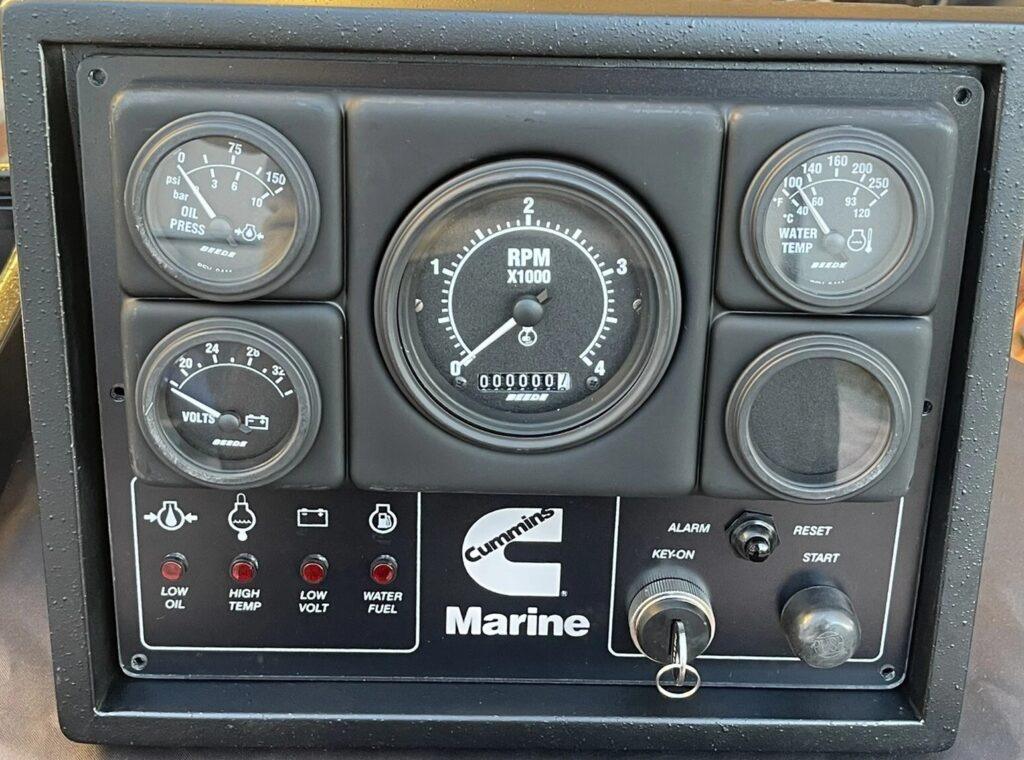
The Cummins 6BTA alarm panel monitors important engine conditions such as oil pressure, water temperature, battery voltage, and in some installations water-in-fuel indication. Faulty senders or wiring can create false alarms, but real alarms also need to be respected until proven otherwise.
Key alarm-related issues include:
- Low oil pressure warning from bad sender or wiring
- High temperature warning from sensor fault
- Low-voltage alarm from charging issue
- Water-in-fuel alarm from contamination or sensor fault
Fuel-related alarms should also be checked against the Fuel System Diagnosis Center and Fuel Contamination & Filtration Issues Center. A false alarm and a real alarm can look identical on the panel, which is why verification matters so much.
When Electrical Problems Look Like Fuel Problems
A weak starting circuit can make a healthy 6BTA act like it has a fuel problem. If the engine is not cranking fast enough, combustion quality falls off. That can create extended crank time, smoke on startup, rough initial firing, or hard-start behavior that looks injector- or fuel-related when the real issue is electrical.
The opposite can also happen. A crank-no-start problem may get blamed on the batteries when the engine is actually spinning at acceptable speed and the fault is in the fuel or shutdown side. That is why cross-checking symptoms is so important.
Useful crossover pages in your network include:
- Smoke & Combustion Diagnosis Center
- Marine Diesel Turbo Diagnosis Center
- Cooling System Diagnosis Center
Professional Cummins 6BTA Electrical Diagnosis
Accurate electrical diagnosis requires testing under load, not guessing based on what “seems likely.” A battery connection can look clean and still have serious resistance. A starter can sound alive and still be weak. A panel can show voltage and still hide a charging fault. Real diagnosis means measuring what the system is doing during actual cranking and actual running conditions.
A structured process typically includes:
- Battery load testing
- Cranking voltage measurement
- Voltage-drop testing across positive and ground circuits
- Starter draw and engagement inspection
- Alternator output testing
- Alarm panel and sender verification
- Harness and connector inspection
Advanced engine and system analysis is also available through the Computerized Marine Engine Survey Diagnostics Center, which helps connect electrical reliability issues with deeper overall engine-condition testing.
Cummins 6BTA Electrical & Starting Service in Ventura & Channel Islands Harbor
805 Marine Diesel Mechanic provides mobile Cummins 6BTA electrical diagnosis and starting-system service throughout:
- Ventura Harbor
- Channel Islands Harbor
- Oxnard
- Santa Barbara
If your Cummins 6BTA cranks slowly, clicks without starting, drops panel power during crank, or shows repeated low-voltage warnings, professional diagnosis can isolate the real problem quickly and prevent unnecessary parts replacement.
Cummins 6BTA Electrical & Starting FAQ
1. Why does my Cummins 6BTA click but not crank?
This usually points to weak batteries, poor cable connections, serious voltage drop, or a failing starter solenoid.
2. Can low voltage cause hard starting on a 6BTA?
Yes. If cranking speed is too low, combustion quality drops and the engine may act like it has a fuel problem even when the real cause is electrical.
3. What does the low-voltage light on the Cummins panel mean?
It usually indicates a charging-system problem, weak batteries, wiring resistance, or a voltage-drop issue that needs to be tested under load.
4. How often should a marine starter and charging system be inspected?
They should be checked during routine service and any time you notice slow crank, hard starting, dim panel behavior, or warning lights.
5. Can a battery show good voltage and still fail to crank the engine properly?
Yes. A battery may look acceptable at rest and still collapse badly when the starter draws current. That is why load testing matters more than surface voltage alone.
6. Can corroded battery cables really stop a 6BTA from starting?
Absolutely. Even moderate cable corrosion can create enough resistance to prevent proper starter performance.
7. Can a bad ground cable act like a bad starter?
Yes. Poor grounds are one of the most overlooked causes of slow crank and no-start complaints because they reduce current flow on the return side.
8. Why do my gauges drop out when I crank the engine?
That usually points toward severe voltage drop, weak batteries, poor connections, or a starter drawing excessive current.
9. Can a charging problem cause repeated hard starts?
Yes. If the alternator is not restoring the batteries after each run, starting reliability gradually declines and the complaint keeps returning.
10. Can a bad starter solenoid click but still fail to engage?
Yes. An audible click does not prove that the starter is actually receiving full current or mechanically engaging the engine.
11. Can a weak starting circuit make the engine seem like it has fuel problems?
Yes. Slow cranking can make a healthy engine start poorly and behave like it has a fuel or injector issue.
12. Can false alarms come from senders or wiring instead of real engine problems?
Yes. Alarm senders and panel wiring can fail, but the warning should always be verified before assuming it is false.
13. What if my 6BTA cranks fine but still will not start?
Then the problem may be fuel- or shutdown-related rather than cranking-related. Related page: Engine Will Not Start Diagnosis Center.
14. Can water-in-fuel alarms overlap with electrical diagnosis?
Yes. Some alarms are sensor-related and some are real contamination warnings, which is why they should be cross-checked against the Fuel Contamination & Filtration Issues Center.
15. Can repeated crank attempts damage the starter?
Yes. Repeated cranking can overheat the starter and create a second failure on top of the original problem.
16. Can alternator belts affect charging enough to create low-voltage problems?
Yes. Loose or slipping belts can reduce alternator output enough to leave the batteries undercharged.
17. Is mobile diagnosis useful for Cummins 6BTA electrical problems?
Yes. Starting and voltage-drop complaints are often easiest to diagnose on the boat with the same batteries, cables, panel, and environment where the problem occurs.
18. Can electrical faults also trigger shutdown-like symptoms?
Yes. Faults in alarm inputs, sender circuits, or weak voltage behavior can overlap with shutdown complaints. Related page: Marine Diesel Engine Shutdown Causes.
19. When should I call a mechanic for Cummins 6BTA starting problems?
If the engine cranks slowly, clicks without starting, drops panel voltage, or repeatedly triggers alarms, it is time for professional diagnosis through the contact page.
20. Where should I start if I want the full Cummins 6BTA electrical pathway?
Start with the Master Marine Diesel Troubleshooting Guide, then move through the linked starting, shutdown, fuel, smoke, and cooling pages from there.
One Response