
Why Does My Boat Shaft Spin But the Boat Doesn’t Move Properly? (Marine Diesel Guide)
If your engine is running and your shaft is spinning but the boat is not moving correctly, you are dealing with a power transfer failure somewhere in the drivetrain. This is a critical marine diesel issue because it means the engine is producing power, but that power is not reaching the water efficiently.
After more than 30 years diagnosing marine diesel systems throughout Ventura, Oxnard, Channel Islands Harbor, and Santa Barbara, we consistently see this problem caused by propeller fouling, spun hubs, transmission slippage, or coupling failures. The key is understanding where the power transfer breaks down.
Start with the full system here:
Marine Diesel Troubleshooting Guide
What This Problem Really Means
Marine propulsion follows a simple chain:
If any part of that chain fails, your boat loses thrust. Engines from manufacturers like
Caterpillar Marine and
Cummins Marine Engines rely on uninterrupted power transfer. When that chain breaks, the engine may sound fine—but propulsion is lost.
Common Symptoms
- Shaft spins but boat barely moves
- Engine RPM increases without speed gain
- Loss of thrust under load
- Vibration or unusual drivetrain noise
- Boat struggles to get on plane
Related: Power Loss Guide
Related orphan post: Why Does My Boat Engine Use Too Much Fuel?
1. Propeller Fouling (Most Common Cause)
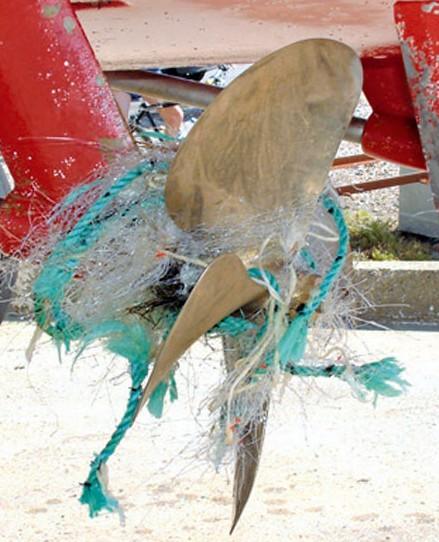
Rope, fishing line, kelp, or debris wrapped around the propeller is the most common cause of sudden propulsion loss. The shaft still spins, but the prop cannot push water effectively.
- Immediate loss of thrust
- Increased drag
- Sudden performance drop
2. Damaged Propeller
Bent blades, missing sections, or imbalance can reduce thrust significantly.
Related: Full RPM Guide
3. Spun Prop Hub
A spun hub allows the prop to slip under load. The shaft spins, but the prop loses grip.
4. Transmission Slippage
Internal clutch wear or fluid issues can cause the transmission to slip under load.
5. Coupling Failure
A loose or worn coupling prevents full power transfer.
Related: Clunk Guide
6. Shaft Damage
A partially failed shaft or misalignment reduces propulsion efficiency.
7. Cutlass Bearing Drag
Excess drag limits effective shaft rotation.
8. Cavitation
The prop spins in aerated water, losing bite.
9. Improper Prop Setup
Incorrect pitch or sizing reduces thrust.
Related: Sluggish Acceleration Guide
10. Drivetrain Wear
Wear across multiple components reduces efficiency over time.
Step-By-Step Diagnosis
- Inspect prop for debris
- Check hub condition
- Inspect coupling
- Test transmission
- Evaluate shaft alignment
- Load test under operation
Related:
Grinding Noise
Vibration Guide
Why This Problem Is Serious
- Loss of propulsion offshore
- Safety risk in tight maneuvering
- Transmission damage
- Potential complete drivetrain failure
Professional Diagnosis
805 Marine Diesel Mechanic specializes in real-world propulsion diagnostics with over 30 years of experience servicing Ventura, Oxnard, Channel Islands Harbor, and Santa Barbara.
Frequently Asked Questions
1. Why is my shaft spinning but the boat not moving?
Usually prop fouling, hub failure, or transmission slippage.
2. Can rope cause propulsion loss?
Yes, it is the most common cause.
3. What is a spun prop hub?
A hub that slips under load and prevents thrust.
4. Can a transmission slip?
Yes, internal clutch wear can cause this.
5. Is this dangerous?
Yes, it can leave you without propulsion.
6. Should I fix it immediately?
Yes, it is a safety issue.
7. Can cavitation cause this?
Yes, the prop loses bite in aerated water.
8. Can shaft damage cause this?
Yes, especially misalignment or fracture.
9. Can incorrect prop size cause issues?
Yes, it reduces efficiency.
10. Can coupling failure cause this?
Yes, power is not transferred fully.
11. Why does RPM increase but speed doesn’t?
Power is not reaching the prop effectively.
12. Can fuel issues cause this?
Indirectly, if engine power is reduced.
13. Can this damage the transmission?
Yes, especially if slipping continues.
14. Is this common?
Yes, especially with debris entanglement.
15. Can vibration be related?
Yes, drivetrain issues often create vibration.
16. Can I diagnose this visually?
Sometimes, especially with prop fouling.
17. Do I need a haul-out?
Often yes, for prop inspection.
18. What should I check first?
Inspect the propeller for debris.
19. Do you offer mobile diagnostics?
Yes, throughout Ventura and surrounding areas.
20. Where should I start diagnosis?
Start here: Marine Diesel Troubleshooting Guide
3 Responses