
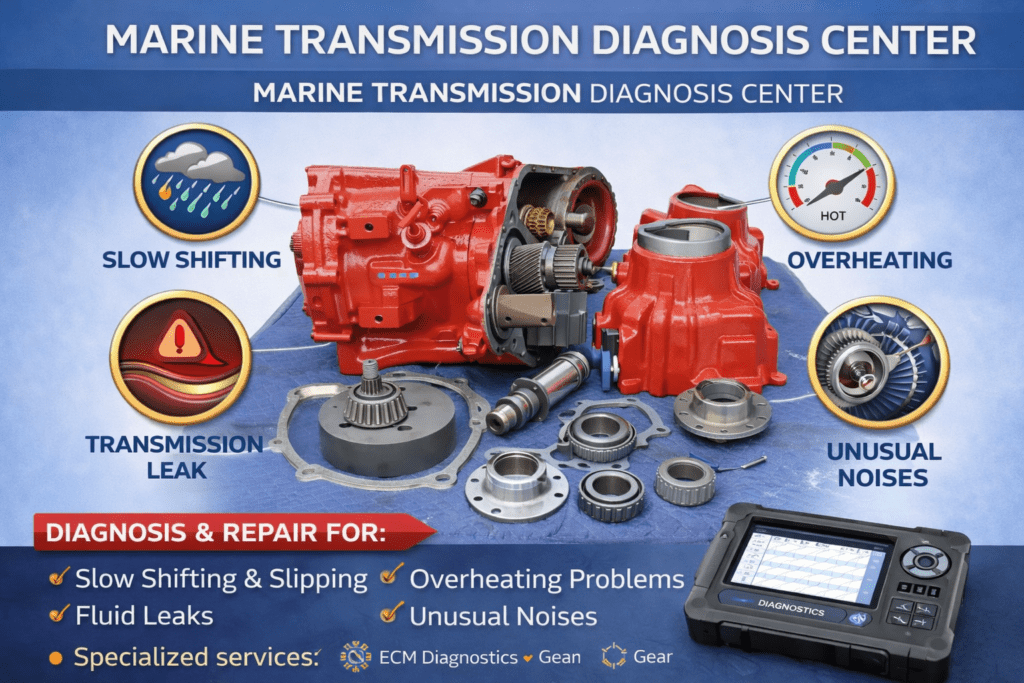
Marine transmission problems are often blamed on the gearbox too early. In the real world, slow shifting, slipping, overheating, leaks, unusual noises, vibration, or loss of propulsion can come from the transmission itself, but they can also come from alignment problems, coupling failures, drivetrain damage, propeller loading issues, or an engine that is struggling under load. This marine transmission diagnosis center is built to help boat owners and yacht operators isolate the real failure point before money is wasted on the wrong repair.
At 805 Marine Diesel Mechanic, we use a system-based diagnostic process built from over 30 years of hands-on marine diesel experience. That means we do not just ask whether the boat goes into gear. We look at how the transmission engages, how the engine responds under load, whether the shaft and coupling are transferring power correctly, whether alignment is stressing bearings and seals, and whether the problem is truly hydraulic, mechanical, thermal, or downstream in the propulsion system.
What This Marine Transmission Diagnosis Center Covers
This page acts as the transmission hub for your troubleshooting structure. It connects the major failure patterns that marine boat owners see in the field and routes them toward the correct deeper pages. If your boat has a known brand-specific gearbox issue, start with one of these core transmission posts:
- ZF Marine Transmission Problems Guide
- Twin Disc Transmission Problems Guide
- Detroit Diesel Allison Marine Transmission
- Marine Drivetrain & Coupling Failures
- Shaft, Prop & Transmission Alignment Guide
If you are not yet sure where the failure is, start broad with the Master Marine Diesel Troubleshooting Guide, then work back into this transmission center.
Why Marine Transmission Problems Get Misdiagnosed
Marine transmissions sit in the middle of the power path. Because they connect engine power to the shaft system, symptoms from several different systems can all feel like “the transmission is bad.” That is why so many owners report slipping, hesitation, no movement, or heavy vibration and assume the gearbox must be removed. In reality, the true problem may be a weak coupling, a misaligned shaft, a propeller hub issue, a dragging drivetrain, or an engine that stalls or falls off under gear engagement.
For example, if the engine bogs hard and dies when gear is selected, the real problem may not be an internal gearbox failure at all. It may be a severe load event, idle control issue, fuel weakness, or driveline resistance. That crossover is exactly why this page ties directly into Why Does My Boat Engine Stall When Put Into Gear?. Likewise, if the shaft appears to rotate but the boat does not move properly, the failure may be after the transmission, which is why you should compare the symptom with Why Does My Boat Shaft Spin But the Boat Doesn’t Move Properly?.
Core Marine Transmission Symptoms
Slow Shifting or Delayed Engagement
Slow shifting usually points toward hydraulic pressure loss, fluid problems, worn clutch elements, control issues, or valve body problems. But you still have to verify whether the delay is truly inside the transmission or whether the engine is dropping off so hard that engagement feels lazy. This is especially important on older gearboxes and on boats where fluid condition and maintenance history are unknown.
Slipping Under Load
True slip shows up when engine RPM rises but the boat does not accelerate proportionally. That can be caused by clutch wear, pressure loss, overheated fluid, or an internal transmission fault. But similar behavior can also happen when a coupling is failing or a propeller hub is slipping. That is why a slipping complaint should always be cross-checked against Marine Drivetrain & Coupling Failures and Shaft, Prop & Transmission Alignment Guide.
Overheating
A hot transmission is never a small issue. Heat rapidly shortens clutch life, reduces lubrication quality, hardens seals, and increases internal wear. Transmission overheating can be caused by cooler restriction, wrong fluid, excessive load, chronic slip, or a drivetrain that is forcing the gearbox to work against resistance. Boats with vibration, whining, or poor alignment often run hotter because load is not transferring smoothly through the system.
Fluid Leaks
Leaks should never be treated as “normal old boat behavior.” A front or rear seal leak may indicate pressure problems, overheating, shaft movement, or alignment issues. A leak can be the warning sign before clutch damage, low-pressure engagement problems, or total fluid loss. If a seal keeps failing, the right answer is often deeper than just installing another seal.
Unusual Noises
Whining, grinding, clunking, and harsh gear engagement all matter. A whining noise under load may be related to bearings, gear mesh stress, or misalignment, which is why it should be cross-checked against Why Is My Boat Making a Whining Noise Under Load?. A clunk when shifting points more toward slack, coupling shock, drivetrain looseness, or mount/alignment problems, so it belongs next to Why Does My Boat Engine Clunk When Shifting Into Gear?.
Transmission vs Drivetrain vs Engine: The Separation That Saves Money
The most important part of marine transmission diagnosis is separating where power is being lost.
When It Is More Likely a True Transmission Problem
- Delayed or weak engagement into gear
- RPM rises without matching thrust
- Burnt or dark transmission fluid
- Transmission runs abnormally hot
- Internal pressure faults or chronic slip
When It Is More Likely a Drivetrain or Coupling Problem
- Boat goes into gear but propulsion is weak or inconsistent
- Shaft spins but thrust does not match
- Heavy vibration increases with speed
- Clunking or mechanical knock during shift engagement
- Noise changes with shaft load more than with engine RPM alone
When It Is More Likely an Engine-Under-Load Problem
- Engine loses power when put in gear
- Boat accelerates poorly and cannot carry load
- Engine smokes, surges, or falls on its face under throttle
- Problem feels like slip but really starts with weak engine output
That third category is why transmission complaints often have to be compared with Why Does My Boat Engine Lose Power Under Load?. If the engine cannot make full torque, the transmission and drivetrain can be blamed unfairly.
How Alignment Problems Create Transmission Problems
Alignment problems are one of the most common hidden causes behind recurring marine transmission complaints. A transmission may be rebuilt, the fluid may be changed, or a seal may be replaced, yet the same symptoms keep returning because the true issue is that the engine, coupling, shaft, and propeller are not running on the same centerline.
When alignment is off, the transmission output bearing and seals see side-loading they were never meant to handle. That causes heat, wear, leaks, and poor power transfer. Over time, alignment problems can also damage couplings, accelerate bearing wear, create vibration, and make the boat feel harsh when shifting into gear. This is why the transmission center must link directly into the deeper alignment pathway through Shaft, Prop & Transmission Alignment Guide.
Alignment-related complaints also overlap closely with vibration pages, including Why Does My Boat Engine Vibrate Excessively? and Yacht Engine Excessive Vibration Marine Diesel Diagnosis Guide. If the boat runs rough only under gear load, the answer may be in the driveline geometry, not the gearbox internals.
Brand-Specific Marine Transmission Diagnosis
ZF Marine Transmissions
ZF gearboxes are common across many yacht and pleasurecraft applications. Problems often involve shift quality, fluid condition, cooler performance, and internal clutch wear, but they can also be misread when the real issue is downstream. Start with ZF Marine Transmission Problems Guide and compare the symptom to drivetrain and alignment pages if the failure pattern is inconsistent.
Twin Disc Transmissions
Twin Disc units are heavily used in both commercial and recreational marine service. When they begin showing slow engagement, slip, or heat, the diagnosis must separate true hydraulic/internal failure from load and alignment issues. Use Twin Disc Transmission Problems Guide as the brand-specific pathway.
Detroit Diesel Allison Marine Transmissions
Older Detroit Allison units can still be excellent gearboxes, but age, service history, cooler condition, seals, and drivetrain stress all matter. Complaints on these systems often involve harsh shifts, leaks, delayed engagement, and coupling or driveline crossover issues. Use Detroit Diesel Allison Marine Transmission to move into that branch.
Marine Transmission Diagnostic Process We Use in the Field
Real diagnosis is not guessing and it is not throwing a transmission at the boat because the owner says it “feels like it is slipping.” A proper process usually looks like this:
1. Confirm the Complaint Under Real Load
The problem must be understood at the exact condition where it happens. Cold only, hot only, idle engagement, cruise load, full throttle, after extended run time, or only in reverse all matter.
2. Check Fluid, Condition, and Service History
Fluid level, fluid smell, discoloration, contamination, and signs of overheating often tell the story quickly. Burnt fluid points toward slip or excessive heat. Repeated contamination can point toward internal wear or external cooling issues.
3. Separate Engine Output from Gearbox Output
If the engine is weak under load, transmission behavior will be misread. This is where the loss-of-power page becomes important. If the boat falls flat when throttle is applied and the engine never truly makes power, the gearbox may not be the root problem.
4. Check Coupling, Shaft, and Alignment
Any time there is vibration, clunking, repeated seal failure, or shaft-related inconsistency, the gearbox must be evaluated together with the driveline. That means the transmission center should naturally feed people into Marine Drivetrain & Coupling Failures and Shaft, Prop & Transmission Alignment Guide.
5. Verify Cooling and Heat Exchange
Marine transmissions live or die by temperature. A restricted cooler, poor water flow, or chronic overload can cook a transmission that would otherwise survive for years.
6. Decide Whether the Failure Is Internal, External, or Systemic
This is where proper diagnosis saves money. Some boats truly need internal transmission repair. Others need alignment correction, coupling replacement, cooler service, or an engine-side load diagnosis. The right answer comes from narrowing the failure path logically.
Related Failure Pathways Inside This Center
This diagnosis center is designed so the pages reinforce each other instead of standing alone. If your problem sounds like one of these, go directly into that page next:
- Boat stalls when put into gear
- Shaft spins but boat does not move properly
- Whining noise under load
- Boat engine vibrates excessively
- Clunk when shifting into gear
- Engine loses power under load
- Yacht excessive vibration guide
External Authority References
Marine Transmission Diagnosis Center FAQ
1. What is the most common marine transmission complaint?
Slow shifting, slipping, and overheating are three of the most common complaints. The important part is determining whether the fault is truly internal to the transmission or whether the symptom is being created by alignment, coupling, shaft, or engine load issues.
2. Can a marine transmission feel bad when the real problem is in the shaft system?
Yes. That happens all the time. A bad coupling, spun hub, or alignment problem can make the transmission seem weak even when the gearbox is actually engaging correctly. Compare symptoms with Marine Drivetrain & Coupling Failures.
3. Why does my boat stall when I put it into gear?
That can be caused by excessive drivetrain drag, idle control problems, fuel weakness, or load that is too heavy for the engine at engagement. It should be checked against the stall-when-put-into-gear guide before blaming the gearbox.
4. Does a fluid leak always mean the transmission is worn out?
No. A leak can come from heat, pressure, misalignment, shaft movement, or worn seals without the entire transmission being destroyed. But leaks should never be ignored because they often point to a deeper issue.
5. Can bad alignment cause transmission leaks?
Yes. Misalignment side-loads bearings and seals, which can lead to recurring leaks, heat, and premature wear. That is why the transmission center ties directly into the alignment guide.
6. What causes a whining noise under load?
A whining noise can come from bearings, gear mesh stress, alignment issues, or drivetrain load problems. It is a crossover symptom and should be compared to the whining-noise-under-load page.
7. Can engine power loss feel like transmission slipping?
Yes. If the engine loses torque under load, the boat may feel like the transmission is slipping when the real issue starts on the engine side. That is why this center links to engine loses power under load.
8. What does it mean if the shaft spins but the boat does not move properly?
That usually points downstream of the transmission. A spun propeller hub, coupling issue, or shaft-related problem is more likely than an internal transmission failure. Use the shaft-spins-but-boat-doesnt-move guide next.
9. Is vibration a transmission problem or a driveline problem?
It can be either, but heavy vibration under load often pushes the diagnosis toward alignment, couplings, shaft condition, mounts, or propeller issues. Review both boat vibration and yacht excessive vibration for crossover logic.
10. When is a clunk while shifting a serious warning sign?
A clunk means shock is being absorbed somewhere in the system. That can be caused by slack in the driveline, loose hardware, worn couplings, mount problems, or harsh gear engagement. Compare it with the clunk-when-shifting page.
11. Are ZF, Twin Disc, and Allison problems diagnosed the same way?
The diagnostic logic is similar, but the exact failure modes, controls, and service history patterns can vary by brand and model. That is why this center routes deeper into ZF, Twin Disc, and Detroit Allison pages.
12. Can overheating destroy a marine transmission quickly?
Yes. Heat breaks down fluid, damages friction materials, hardens seals, and accelerates wear. A hot transmission should be treated as an urgent diagnostic problem, not just a maintenance note.
13. Why is system-based diagnosis better than replacing parts one by one?
Because replacing parts without isolating the true root cause wastes money and often leaves the real problem in place. A repeated seal failure, for example, may be caused by alignment, not the seal itself.
14. Can a bad coupling damage the transmission?
Yes. A failing coupling can create shock, misalignment, vibration, and inconsistent power transfer that stresses the gearbox and output components. That is why coupling diagnosis belongs directly in this center.
15. What if my transmission goes into gear but the boat still feels weak?
That points toward several possible crossover paths: internal slip, bad coupling, poor alignment, propeller issues, or weak engine output. The answer comes from separating where the power is being lost.
16. Is a transmission cooler part of the diagnostic process?
Absolutely. Cooler restriction or reduced water flow can drive fluid temperature up and damage the transmission even if the rest of the gearbox is mechanically sound.
17. Can alignment problems develop slowly over time?
Yes. Mount wear, hull movement, prior repairs, or cumulative drivetrain stress can create gradual misalignment that only becomes obvious once vibration, leaks, or harsh shifting start showing up.
18. Do older marine transmissions require a different approach?
Older gearboxes often need a more careful diagnostic approach because age, maintenance history, seals, fluid contamination, and related drivetrain wear all stack together. That is especially true on older Allison and similar legacy systems.
19. When should I call for professional marine transmission diagnosis?
If you have slipping, delayed engagement, overheating, leaks, whining, clunking, vibration, or unexplained loss of propulsion, it is time for a real system-level inspection through the contact page.
20. Where should I start if I do not know whether the problem is transmission, engine, or drivetrain?
Start with the Master Marine Diesel Troubleshooting Guide, then use this Marine Transmission Diagnosis Center to narrow the failure path into the correct deeper page.
With over 30 years of marine diesel experience, 805 Marine Diesel Mechanic provides mobile transmission, drivetrain, and alignment diagnosis throughout Ventura, Channel Islands Harbor, Oxnard, and Santa Barbara.
One Response