
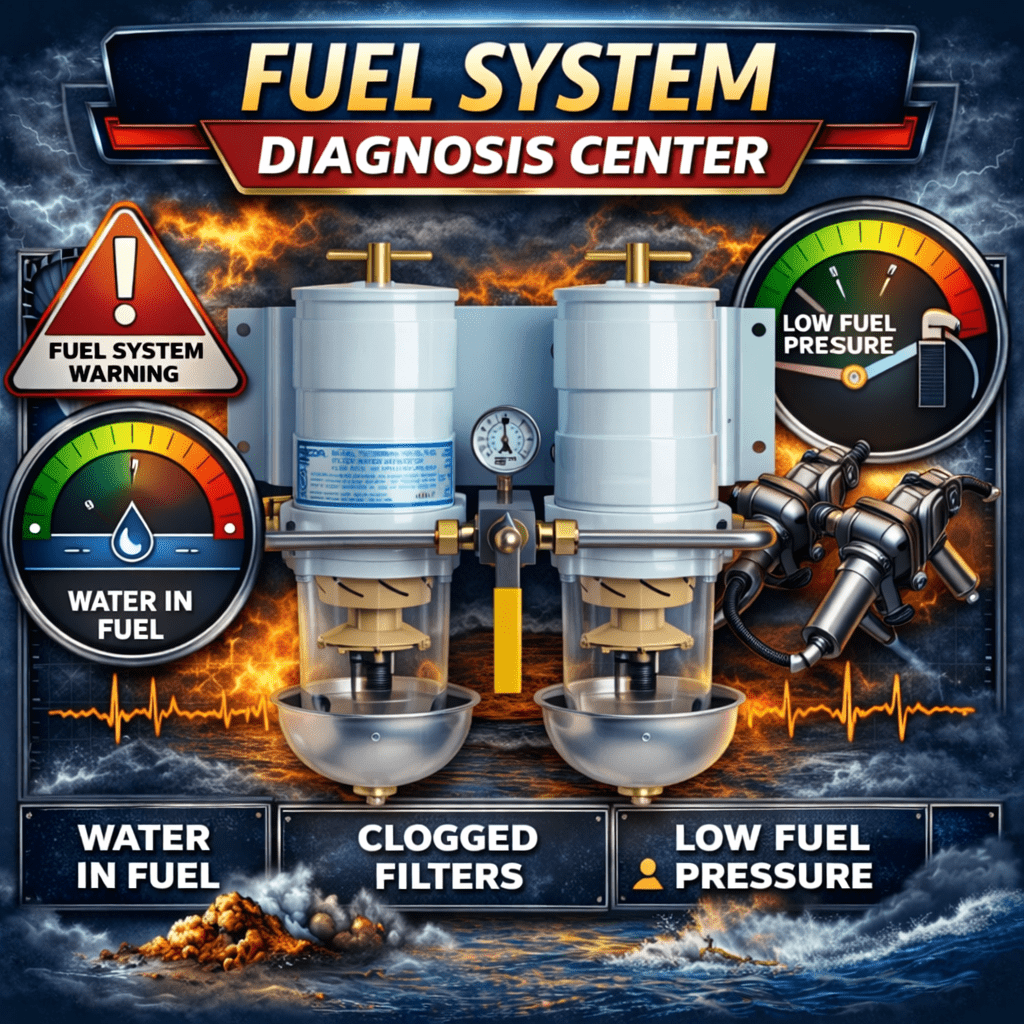
Marine Diesel Fuel System Diagnosis Center: Water, Air & Low Pressure Problems
Fuel system failures are the number one cause of marine diesel engine problems, yet they are also the most misdiagnosed. When fuel delivery becomes unstable—whether from restriction, air intrusion, or contamination—the engine does not fail in one obvious way. Instead, it produces symptoms that overlap with cooling, turbo, and mechanical systems.
At 805 Marine Diesel Mechanic, serving Ventura, Oxnard, Channel Islands Harbor, and Santa Barbara, fuel system diagnosis always starts with system logic. Before replacing parts, symptoms should be mapped through the Master Marine Diesel Troubleshooting Guide, then narrowed into fuel system testing.
The Fuel System as a Complete Chain
The marine diesel fuel system operates as a continuous flow path from tank to injector and back. Any disruption—whether from debris, air, or restriction—affects combustion directly. That is why engines struggling with not reaching full RPM or showing loss of power under load should always be evaluated from a fuel-first perspective before assuming drivetrain or turbo failure.
Fuel systems are also directly tied to air and combustion performance. When fuel delivery becomes inconsistent, symptoms often overlap with turbo system diagnosis or even smoke & combustion diagnosis, which is why isolating the root cause requires structured testing.
Symptom-Based Fuel Diagnosis (Authority Flow)
An engine that cranks but will not start often indicates fuel delivery failure before injection. This mirrors no-start after filter change scenarios where air enters the system and prevents priming.
If the engine starts and then dies, fuel supply is present but cannot be sustained. This pattern aligns with engine starts then dies, where restriction or air intrusion interrupts flow.
Engines that surge at cruise RPM often suffer from unstable pressure, matching cruise RPM surging where fuel delivery fluctuates under load.
Black smoke under load frequently appears when combustion is incomplete due to poor fuel atomization. This is why those conditions should be cross-checked with black smoke diagnostics instead of blaming the turbo first.
Water Contamination — The Root of Long-Term Damage
Water contamination begins at the tank and spreads through the system. Once present, it reduces lubrication, promotes microbial growth, and creates debris that clogs filters and injectors.
This progression often leads to symptoms that overlap with fuel contamination diagnosis and can eventually cause injector failure, which may also appear similar to excessive fuel consumption problems.
Air Intrusion — The Invisible Failure
Air intrusion occurs on the suction side and does not leak fuel outward, making it difficult to detect. Instead, it introduces instability into fuel delivery.
This leads to hard starting, shutdown after startup, and inconsistent performance, which closely matches air vs restriction diagnosis patterns.
Engines experiencing air intrusion may also show behavior similar to hard starting cold vs warm, where fuel pressure cannot stabilize.
Fuel Restriction — The Most Common Real-World Failure
Restriction develops gradually and is often overlooked until performance is affected. As filters clog and lines degrade, fuel flow decreases, especially under load.
This is why hesitation during acceleration often matches hesitation when throttling up, and why engines that stall under load align with stalling in gear conditions.
Restriction also increases vacuum, which can pull air into the system, combining two failure modes into one.
Advanced Diagnostics — Where Guessing Stops
Professional fuel system diagnostics includes vacuum testing, pressure testing, and flow verification. These methods confirm whether fuel delivery is stable under load.
More complex cases often require deeper analysis through the Computerized Diagnostics Center, where live data reveals performance issues that cannot be seen at idle.
Boost testing may also be required to confirm whether performance issues are airflow-related, especially when symptoms overlap with boost pressure testing diagnostics.
Fuel System Failures and Cross-System Effects
Fuel problems rarely stay isolated. As delivery becomes unstable, combustion efficiency drops, increasing exhaust temperature and affecting turbo performance.
This can lead to symptoms that resemble aftercooler restriction issues or even heat exchanger problems, even though the root cause began in the fuel system.
Prevention & System Upgrades
Fuel system reliability improves significantly with proper maintenance and upgrades. Dual filtration, vacuum monitoring, and regular inspection prevent most failures before they occur.
Fuel polishing systems help maintain clean fuel, while regular maintenance practices like fresh water flushing reduce contamination risk.
Routine service through marine diesel engine services ensures that early warning signs are addressed before they escalate.
FAQ
1. What causes fuel system failure most often?
Restriction, air intrusion, and contamination are the most common causes, especially when multiple symptoms appear at once and affect engine performance under load.
2. Can fuel issues cause power loss?
Yes, unstable fuel delivery reduces combustion efficiency and often mirrors loss of power under load.
3. Why does my engine start then die?
This typically indicates unstable fuel delivery caused by restriction or air intrusion.
4. Can air in the fuel system cause hard starting?
Yes, air disrupts fuel pressure and prevents proper injection timing.
5. What causes black smoke?
Incomplete combustion due to poor fuel atomization.
6. Can water damage injectors?
Yes, it reduces lubrication and causes corrosion.
7. How do I detect restriction?
Vacuum testing identifies restriction early.
8. Why does my engine surge?
Fuel pressure instability causes surging.
9. Can hoses fail internally?
Yes, internal collapse can restrict flow.
10. Can fuel mimic turbo issues?
Yes, always rule out fuel first.
11. What is fuel polishing?
Cleaning stored fuel of contaminants.
12. Can contamination spread?
Yes, through the entire system.
13. Why hesitation under throttle?
Delayed fuel delivery.
14. Can fuel issues cause vibration?
Yes, uneven combustion causes vibration.
15. Can restriction affect RPM?
Yes, limits maximum RPM.
16. Should I monitor vacuum?
Yes, for early warning.
17. Can contamination cause rough idle?
Yes, unstable combustion.
18. Can lift pumps fail under load?
Yes, especially at high demand.
19. Who should diagnose?
A trained marine diesel technician.
20. Where should I start?
Start with the Master Guide.
2 Responses