Diagnose marine diesel engine problems quickly using a proven, symptom-based system built from over 30 years of real-world experience. This interactive marine diesel troubleshooting guide helps boat owners identify the root cause of common engine problems including no-start conditions, loss of power under load, overheating, and black, white, or blue exhaust smoke.

How to Diagnose Your Marine Diesel Engine Problem

Start by identifying your primary symptom, then click the matching section in the diagram below. Each path walks you through a structured diagnostic process covering fuel system faults, air intake restrictions, turbocharger issues, cooling system failures, electrical problems, and mechanical engine damage.

Interactive marine diesel troubleshooting diagram showing no start, poor performance, smoke problems, overheating, fuel and filters, electrical systems, air and turbo, and cooling system diagnostic paths

How to Use This Marine Diesel Diagnostic Diagram

Start with the symptom your engine is showing most clearly. Click the matching section in the troubleshooting diagram above to move directly into the most likely diagnostic path.

If your engine will not start, begin with the No Start path. If the engine is losing RPM, struggling under load, or feels weak at cruise, follow the Poor Performance path. If smoke color is the clearest clue, use the Smoke Problems branch. If temperature is climbing or coolant flow seems weak, move into the Overheating path.

This symptom-first process helps you move toward the real cause faster, avoid replacing good parts, and narrow the problem before it becomes a larger repair.

Not sure which branch fits your symptoms?


Schedule Professional Marine Diesel Diagnostic Service

Why This Marine Diesel Troubleshooting Guide Works

How to Use This Guide

The fastest way to waste time in marine diesel diagnosis is to start with assumptions. Many boat owners jump straight to injectors, turbochargers, ECU concerns, or internal engine damage before confirming the simple issues that actually cause the majority of real-world service calls. In practice, problems like restricted fuel delivery, contaminated diesel, suction-side air leaks, impeller failure, fouled coolers, corroded electrical connections, battery weakness, and overdue maintenance account for far more failures than major component damage.

This guide is built around that reality. It follows the same symptom-first diagnostic process used by trained marine diesel technicians working on inboard engines in Santa Barbara, Ventura, and Channel Islands Harbor.

Start with the symptom you are seeing most clearly. Is the engine hard to start? Is it cranking slowly due to electrical issues? Does it start and then shut down? Does it produce black smoke under load or white smoke at startup? Is temperature rising only at cruise RPM, or is the engine struggling with low power and loss of RPM? Is vibration increasing with speed?

Each symptom points toward a different system, and each section below is designed to narrow those possibilities without skipping the fundamentals. For example, if the engine will not reach full RPM, do not immediately blame the propeller or turbocharger. Start by confirming clean fuel supply, unrestricted airflow, proper raw water flow, and accurate load conditions. Many performance issues are ultimately traced back to fuel delivery problems or airflow restriction identified through comparisons like the fuel vs air restriction diagnostic guide.

If the engine overheats at idle, your diagnostic path may differ from one that overheats only under load. If the engine produces white smoke only during cold start and then clears, the likely cause differs from smoke that continues once the engine is warm. These differences are what make structured troubleshooting more effective than guess-based repairs.

This page works as a central diagnostic hub. As you move through each section, you will be guided into deeper system-specific troubleshooting including fuel system issues, airflow and turbo performance, electrical and starting faults, and mechanical condition analysis. When multiple symptoms overlap, it is often best to follow the full marine diesel troubleshooting process rather than focusing on a single component too early.

Need Help Interpreting Symptoms? Contact 805 Marine Diesel Mechanic

Marine Diesel Troubleshooting Guide-Diagnose Boat Engine Problems Fast with 805 Marine Mechanic

Why This Marine Diesel Troubleshooting Guide Works

This system is built from over 30 years of real-world marine diesel diagnostic experience working on inboard engines throughout Ventura, Santa Barbara, and Channel Islands Harbor.

Instead of guessing or replacing parts, this guide follows the same structured diagnostic process used by trained marine diesel technicians — starting with symptoms, then confirming fuel delivery, air intake, cooling performance, electrical support, and finally mechanical condition.

This approach reduces unnecessary repairs, speeds up troubleshooting, and helps identify the true root cause of engine problems the first time.

Start With the Symptom, Not the Guess

A strong marine diesel diagnostic process does not start with parts. It starts with the symptom. What changed, when it changed, and under what exact conditions the problem appears will determine the correct path faster than any assumption. Did the issue begin after fueling? After a layup period? After an overheat? After running in rough water? After routine maintenance? After changing filters, impellers, batteries, or belts? Does it happen only cold, only hot, only under load, only in reverse, or only above a certain RPM? These details matter because they quickly narrow the failure path.

For example, a boat that starts normally cold but loses RPM after 20 minutes at cruise often points toward fuel restriction, tank venting problems, thermal electrical issues, or heat-related air leaks. A boat that starts hard after sitting may indicate fuel drain-back, weak preheat support, injector spray concerns, compression loss, or battery performance issues. A boat that suddenly produces black smoke under load while also losing top RPM may suggest restricted airflow, over fueling, propeller overload, fouled running gear, or turbo inefficiency. In many of these cases, the root cause traces back to fuel delivery problems or air and turbo system performance.

The more accurate the symptom description, the more accurate the next diagnostic step becomes. That is why this guide is structured around real operating conditions instead of guess-based repair. When multiple symptoms overlap, it is often more effective to follow a structured process like the marine diesel troubleshooting guide rather than replacing parts prematurely.

Common Warning Signs Before Major Failure

Most major marine diesel failures are not sudden. They are preceded by smaller warning signs that were missed, dismissed, or misinterpreted. Catching these early often means the difference between a controlled service visit and a much larger repair.

Many owners wait for a complete failure — no-start, overheat alarm, or shutdown — before taking action. In reality, the most efficient repairs happen earlier. When symptoms are addressed before the engine enters protection mode or before damage spreads to other systems, diagnosis is faster and repair decisions are more controlled.

This is especially true on inboard marine diesel engines operating in saltwater environments, where restricted coolers, aging hoses, corrosion, contaminated fuel, and electrical degradation can combine into larger system failures over time. When symptoms begin to overlap, evaluating fuel delivery, cooling performance, and electrical support together will usually identify the root cause much faster than isolating a single component.

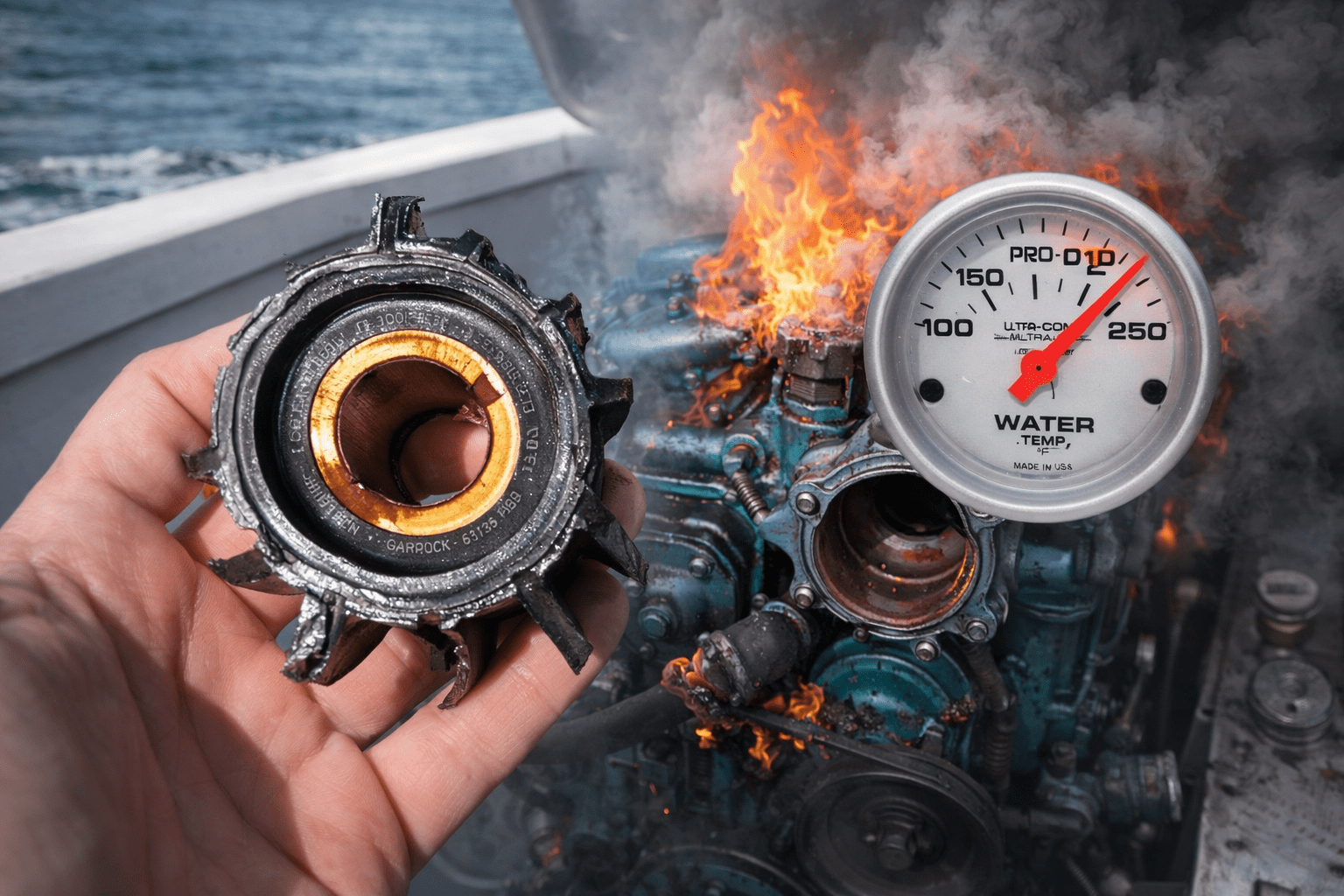
Marine diesel seawater pump corrosion failure comparison showing new vs damaged pump causing engine overheating diagnosed by 805 Marine Diesel Mechanic Ventura Channel Islands Harbor

Fuel System Diagnostics Overview

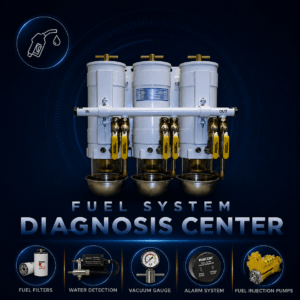
Fuel system problems are among the most common causes of hard starting, shutdowns, surging, low power, smoke complaints, and loss of RPM. In many cases, the issue is not the injection pump or injector set. The issue is upstream. Dirty diesel, microbial growth, water intrusion, restricted pickup tubes, collapsing hoses, clogged Racor elements, tank vent restrictions, lift pump weakness, or suction-side air leaks can all create symptoms that mimic more expensive failures.

That is why professional marine diesel diagnosis usually starts with fuel supply quality, fuel delivery stability, and fuel restriction checks before moving deeper into high-pressure components. A clean, consistent fuel supply is the foundation of combustion. When it is unstable, the engine cannot perform correctly no matter how healthy the rest of the system may be. This is also why many problems that appear to be injector or turbo-related are actually traced back to the fuel system during proper testing.

Common Fuel-Related Symptoms

Fuel system issues often overlap with air and turbo-related problems, which is why it is important to compare symptoms carefully before replacing parts. Many low-power and smoke complaints are caused by restriction or contamination rather than major component failure. A direct comparison between these systems can be found in the Fuel Restriction vs Air Restriction Diagnosis Guide.

For deeper fuel-side troubleshooting, use the following diagnostic resources:

Air Intake and Turbo Overview

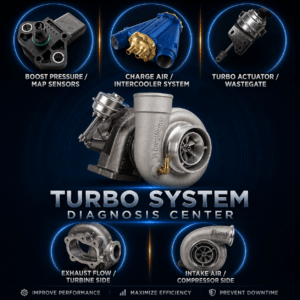
Air-side problems are frequently overlooked because many owners naturally suspect fuel first. That makes sense, but restricted intake flow, turbocharger performance loss, leaking boost plumbing, clogged air filters, aftercooler fouling, and exhaust-side issues can all affect combustion quality and power output. In a turbocharged marine diesel, air delivery is just as important as fuel delivery. The engine must receive the right air mass at the right time or it will smoke, run hot, and fail to produce rated power. Many of these issues are properly diagnosed through the Marine Diesel Turbo System Diagnosis Center, especially when boost performance is in question.

Black smoke under load is one of the classic symptoms that brings the air side into focus. So does a boat that feels sluggish, cannot reach expected RPM, or seems to work harder than normal to stay on plane. These symptoms often overlap with Engine struggling to reach rated RPM, where airflow restriction, turbo inefficiency, or boost leaks prevent the engine from reaching proper performance.

But air-side issues do not always show up as a simple black-smoke complaint. Sometimes the first sign is higher exhaust temperature, rising coolant temperature under load, or a gradual loss of efficiency. In many cases, these symptoms are misdiagnosed as fuel-related problems, which is why comparing both systems is critical. A clear breakdown of these overlapping symptoms can be found in the Fuel Restriction vs Air Restriction Diagnosis Guide.

Common Air and Turbo-Related Symptoms

These pages support deeper air-side and power-loss diagnosis:

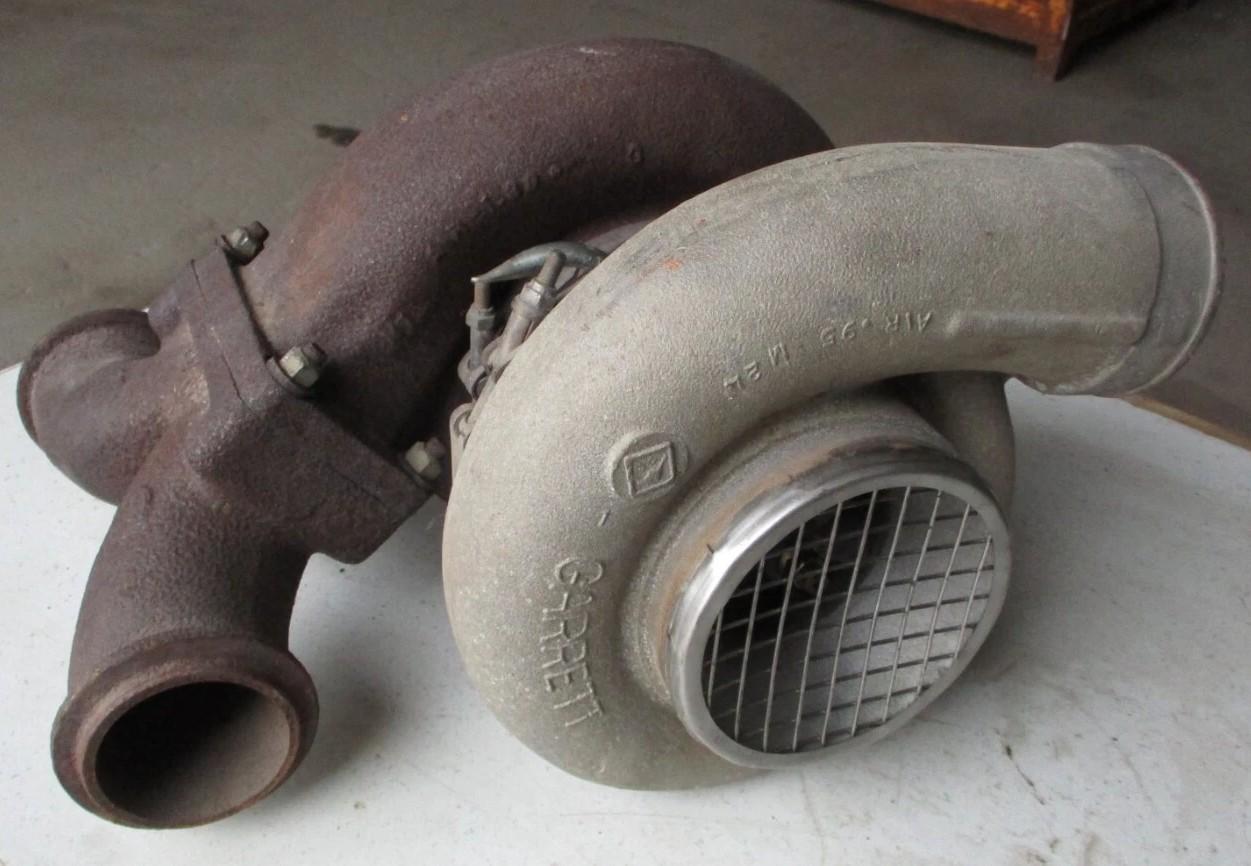
Detroit Diesel 8V92 marine turbocharger close-up showing compressor and turbine housing used for diagnosing low boost and power loss

Cooling System Diagnostics Overview

Marine diesel engines do not use automotive-style radiator systems. They rely on raw water and heat exchanger systems, often with additional components such as aftercoolers, oil coolers, transmission coolers, seawater pumps, thermostats, expansion tanks, and coolant circuits that all need to work together. When even one part of that system becomes restricted, worn, corroded, scaled, or partially blocked, engine temperatures can rise fast under load. These issues are most effectively diagnosed using the Marine Diesel Cooling System Diagnosis Center, where each component is tested in sequence.

Overheating at idle and overheating at cruise are not the same diagnostic event. A boat that overheats only at higher RPM may point toward raw water volume loss, restricted exchangers, slipping belts, failing impellers, marine growth, or excessive load. A boat that overheats even at lower RPM may point toward more severe flow restriction, thermostat issues, coolant-side problems, or broader system neglect. That is why the exact operating condition matters, especially when comparing symptoms within the cooling system.

Cooling issues can also overlap with Engine not reaching full RPM, as well as combustion-related symptoms like black smoke under load. Higher engine temperature affects combustion efficiency, oil condition, component life, and long-term reliability. It is one of the fastest ways for a manageable service issue to become a larger failure.

Common Cooling System Symptoms

For deeper cooling system troubleshooting, use the following diagnostic resources:

Book Cooling System Inspection

Electrical and Starting Diagnostics Overview

Electrical and starting faults are often blamed on the starter motor when the actual root cause is somewhere else in the circuit. Battery condition, cable resistance, loose grounds, corroded terminals, solenoid function, charging performance, key switch issues, relay faults, harness degradation, and control system problems can all create hard starting or no-start complaints. Some of these failures are constant. Others appear only when hot, only under vibration, or only after sitting.

Professional diagnosis here means checking voltage drop, cranking speed, connection integrity, battery condition under load, charging output, and system behavior under real operating conditions. Guessing at starters and alternators without testing often wastes time and money.

Use this related page for deeper support:

Smoke and Combustion Diagnostics Overview

Exhaust smoke is one of the most useful visual clues in marine diesel diagnosis, but only when it is interpreted correctly. Black smoke usually points toward incomplete combustion caused by fuel-air imbalance, overload, or restricted airflow. White smoke often points toward unburned fuel, poor atomization, cold combustion conditions, timing-related concerns, or in some cases coolant intrusion. Blue smoke typically points toward oil burning, though the exact cause can vary from turbo seal problems to ring wear, valve guide issues, breather problems, or oil control concerns.

The key is not just the color. It is when the smoke occurs, how long it lasts, how heavy it is, what the engine is doing at the time, and what other symptoms exist alongside it. That is why smoke should always be diagnosed in context, not in isolation.

Mechanical Failure Diagnostics Overview

Not every marine diesel complaint is a fuel or air issue. Mechanical problems such as compression loss, valve train issues, injector sealing faults, exhaust restriction, bearing wear, coupling misalignment, driveline faults, internal engine wear, and abnormal combustion events can all show up through sound, vibration, smoke, or poor running quality. This is where experience matters most because many mechanical issues produce symptoms that overlap with more common service items.

That is why deeper mechanical diagnosis should usually come after the basic fuel, air, cooling, and electrical fundamentals are confirmed. Once those are ruled out properly, the next steps become much clearer and much more defensible.

Fast Symptom Index

Use this quick symptom index to jump toward the most likely diagnostic path:

Later sections of this page expand these symptom paths in more detail, with FAQ support and stronger cross-linking into the rest of your diagnostic content.

Related Marine Diesel Diagnostic Guides

Mobile Marine Diesel Service Areas

805 Marine Diesel Mechanic provides mobile marine diesel diagnostic and repair support for inboard engines in Santa Barbara, Ventura, Oxnard, and Channel Islands Harbor. We work with boat and yacht owners who need a systematic approach to marine diesel problems rather than guess-based part swapping. Whether you are dealing with a no-start condition, chronic overheating, black smoke under load, shutdowns underway, or low power at cruise, the right testing sequence saves time and helps protect the engine from secondary damage.

Our work commonly includes cooling system service, aftercooler and heat exchanger evaluation, oil cooler and seawater system inspection, fuel contamination diagnosis, filter and restriction testing, hose and fitting replacement, electrical and starting diagnostics, survey-related engine assessment, and deeper marine diesel troubleshooting for older and newer inboard platforms.

Marine diesel engine diagnostic inspection onboard yacht showing inboard engine, cooling system components, and technician performing troubleshooting

When to Call a Trained Technician

Some marine diesel issues can be narrowed down with careful observation, filter checks, fluid inspections, alarm history, and symptom tracking. But once the engine shows persistent smoke, repeated shutdowns, major power loss, overheat trends, abnormal vibration, charging instability, or signs of contamination across multiple systems, professional testing becomes the safer move. That is especially true when the boat is relied on for offshore use, longer runs, or regular seasonal operation.

The goal is not just to make the symptom disappear for one trip. The goal is to identify the real root cause, confirm supporting data, and make the next repair step count.

Contact 805 Marine Diesel Mechanic for Advanced Troubleshooting


No-Start Diagnostics: When the Engine Will Not Fire

A true no-start condition means the engine either does not crank at all, cranks too slowly to start, or cranks normally but never begins combustion. These are three different problems, and separating them immediately saves time. Many boat owners describe all three as “it won’t start,” but the next test depends on which version is happening. For a full breakdown of this process, see Boat Engine Won’t Start Diagnosis.

If the engine does not crank, the first path is electrical. Check battery switch position, battery voltage, main cable condition, fuse protection, neutral safety function if equipped, starter relay behavior, and ground integrity. If the engine cranks slowly, focus on battery health under load, cable resistance, starter draw, connection corrosion, and voltage drop across both positive and negative paths. This type of testing is covered in the Electrical & Starting System Diagnosis Center.

If the engine cranks at normal speed but does not fire, the path usually shifts toward fuel delivery, air intrusion, shutdown circuits, glow or preheat support on cold starts, and combustion-related concerns. Many no-start conditions that appear electrical are actually fuel-related, especially after filter service, fuel contamination events, or long storage periods.

The biggest mistake in no-start diagnosis is replacing parts before confirming the basics. A starter may be blamed when the true issue is cable resistance. Injectors may be blamed when the real issue is suction-side air leak, empty secondary filter housing, or shutdown solenoid failure. On inboard marine diesel engines, storage time, moisture, salt exposure, and maintenance history all matter. Many of these overlapping symptoms are also seen in hard starting conditions, where the engine eventually starts but underlying issues are already present.

Start by answering these questions:

On many boats, the real answer is found in the first few minutes of organized inspection. A loose ground, corroded battery lug, failed lift pump, blocked pickup, or stuck shutdown device can imitate far more serious engine trouble. This is why structured marine diesel troubleshooting matters. The engine should not be judged until supply, support, and control systems are verified first.

Book No-Start Diagnostic Service

Marine diesel no-start diagnostic image showing battery cables starter motor and electrical connections inspected by 805 Marine Diesel Mechanic on inboard diesel boat engine

No Crank Path

If the starter never engages, begin with battery switch position, battery charge state, visible cable condition, and any inline or main fuse protection. Then move to the control side: key switch output, start relay activation, neutral safety status if equipped, and solenoid trigger signal. Saltwater environments are hard on terminals, lugs, grounds, and harness junctions. A circuit that worked last season may now fail under load because of hidden corrosion under insulation or at a lug interface. For a full electrical breakdown, see the Electrical & Starting System Diagnosis Center.

Common no-crank causes include:

Slow Crank Path

Slow cranking usually means the engine is not seeing enough available voltage and current at the starter under load. Battery age matters, but cable quality matters just as much. Voltage-drop testing across both positive and negative sides of the circuit is one of the fastest ways to identify hidden resistance. Marine starting circuits often fail at the cable ends long before the cable jacket looks obviously damaged from the outside.

Slow cranking can also create false secondary symptoms. The engine may smoke white during crank, fail to catch cleanly, or appear to have injector or compression trouble when the real problem is simply insufficient cranking speed. That is why starting RPM matters. Diesel combustion depends on cranking speed and heat generation as much as fuel presence. This overlap is commonly seen in white smoke at startup conditions, where combustion is incomplete during initial firing.

Cranks But Will Not Fire

If the engine spins normally but never starts, fuel delivery and support systems move to the top of the list. Check filter fill, recent service history, fuel shutoff function, tank level accuracy, vent restrictions, air leaks, priming success, and whether the complaint began after fuel filter replacement or running in rough water. Air intrusion on the suction side can leave the engine cranking with no stable combustion even though batteries and starter are healthy. This is one of the most common paths into the Diesel fuel troubleshooting

Cold-start support should also be considered where applicable. Some engines are very sensitive to glow plug or intake preheat performance when ambient temperatures drop or after longer sit periods. At the same time, it is important not to jump too quickly toward injectors or internal engine damage until supply-side basics are proven first.

Hard-Start Diagnostics: Long Crank, Uneven Fire, Delayed Start

Hard starting is one of the most useful early-warning symptoms in marine diesel troubleshooting because it often appears before a full no-start. Owners may notice that the engine still starts every time, but it takes longer, smokes more, shakes on initial fire, or needs repeated attempts. That change matters. The engine is telling you a support system has weakened. For a deeper breakdown, see the Hard Starting Marine Diesel Diagnosis Guide.

Hard starting is commonly linked to fuel drain-back, air in fuel, weak lift pump performance, partial restriction, poor atomization, glow system issues on cold starts, declining battery performance, or lower combustion efficiency from wear or compression-related factors. The key is to determine whether the symptom is worse cold, hot, after sitting, after recent service, or after fueling.

If hard starting is accompanied by white smoke at startup, that often points toward incomplete combustion during initial firing. That can happen when cranking speed is marginal, fuel atomization is poor, cylinders are cold, preheat performance is weak, or compression is lower than ideal. If hard starting is worse after the engine sits for days, fuel drain-back and air leaks move higher on the suspect list. These overlapping symptoms are often confirmed through both the fuel system and electrical system during proper testing.

A useful question here is whether the symptom is consistent. A consistent long crank every cold start often points in one direction. A random hard start after fueling or after rough water may point in another. Pattern matters.

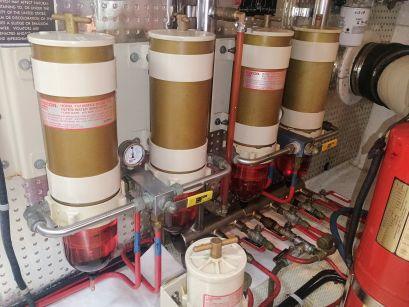
Dual Racor fuel filters on marine diesel engine showing primary and secondary filtration system for diagnosing fuel restriction and hard starting

Engine Starts Then Dies or Shuts Down Underway

An engine that starts and then dies, or one that shuts down underway, is one of the highest-priority symptoms on the page because it can become a safety issue fast. These failures are often intermittent at first, which makes them frustrating and easy to misdiagnose. The engine may restart after sitting. It may fail only at higher RPM. It may die when the sea state gets rough. It may run perfectly in the slip and fail under load outside the harbor. Those details matter. For a focused breakdown, see Boat Engine Shutting Down While Running.

The most common paths include unstable fuel supply, vent restriction, pickup blockage, contaminated fuel, suction-side air leaks, failing lift pump, thermal electrical interruption, shutdown circuit problems, and heat-related component failures. Protection systems may also be involved if the engine is actually overheating or losing oil pressure, though those conditions need to be confirmed rather than assumed. In many cases, these failures trace back to the fuel system or an intermittent issue within the electrical system.

An engine that dies after 10 to 30 minutes of running often points toward a different diagnostic path than one that dies immediately. Time-to-failure is useful data. So is whether the engine surges or loses RPM before shutdown, or whether it cuts abruptly as if electrical power was removed. If the engine shows signs of power loss before shutdown, it is often tied to Engine struggling to reach rated RPM which should be evaluated together rather than separately.

Questions to Ask with Shutdown Complaints

Low Power and Loss of RPM Diagnostics

Low power is one of the most commonly misdiagnosed marine diesel complaints because the symptom can come from far more than the engine alone. The engine may be healthy and still fail to reach expected RPM because of prop load, fouled hull condition, driveline drag, restricted fuel delivery, air restriction, turbo inefficiency, cooling system distress, or inaccurate instrumentation. That is why low power must be approached as a complete propulsion-system diagnosis rather than a narrow engine guess.

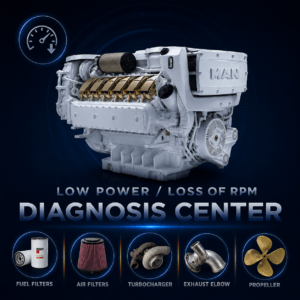
Start by confirming the complaint. Is the engine losing 100 RPM or 500 RPM? Does the problem appear only fully loaded, only after warming up, or all the time? Is there smoke? Does boost feel delayed? Has the bottom been cleaned? Was a propeller changed? Was the problem gradual or sudden? Many of these issues are covered in the Low Power / Loss of RPM Diagnostics Center, where propulsion, fuel, and air systems are evaluated together.

Low power often overlaps with black smoke under load, elevated temperature, and air restriction complaints. A turbocharged engine that cannot get enough clean air will often smoke under load. A fuel-restricted engine may flatten out at higher RPM and feel starved. A boat with driveline or hull loading issues may make the engine appear weak even though the problem is outside the combustion system. In many cases, comparing symptoms using the Fuel Restriction vs Air Restriction Diagnosis Guide helps isolate the root cause faster.

Schedule Low Power Diagnostic Service

Common Low-Power Causes

Low power marine diesel diagnostic image showing turbocharger fuel filters and engine room inspection by 805 Marine Diesel Mechanic for loss of RPM under load

Fuel Restriction vs Air Restriction

This is one of the most important diagnostic splits on the entire page. Fuel restriction and air restriction can create similar complaints: low power, sluggish acceleration, smoke, and inability to reach full RPM. But the way the engine behaves often gives clues. Fuel restriction may present as flattening out, surging, or starving under sustained load. Air restriction often shows more obvious black smoke and a heavier overloaded feel when throttle is applied. Neither pattern is absolute, which is why both must be tested rather than guessed.

That is why this page repeatedly points back to your dedicated comparison content. It is one of the most useful educational pieces for owners and one of the best conversion paths for real diagnostic work. Read the full breakdown here: Fuel Restriction vs Air Restriction Diagnosis. This comparison is especially important when working through Engine struggling to reach rated RPM where both systems must be evaluated together.

Overheating Diagnostics: Idle, Cruise, and Full-Load Temperature Problems

Overheating is one of the most serious marine diesel complaints because it can escalate from a service issue to component damage quickly. Unlike many automotive systems, marine diesel cooling depends on multiple exchangers, raw water flow, belt-driven pumps, hose integrity, coolant condition, zinc maintenance, and often aftercooler performance as part of the same operating environment. A partial restriction in one place can affect the entire thermal balance of the engine. These systems are best evaluated using the Marine Diesel Cooling System Diagnosis Center.

The first thing to establish is when the overheat happens. Does it overheat only at cruise? Only at wide-open throttle? At idle in the harbor? After a long run? Right after impeller service? At the same RPM every time? Overheating under load often points toward raw water volume loss, exchanger restriction, marine growth, slipping belts, impeller vane loss, clogged coolers, or load issues. Overheating even at lighter RPM may push thermostats, coolant-side problems, major restriction, or circulation problems higher on the list.

Marine diesel engines also suffer from deferred cooling maintenance. Heat exchangers, aftercoolers, seawater pumps, oil coolers, and hoses age internally even when they still look acceptable from the outside. Salt, scale, zinc debris, old impeller fragments, and corrosion products can move through the system and create repeat failures if the whole system is not evaluated together. These issues frequently overlap with Engine struggling to reach rated RPM especially when the engine is operating under load.

Book Overheating Diagnostic Service

Common Overheating Causes

Marine diesel seawater pump impeller destroyed causing overheating diagnosed by trained technician at 805 Marine Diesel Mechanic Ventura Channel Islands Harbor

Overheating at Idle

Idle overheating often points toward restricted flow, circulation issues, or broader cooling imbalance rather than simple high-load demand. A boat that overheats slowly while idling in the slip may be dealing with raw water feed problems, thermostat behavior, poor coolant circulation, debris in exchangers, or lingering air in the system after service. If overheating happens only at idle but not on plane, that pattern should be noted because it steers the next tests. A deeper breakdown of this pattern can be found in Boat Engine Overheating at Idle.

Overheating Under Load

This is one of the most common real-world complaints. The engine runs acceptably at low RPM, but the temperature climbs as load increases. That usually moves raw water delivery, exchanger efficiency, turbo and aftercooler cleanliness, belt performance, and hull or prop demand to the front of the line. On many boats, the engine is not technically “bad” at all. It is simply being asked to work harder than the cooling system can currently support. These symptoms often overlap with low power and loss of RPM conditions, especially when load increases.

Fuel Contamination and Filtration Problems

Contaminated diesel fuel can produce an incredible range of symptoms, from hard starting and shutdowns to low power, smoking, repeated filter clogging, and injector wear over time. Water intrusion, microbial growth, tank sludge, rust, sediment, and unstable fuel quality all create restriction and supply problems that the engine feels immediately. Rough water can worsen the complaint by stirring contamination that had settled lower in the tank.

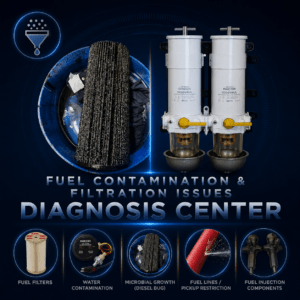
One of the strongest clues is repeated filter loading. If primary or secondary filters continue to clog, the engine is usually reacting to a fuel quality problem upstream, not simply a bad filter choice. In those situations, swapping filters without evaluating tank condition and fuel cleanliness only delays the real fix. These conditions are best diagnosed through the Fuel Contamination & Filtration Issues Center, where tank condition and fuel quality are evaluated together.

Fuel contamination symptoms often overlap with general supply-side issues, which is why they are frequently confirmed through the Fuel delivery Issues before moving deeper into injection components.

Schedule Fuel Contamination Inspection

Signs of Contamination-Related Trouble

Fuel contamination diagnostic image showing Racor bowl diesel filtration manifold and signs of water or debris inspected by 805 Marine Diesel Mechanic

Air in Fuel System Diagnostics

Air intrusion on the suction side is one of the most common hidden causes of hard starting, stalling, rough idle after service, and random shutdown behavior. The problem may come from hose fittings, filter seals, loose drain fittings, cracked hoses, pickup tube issues, poorly seated O-rings, or any point where the system can pull air without always leaking fuel externally. That is what makes it tricky. The line may not drip diesel, but it can still draw air under suction. These issues are commonly diagnosed through the Fuel system issues center

Engines affected by air intrusion often start harder after sitting, may require re-priming, or may run acceptably until bubbles accumulate enough to disrupt stable combustion. Sometimes the clue is visible in a clear section of line where equipped. Other times the evidence is indirect: empty or partially empty filter housings, delayed fire after service, or an engine that runs well only after extended manual priming. These symptoms are frequently associated with hard starting conditions.

This type of complaint is common after maintenance because even a small issue with filter installation can create a major symptom. That is why “the problem started after I changed the filters” is one of the most useful things a boat owner can say. A direct comparison of restriction vs air intrusion can be found in the Fuel Restriction vs Air Restriction Diagnosis Guide.

Engine Surging and Unstable Cruise RPM

Marine diesel surging can feel like the engine is repeatedly gaining and losing fuel, struggling to hold steady load, or hunting at cruise RPM. This complaint is often connected to restriction, air intrusion, unstable supply pressure, contamination, or control-related issues depending on engine type. Sometimes surging is more obvious in a narrow RPM band, which can help isolate whether the issue is load-related or present across the full range. For a deeper breakdown, see Marine Engine Surging at Cruise RPM.

A boat that surges only at cruise but not at idle or only after warming up gives better diagnostic clues than a boat described simply as “running rough.” That is one reason the guide keeps returning to operating condition. Marine engines behave differently under dockside testing than they do pushing a hull through water under real load. These symptoms often overlap with low power and RPM loss conditions.

Rough Idle and Uneven Running

Rough idle on an inboard marine diesel can come from fuel quality issues, injector imbalance, air in fuel, low compression on one or more cylinders, poor mount condition, timing-related concerns, cold combustion factors, or electrical support issues on electronically controlled platforms. The important thing is to separate true combustion unevenness from vibration transmitted through mounts, shaft alignment, or driveline components.

If the engine smooths out completely as RPM rises, the diagnostic path may differ from an engine that remains rough across the range. If rough idle is paired with white smoke, hard start, or shutdown complaints, combustion quality and fuel supply move higher on the list. If rough idle is paired with abnormal vibration but no smoke, mount, alignment, coupling, and driveline contributors should not be ignored. These conditions are often linked back to white smoke at startup or broader fuel system instability.

Black Smoke Diagnostics: Too Much Fuel, Not Enough Clean Air, or Too Much Load

Black smoke is one of the clearest visible signs that a marine diesel engine is not burning fuel efficiently under the conditions being asked of it. In simple terms, black smoke usually means the engine is getting more fuel than the available clean air can support, or it is being loaded hard enough that combustion quality falls away. That can happen because of air restriction, turbocharger inefficiency, boost leaks, aftercooler fouling, exhaust restriction, over fueling, prop overload, dirty running gear, or fuel system issues that are affecting spray and burn quality.

The key is context. A quick puff of darker smoke during hard throttle application is not the same as sustained black smoke at cruise. A boat that smokes black only when fully loaded with fuel, gear, and passengers may point toward load demand. A boat that suddenly begins smoking black at the same RPM it used to handle cleanly suggests a system change that deserves testing. For a full breakdown, see Yacht Engine Black Smoke Under Load.

These symptoms frequently overlap with low power conditions and are often clarified by comparing airflow vs fuel supply using the Fuel Restriction vs Air Restriction Diagnosis Guide. In many cases, deeper inspection through the Turbo System Diagnosis Center is required when airflow is suspected.

Common Black Smoke Causes

Black smoke should never be dismissed as normal just because the engine still “runs.” Heavy black smoke means the engine is operating inefficiently, often hotter than it should, and under conditions that can shorten component life. It is also one of the clearest reasons to evaluate both engine health and vessel load condition together rather than separately.

Marine diesel black smoke diagnosis under load showing exhaust observation and turbo air system inspection by 805 Marine Diesel Mechanic in Ventura Harbor

White Smoke Diagnostics: Unburned Fuel, Cold Combustion, Timing, or Internal Concerns

White smoke can mean several different things, and the timing of the smoke is what helps separate them. White smoke at a cold start that clears as the engine warms may point toward incomplete combustion during initial firing. That can be influenced by low cylinder temperature, weak preheat support where equipped, marginal cranking speed, fuel atomization issues, compression-related concerns, or injector problems. A detailed breakdown of this condition can be found in Marine Engine White Smoke at Startup Diagnosis.

White smoke that persists hot, especially under load, deserves more serious attention because it may point toward ongoing combustion inefficiency, timing-related issues, or coolant intrusion depending on the exact engine and symptom pattern. When white smoke is paired with rough idle or long crank conditions, it is often related to hard starting and poor combustion quality rather than immediate internal failure.

One of the biggest mistakes owners make is assuming all white smoke means “water” or “head gasket.” Sometimes it does not. On many marine diesels, persistent white smoke is more directly related to unburned fuel than coolant, especially when accompanied by rough idle, hard starting, or cold-combustion complaints. But that is exactly why proper diagnosis matters. The smoke color is only the starting point, not the final answer. When internal damage is suspected, further inspection may lead into mechanical failure diagnostics, but only after supply and combustion basics are verified first.

Questions That Matter with White Smoke

Azimut yacht producing white smoke at startup during marine diesel diagnosis by 805 Marine Diesel Mechanic in Ventura California

Blue Smoke Diagnostics: Oil Burning, Turbo Seals, Wear, or Breather Problems

Blue smoke usually points toward engine oil entering the combustion process or exhaust path, but the reason that oil is getting there can vary a lot. Turbocharger seal issues, worn rings, cylinder wear, valve guide concerns, crankcase ventilation problems, overfilled oil level, and some long-idle operating patterns can all contribute. Like the other smoke colors, timing matters. Blue smoke at startup may mean something different from blue smoke under sustained load or during long idle periods. A full breakdown of these patterns can be found in Boat Engine Blowing Blue Smoke.

On turbocharged engines, turbo seal issues should always be considered if blue smoke appears along with oil consumption changes, loss of boost, or oil residue on the air side or exhaust side. These conditions are often evaluated through the Turbo System Diagnosis Center, especially when airflow and oil carryover overlap.

But again, that is only one path. A full diagnosis should look at overall engine behavior, crankcase condition, breather performance, and whether the symptom is changing over time. If oil consumption increases or the symptom worsens under load, further inspection may lead into mechanical failure diagnostics after confirming that turbo and breather systems are functioning correctly.

Grand Banks yacht producing blue smoke while running during marine diesel diagnosis by 805 Marine Diesel Mechanic in Ventura California

Turbocharger and Air System Diagnostics

The turbocharger and air system play a major role in power, combustion quality, smoke control, and overall engine efficiency. When the turbo does not spool correctly, when boost leaks out of the system, or when the intake path is restricted, the engine often responds with sluggish acceleration, black smoke, elevated temperatures, and inability to reach full RPM. On some boats the complaint feels like “the engine just doesn’t pull anymore.” On others it appears as delayed throttle response, smoke under load, or rising temperature once the vessel is pushed hard. A full evaluation of these conditions is covered in the Marine Diesel Turbo System Diagnosis Center.

A proper air-side inspection should include the air filter and intake path, turbocharger visual condition, compressor and turbine-side observations where accessible, boost plumbing, clamps, aftercooler condition, and overall cleanliness of the charge-air path. Oil residue, soot patterns, loose clamps, damaged hoses, and salt-related corrosion all tell part of the story. So does the engine’s actual running behavior under load. Many of these symptoms overlap with black smoke under load conditions, where airflow and fuel balance must be evaluated together.

Because air-side and fuel-side issues can present similarly, it is important to compare both systems rather than assume one path. A direct comparison can be made using the Fuel Restriction vs Air Restriction Diagnosis Guide. These symptoms are also commonly tied into low power and loss of RPM complaints, especially when boost performance is reduced.

Common Turbo and Air-Side Signs

Marine diesel turbocharger showing exhaust housing and charge air piping inspected by trained technician at 805 Marine Diesel Mechanic Ventura Channel Islands Harbor

Why Aftercoolers Matter in Marine Diesel Diagnosis

Aftercoolers are often overlooked by owners because they are out of sight and not as familiar as filters, belts, or pumps. But on many marine diesel engines they are critical to keeping intake air density and combustion quality where it needs to be. A fouled or restricted aftercooler can contribute to smoke, power loss, and elevated thermal stress, especially under load. In saltwater service, aftercooler maintenance matters more than many owners realize.

When a vessel shows a combination of low power, black smoke, and higher-than-normal load temperature, the aftercooler should never be ignored in the diagnostic picture. These symptoms are commonly tied into air and turbo system performance, where airflow restriction and charge-air cooling efficiency must be evaluated together.

Electrical, Starting, and Charging System Diagnostics

Electrical faults on marine diesel engines do not always present as a clean no-start. Sometimes they appear as intermittent cranking weakness, hot-start trouble, low charging output, unexplained alarm behavior, shutdowns, gauge irregularities, or electronics that reset during starting. In boats, cable length, terminal exposure, vibration, moisture, and salt all increase the chance of voltage loss and connection degradation over time.

Good electrical diagnosis is not guessing. It means checking battery state, charging output, cable integrity, ground path quality, terminal cleanliness, fuse and relay function, harness condition, and voltage-drop performance while the system is actually working. A battery can look acceptable at rest and still fail badly under load. A cable can look fine externally and still lose critical voltage across hidden corrosion at the lug or inside the crimp. For a deeper brand-specific example, see Perkins Electrical & Starting System Diagnosis.

Many of these symptoms overlap with hard starting conditions, especially when battery performance and cranking speed begin to decline.

Schedule Electrical Diagnostic Service

Common Electrical and Charging Complaints

Charging System Faults

Charging faults deserve special attention because they can quietly create many other symptoms. A weak alternator, poor belt drive, failing regulator, or high-resistance connection may leave the battery bank undercharged. That can then show up later as hard starting, slow crank, false sensor behavior, or control instability. On some boats, the charging issue is misread as a starter problem because the real failure only becomes obvious after repeated use and partial battery depletion.

Look for signs such as belt dust, pulley wobble, output inconsistency, hot cable connections, battery smell, unexplained low-voltage alarms, and repeated need for external charging. These clues often show up before total failure.

Knocking, Ticking, and Unusual Engine Noise

Abnormal engine noise should never be ignored, especially when it is new, getting worse, or paired with smoke, vibration, or power loss. Knocking, ticking, tapping, rattling, or heavier combustion noise can come from very different sources. Some are external and manageable, such as loose brackets, pulley issues, belt-driven accessories, or driveline-related contact. Others point toward valve train issues, injector timing or combustion problems, exhaust leaks, internal wear, or more serious mechanical distress.

The most important first step is to define the noise. Is it tied to engine RPM or vessel speed? Is it stronger cold or hot? Does it change under load? Does it appear only in gear? Does it come with smoke or power loss? A knock that increases under load may lead the diagnosis differently than a light tick only heard at idle with the engine compartment open. For deeper analysis, see Why Does My Boat Engine Knock or Make Ticking Noise?.

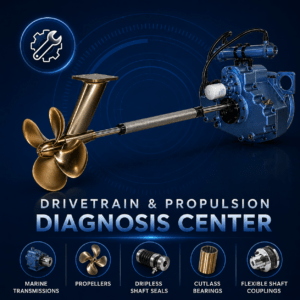
Noise complaints often overlap with broader system issues, including mechanical failure diagnostics and drivetrain and propulsion diagnostics, especially when vibration or load-related factors are involved.

Do not assume all ticking means internal failure. Exhaust leaks, injector line noise, accessory-driven issues, and mount-related resonance can create deceptive sounds. But do not dismiss it either. New noise is diagnostic information.

Marine transmission gears and drivetrain components causing clunk when shifting into gear diagnosed by trained technician at 805 Marine Diesel Mechanic Ventura Channel Islands Harbor

Excessive Vibration

Excessive vibration can come from the engine, the driveline, or the interaction between them. Misalignment, worn engine mounts, damaged couplings, shaft issues, propeller damage, prop load imbalance, and uneven combustion can all create vibration complaints. That is why vibration must be diagnosed as a propulsion-system problem, not simply an engine problem. A deeper breakdown of these patterns can be found in Why Does My Boat Engine Vibrate Excessively?.

If vibration changes noticeably in and out of gear, with RPM, or with vessel speed, that pattern matters. A vibration that shows up only at a narrow RPM band may point toward resonance or alignment-related conditions. A vibration that grows steadily with engine speed may lead elsewhere. If the complaint is accompanied by knocking, hard shifting, driveline noise, or recent propeller work, those details should move up the list immediately.

Because vibration is often tied to multiple systems, it is commonly evaluated through both drivetrain and propulsion diagnostics and mechanical failure diagnostics, especially when load and alignment factors are involved.

Marine diesel vibration diagnostic image showing engine mounts shaft coupling and drivetrain inspection by 805 Marine Diesel Mechanic on inboard boat

Advanced Marine Diesel Diagnostic Surveys

Some problems cannot be solved responsibly through quick observation alone. When symptoms overlap, when the history is unclear, when a purchase survey needs deeper engine support, or when the owner wants defensible data before major repair decisions, advanced marine diesel diagnostics become the right step. This is especially true on higher-value vessels, electronically influenced engines, chronic low-power complaints, repeat overheating cases, or smoke issues that have already resisted basic service attempts.

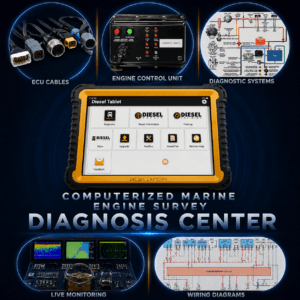
Advanced diagnostic work can include deeper operating observations, system testing, cooling component evaluation, fuel restriction analysis, electrical performance checks, combustion symptom interpretation, and broader engine-room condition review. For buyers and owners, this kind of testing helps separate cosmetic reassurance from real mechanical confidence. A full breakdown of this process can be found in Professional Computerized Diagnostic Surveys.

For a deeper look at how these inspections are performed in real-world conditions, see Computerized Marine Engine Survey Diagnostics Center, along with example surveys such as Cummins 6CTA8.3 Marine Engine Survey and Caterpillar C7 Marine Engine Survey.

Request Advanced Diagnostic Survey Service

When Advanced Diagnostics Are Recommended

Advanced marine diesel diagnostic survey image showing 805 Marine Diesel Mechanic performing onboard engine testing and condition evaluation for yacht owner

Why Maintenance History Changes the Diagnostic Path

No symptom exists in a vacuum. The service history behind the engine changes how the complaint should be interpreted. An overheating complaint on an engine with neglected exchanger service, old hoses, and unknown impeller history is not the same as the same complaint on an engine with recent full cooling service. A hard-start complaint right after filter changes points in a different direction than one that developed gradually over six months. A smoke complaint after long layup is not the same as one that appeared immediately after a fueling event.

That is why strong troubleshooting always asks what work was done recently, what maintenance is overdue, what changed first, and whether the symptom followed fuel, service, storage, or load changes. In real marine service, history shortens diagnosis. Preventative practices such as fresh water flushing and following a structured marine diesel maintenance schedule can significantly reduce the likelihood of recurring failures.

For a full structured approach to symptom-based troubleshooting, refer back to the Master Marine Diesel Troubleshooting Guide, where all major systems are evaluated in a logical diagnostic sequence.

Brands and Inboard Diesel Platforms Commonly Supported

This troubleshooting guide is written around real inboard marine diesel service conditions and is useful across many common propulsion platforms. While each engine family has its own details, the major diagnostic logic remains similar: verify fuel quality and delivery, confirm air and turbo health, inspect cooling performance, check electrical support, interpret smoke correctly, and only move into deeper mechanical suspicion after the fundamentals are proven.

Typical brands include Caterpillar, Cummins, Volvo Penta, Yanmar, Perkins, John Deere, Detroit Diesel, Lugger, MAN, MTU, Beta Marine, FPT, Scania, Ford Lehman, and Vetus. While each platform differs in configuration and controls, the symptom-first diagnostic process remains highly effective across all inboard diesel applications.

Adding a few relevant authority references helps reinforce trust on a master diagnostic page. These resources provide additional background on marine diesel engines, systems, and maintenance:

Need Help Finding the Real Cause?

Marine diesel problems rarely get cheaper by waiting, especially when the symptom already includes overheating, shutdowns, heavy smoke, unstable starting, or progressive power loss. The most efficient next step is usually not replacing parts at random. It is confirming the cause in a logical order so the first repair has a real chance of solving the problem.

805 Marine Diesel Mechanic provides mobile inboard marine diesel diagnostic service in Santa Barbara, Ventura, Oxnard, and Channel Islands Harbor. That includes troubleshooting for fuel delivery problems, low power, smoke diagnosis, cooling system issues, electrical and starting faults, advanced survey-related engine assessment, and broader symptom-based troubleshooting when more than one issue may be involved.

Schedule Marine Diesel Diagnostic Service

Marine Diesel Troubleshooting FAQ

These frequently asked questions help boat and yacht owners understand common marine diesel engine problems before scheduling professional diagnostic service in Ventura, Santa Barbara, Oxnard, or Channel Islands Harbor.

What causes a marine diesel engine not to start?

Common causes include weak batteries, slow cranking, fuel restriction, or shutdown circuit faults. Start with fundamentals before replacing parts. Use the Electrical & Starting System Diagnosis Center to begin proper testing.

Why does my boat engine crank but not fire?

This usually points to fuel delivery issues, air intrusion, or shutdown faults. If filters were recently changed, check for air leaks. Follow the process in the Hard Starting Diagnosis Guide.

What causes hard starting on a marine diesel engine?

Hard starting is often caused by fuel drain-back, air in fuel, weak cranking speed, or injector spray issues. It is an early warning sign of system imbalance. See White Smoke at Startup Diagnosis if smoke is present.

Why does my marine diesel engine start and then die?

This typically indicates unstable fuel supply, clogged filters, tank vent restriction, or suction-side air leaks. It is one of the most common service calls. Review Engine Shutting Down While Running.

What causes low power or loss of RPM in a boat engine?

Low power is usually caused by fuel restriction, air restriction, turbo issues, or excessive load. Always confirm basics first. Start here: Low Power Diagnostics Center.

How do I tell the difference between fuel restriction and air restriction?

Fuel restriction causes starving and RPM loss, while air restriction often produces black smoke. Because symptoms overlap, both must be tested. Use this guide: Fuel vs Air Restriction Diagnosis.

What causes black smoke from a marine diesel engine?

Black smoke means too much fuel or not enough air. Common causes include turbo issues, dirty filters, or overload. Learn more here: Black Smoke Under Load Guide.

What causes white smoke at startup on a marine diesel engine?

White smoke often indicates unburned fuel, cold combustion, or injector issues. It is especially common during cold starts. Full breakdown: White Smoke Diagnosis.

What causes blue smoke from a boat engine?

Blue smoke indicates oil burning, often from turbo seals, rings, or valve guides. This requires deeper inspection. See Blue Smoke Diagnosis Guide.

Why does my marine diesel engine overheat at cruise RPM?

Overheating under load usually means reduced raw water flow or restricted coolers. Always inspect impellers and exchangers first. Start here: Cooling System Diagnosis Center.

Why does my marine diesel engine overheat at idle?

Idle overheating suggests circulation issues, thermostat problems, or internal restriction. It differs from load-based overheating. See Cooling Diagnostics.

What are the signs of fuel contamination in a boat?

Signs include clogged filters, shutdowns, cloudy fuel, and loss of RPM. Rough water often triggers symptoms. Full guide: Fuel Contamination Center.

What causes air in a marine diesel fuel system?

Air intrusion comes from loose fittings, cracked hoses, or poor filter seals. It causes hard starting and stalling. Use Fuel System Diagnosis Center for testing.

Why does my marine diesel engine surge at cruise RPM?

Surging usually indicates unstable fuel supply, restriction, or air intrusion. It often occurs at a specific RPM range. See Surging Diagnosis Guide.

What causes rough idle on a marine diesel engine?

Rough idle can be caused by injector imbalance, fuel quality issues, or air intrusion. It often improves with RPM. Learn more at Rough Idle Diagnosis Guide.

What are the symptoms of turbocharger problems on a marine diesel engine?

Turbo problems cause black smoke, low RPM, and sluggish acceleration. Boost leaks and fouling are common causes. Full guide: Turbo Diagnosis Center.

Why is my boat engine knocking or making ticking noise?

Knocking can come from injectors, valvetrain, or driveline issues. Always identify when and where it occurs. See Knocking Diagnosis Guide.

What causes excessive vibration in a boat engine?

Vibration may be caused by alignment issues, mounts, or prop imbalance. It should be treated as a full propulsion system issue. See Vibration Diagnosis Guide.

When should I call a trained marine diesel technician?

If symptoms persist such as smoke, overheating, shutdowns, or power loss, professional diagnostics are recommended. Schedule service here: Contact 805 Marine Diesel Mechanic.

What is the best way to troubleshoot a marine diesel engine?

The best method is symptom-based testing in a logical order. Avoid guessing and replacing parts blindly. Use the full Master Troubleshooting Guide to follow a structured diagnostic path.

Troubleshooting Quick Links

If the interactive diagram is difficult to use on your device, use these direct links instead:


Built from over 30 years of real-world marine diesel diagnostic experience.