
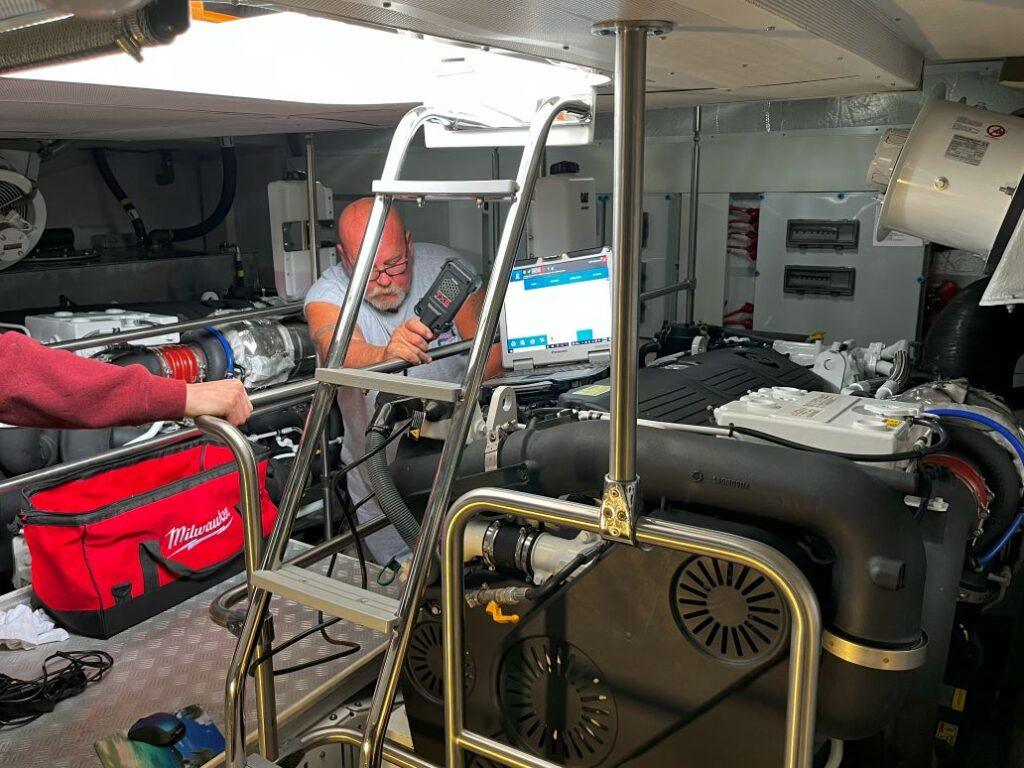
Few things get a boater’s attention faster than a marine diesel engine that cranks too long, starts rough, smokes after startup, or loses power while cruising toward the Channel Islands. Before assuming the engine is worn out, start with the Master Marine Diesel Troubleshooting Guide to separate fuel restriction, air intrusion, cooling-system weakness, turbocharger lag, exhaust backpressure, electrical faults, and true internal engine problems.
At 805 Marine Diesel Mechanic, we diagnose hard-starting and power-loss complaints throughout Santa Barbara, Ventura, Oxnard, and Channel Islands Harbor using a system-based process. A diesel engine needs clean fuel, air, compression, cooling, exhaust flow, and correct load. If one system is weak, the symptom may look like engine failure even when the root cause is a clogged filter, air leak, weak lift pump, fouled heat exchanger, or failing sensor.
For buyers, sellers, and owners who want a deeper baseline before repairs, the required orphan link for this post fits naturally here: a marine engine survey can document fuel, cooling, exhaust, electrical, and operating-condition problems before they become expensive surprises.
Why Marine Diesels Become Hard to Start
Hard starting is one of the earliest signs that a diesel engine is not receiving the right combination of fuel pressure, air, compression, heat, and cranking speed. The problem may be obvious, such as a clogged Racor, or hidden, such as a small air leak at a filter head that drains fuel back to the tank overnight.
In the 805 coastal region, hard-starting complaints are commonly connected to hard starting cold vs warm diagnosis, marine diesel cranks but won’t start, engine turns over but no smoke from exhaust, and no start after fuel filter change.
- Long cranking before firing
- White smoke during start attempts
- No smoke while cranking
- Engine starts then dies
- Rough idle after startup
- Hard restart after sitting overnight
Fuel Contamination and Clogged Filters
Fuel contamination is one of the most common hard-starting and power-loss causes around Santa Barbara, Ventura, and Channel Islands Harbor. Boats that sit for long periods develop condensation, water, microbial growth, and tank sludge. Once the vessel runs in rough water, that debris can move into the pickup tube and filters.
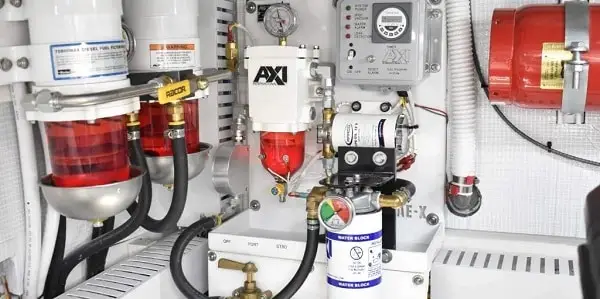
A restricted fuel system can cause extended crank time, smoke after startup, low RPM under load, and shutdowns during acceleration. Before replacing injectors or turbochargers, compare symptoms with Fuel System Diagnosis Center, marine diesel fuel contamination, diesel algae contamination, and Racor filter troubleshooting.
- Clogged primary fuel filters
- Water in Racor bowls
- Dark sludge or microbial growth
- Collapsed fuel hoses
- Restricted pickup tubes
- Weak lift pump delivery
For better prevention, owners should also review Racor fuel filters, choosing your yacht fuel filtration, and marine diesel fuel system problems.
Air Leaks in the Fuel System
A diesel engine can have clean fuel and still fail to start if air enters the system. Air leaks often occur at filter seals, fittings, hoses, lift pump connections, or return plumbing. These leaks may be small enough that fuel does not visibly drip, yet large enough to allow fuel drain-back after shutdown.
Air intrusion usually creates long cranking, rough startup, or an engine that starts and dies. After filter replacement, improper priming can make the same problem worse. Useful related pages include how to prime a marine diesel fuel system, fuel system losing prime, and engine starts then dies.
- Fuel drains back after sitting
- Engine needs repeated priming
- Starts briefly, then shuts off
- Runs rough after filter service
- Clear fuel line shows bubbles
Weak Glow Plug or Preheat Systems
Not every marine diesel uses glow plugs, but smaller engines commonly rely on preheat systems for cold starting. A weak glow plug circuit can create extended cranking, rough startup, white smoke, and uneven combustion until the engine warms.
Cold morning starts in Ventura, Santa Barbara, and Channel Islands Harbor can expose weak preheat systems quickly. A technician should verify battery voltage, relay output, bus bar condition, plug resistance, wiring condition, and correct preheat timing before condemning injectors or compression.
Preheat faults often overlap with white smoke at startup, marine diesel smoke after startup, and Yanmar marine diesel FAQ questions on smaller auxiliary engines.
Injector and High-Pressure Pump Problems
Injectors and fuel pumps can cause hard starting when they cannot deliver the correct pressure, timing, or spray pattern. Mechanical systems may suffer from worn injectors, weak lift-pump supply, pump wear, or rack problems. Electronic common-rail systems may show low rail pressure, failed sensors, or control faults.
Poor injector spray can cause white smoke, rough idle, fuel knock, low power, and excess fuel consumption. Before replacing injectors, the technician should confirm clean fuel supply, filter condition, air-free delivery, compression, and cranking speed.
- Low rail pressure during cranking
- Sticking or worn injectors
- Weak mechanical injection pump output
- Fuel return leakage
- Uneven cylinder contribution
If the engine also smokes or lacks power, compare symptoms with marine diesel smoke diagnosis, blue smoke causes, and black smoke under load.
Why Marine Diesels Lose Power Under Load
Loss of power under load almost always points toward a restriction, missing air, weak fuel delivery, excessive exhaust backpressure, overheating, turbocharger lag, or incorrect propeller load. An engine may sound fine at the dock and still fail under real sea trial conditions.
Local boats often report power loss while running toward Anacapa, Santa Cruz Island, Santa Rosa Island, or returning through afternoon wind and swell. These complaints should be compared with marine diesel low power and loss of RPM diagnosis, loss of power under load, and marine diesel won’t reach full RPM.
- Fuel restriction under high demand
- Air intake restriction
- Turbocharger lag or boost leak
- Cooling system derate
- Exhaust backpressure
- Propeller overload
- Sensor fault or electronic derate
Turbocharger Lag, Boost Loss, and Air Restriction
Marine diesels need clean airflow and proper boost to make rated power. If the turbocharger sticks, lags, leaks oil, or cannot build pressure, the vessel may feel heavy, slow, smoky, and unable to reach cruise RPM.
Turbo issues should be tested instead of guessed. A technician should inspect air filters, turbo shaft play, charge-air hoses, aftercoolers, exhaust leaks, wastegate function, and boost pressure under load. Useful references include turbo lag and slow spool-up, boost pressure testing, turbocharger failure symptoms, and fuel restriction vs air restriction diagnosis.
Cooling System Blockages and Engine Derate
Cooling problems often create power-loss complaints because engines may derate, run hotter, smoke, or lose efficiency when cooling margin disappears. Around the Channel Islands, kelp, sand, scale, impeller fragments, and marine growth can reduce raw-water flow.
A proper cooling diagnosis includes sea strainer inspection, raw-water pump testing, impeller inspection, heat exchanger temperature comparison, aftercooler inspection, and exhaust water discharge checks. Related pages include Cooling System Diagnosis Center, raw water flow problems, heat exchanger clogging symptoms, and seawater pump failure and impeller damage.
If cooling problems appear only at cruise, review overheating at idle vs cruise and overheating under load but not at idle.
Exhaust Restriction and Backpressure
Wet exhaust hoses, mixing elbows, mufflers, and risers can restrict flow over time. Carbon buildup, internal corrosion, delaminated hose, and poor water injection can all increase backpressure. When exhaust cannot leave the engine efficiently, power drops and exhaust temperature rises.
Exhaust restriction can look like fuel restriction or turbocharger failure. The boat may make black smoke, struggle to reach RPM, or feel sluggish during acceleration. Related guides include marine diesel exhaust backpressure problems, high exhaust temperature, and Detroit Diesel 8V53T exhaust restoration project.
Sensor Faults and Electronic Control Problems
Modern diesel engines use sensors to control fuel, boost, rail pressure, temperature, timing, and protection modes. A failing MAP sensor, MAF sensor, rail pressure sensor, cam sensor, crank sensor, or coolant temperature sensor can create hard starts or power loss.
Electronic faults should be evaluated with scan tools, live data, voltage testing, and visual inspection of connectors. Salt air corrosion can create intermittent faults that appear only under vibration or heat. Related diagnostics include electrical and starting system diagnosis, computerized marine engine survey diagnostics, and Glendinning electronic propulsion controls when control systems are involved.
Propeller Load, Bottom Growth, and Drivetrain Issues
Not every power-loss complaint is engine related. A fouled bottom, oversized propeller, damaged prop, tight shaft bearing, poor alignment, or transmission issue can overload the engine and prevent rated RPM.
Drivetrain and load checks are especially important when the engine smokes, reaches lower RPM than normal, or feels heavy after haul-out, prop work, or long slip time. Related pages include engine overload and propeller overload diagnosis, excessive engine vibration, vibration under load, and clunk when shifting into gear.
Our Diagnostic Process
805 Marine Diesel Mechanic uses a step-by-step process so repairs are based on evidence instead of guesswork. The goal is to confirm whether the problem is fuel, air, compression, cooling, exhaust, load, electronics, or mechanical condition.
- Interview owner and document operating symptoms
- Inspect fuel quality, filters, bowls, and restriction
- Check fuel pressure, priming, and air intrusion
- Test battery voltage and cranking speed
- Inspect intake, turbocharger, aftercooler, and boost response
- Evaluate cooling flow, heat exchangers, raw-water pump, and exhaust temperature
- Check exhaust backpressure and mixing elbow condition
- Scan electronic engines for codes and live data
- Perform sea trial testing under load when appropriate
For older engines or purchase decisions, this diagnostic process can be combined with marine engine survey documentation, repower vs rebuild planning, and signs your marine diesel engine is beyond rebuild.
Serving Santa Barbara, Ventura, Oxnard, and Channel Islands Harbor
We provide mobile diesel diagnostics across Santa Barbara Harbor, Ventura Harbor, Oxnard, and Channel Islands Harbor for sportfishers, sailboats, trawlers, commercial boats, and cruising yachts. Whether you run a Perkins, Yanmar, Volvo Penta, Caterpillar, Cummins, MAN, MTU, Lugger, Detroit Diesel, or Vetus, the diagnostic logic remains the same: prove the system before replacing parts.
For brand and project references, see Perkins marine diesel service, Yanmar marine diesel service, Yanmar marine diesel FAQ, Lugger L4105 and L6105 benefits, Vetus M3.29 with SP60 saildrive, and Rolls-Royce MTU 2000 fuel cell system.
External Authority Resources
Caterpillar Marine Engines |
Cummins Marine Engines
Hard-Starting & Power-Loss Marine Diesel FAQ
1. Why does my marine diesel crank but not start?
2. Why does my marine diesel take so long to start?
3. Why does my diesel start and then die?
4. Can clogged fuel filters cause power loss?
5. Can contaminated fuel cause hard starting?
6. Why does my diesel lose power only under load?
7. Can turbo problems cause slow acceleration?
8. Can cooling problems reduce engine power?
9. Can exhaust backpressure cause RPM loss?
10. Why does my engine smoke after startup?
11. Can a weak battery cause hard starting?
12. Can sensors cause a diesel to lose power?
13. Why does my boat not reach full RPM?
14. Can propeller load mimic engine trouble?
15. Should I get a marine engine survey?
16. How do technicians diagnose hard starting?
17. How do technicians diagnose power loss?
18. When should I stop running the engine?
19. Can regular maintenance prevent these issues?
20. What is the best first step for diagnosis?
805 Marine Diesel Mechanic provides hard-starting diagnosis, power-loss troubleshooting, fuel system testing, cooling system diagnostics, boost checks, exhaust restriction inspection, marine engine surveys, and mobile diesel service throughout Santa Barbara, Ventura, Oxnard, and Channel Islands Harbor.
2 Responses