
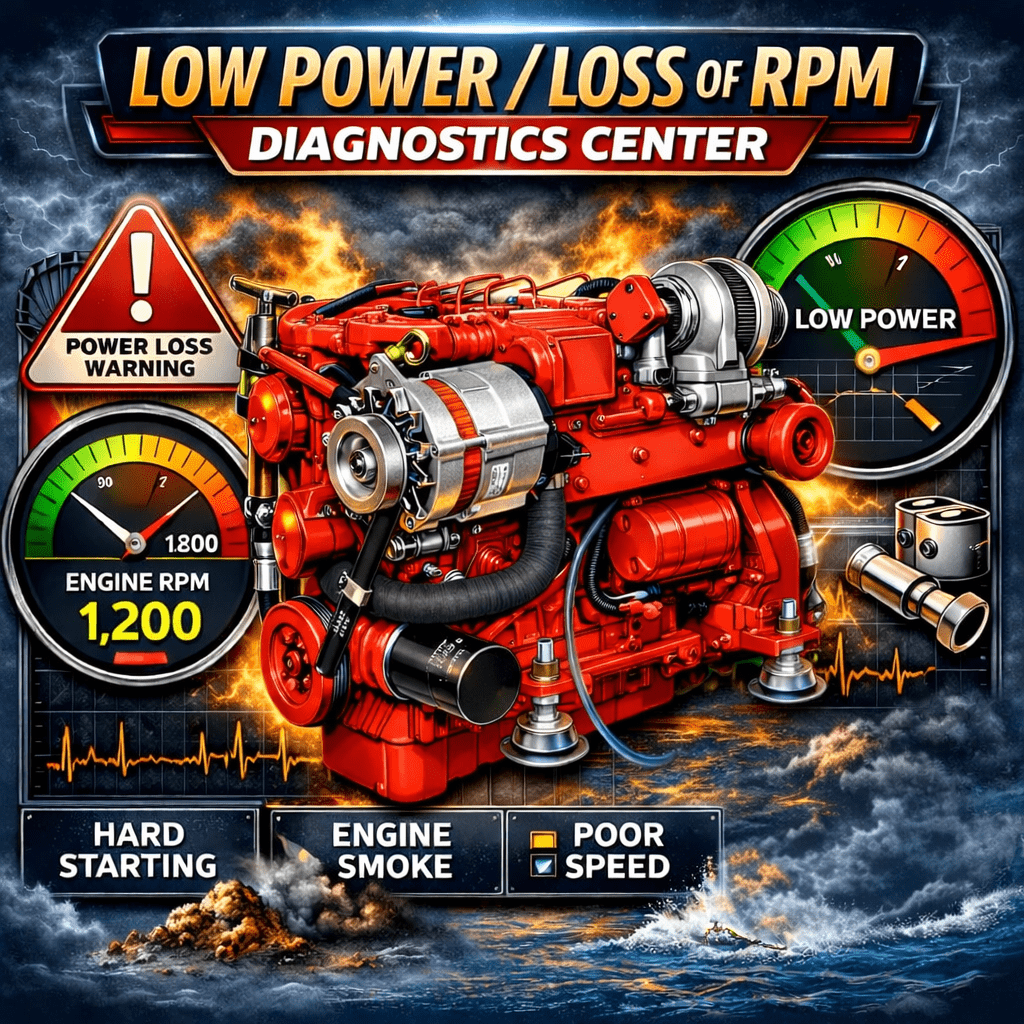
Low Power / Loss of RPM Diagnostics Center
A marine diesel engine that cannot reach rated RPM or feels sluggish under load is almost always being limited by one system. Fuel, air, cooling, exhaust, and mechanical load all contribute to total engine output. When one of these systems falls behind, the engine cannot produce full power.
At 805 Marine Diesel Mechanic, serving Ventura, Oxnard, Channel Islands Harbor, and Santa Barbara, low power diagnosis is performed using system-based logic built on over 30 years of real-world experience. Before replacing parts, symptoms should be mapped through the Master Marine Diesel Troubleshooting Guide to identify which system is actually limiting performance.
Why Low Power Is Never Just One Problem
Low power is a system imbalance, not a single failure. Fuel delivery, airflow, cooling efficiency, exhaust flow, and mechanical load all interact. When one falls behind, the entire system loses efficiency.
This is why engines that cannot achieve full RPM should always be compared with not reaching full RPM, where restriction or load—not engine damage—is usually the cause.
Similarly, engines that struggle under load often match loss of power under load, where demand exposes system limitations.
Fuel System Limitation — The Most Common Cause
Fuel restriction is the most common reason engines lose power. Even minor restriction reduces fuel delivery under load.
Diagnosis always begins at the Fuel System Diagnosis Center, where supply, filtration, and air intrusion are verified.
Fuel issues often overlap with fuel contamination problems, where debris and water reduce system performance.
Engines may also show symptoms similar to engine starts then dies when supply becomes unstable.
Airflow & Turbocharger Performance
Airflow determines how efficiently fuel burns. Turbochargers compress air to increase power output.
Low boost conditions must be verified through boost pressure testing and compared against the Turbo System Diagnosis Center.
Airflow issues often create black smoke under load, which should be analyzed using the Smoke & Combustion Center.
Aftercooler restriction frequently aligns with aftercooler problems, where intake temperature rises and reduces efficiency.
Cooling System Influence on Power
Cooling efficiency directly affects combustion. When temperature rises, power drops.
This is why performance issues should always be cross-checked with the Cooling System Diagnosis Center, especially when overheating and power loss appear together.
Cooling problems may also create instability similar to surging at cruise RPM.
Exhaust Backpressure
Restricted exhaust limits engine breathing. Mixing elbows and risers often accumulate buildup.
This can mimic whining under load and reduce turbo efficiency.
Mechanical Load & Hull Resistance
Propeller damage, fouling, and drivetrain issues can prevent engines from reaching RPM.
These issues often overlap with excessive vibration and should be ruled out before internal engine diagnosis.
Injector & Combustion Efficiency
Injectors control fuel delivery precision. Wear or contamination reduces efficiency.
This aligns with injector damage patterns where contamination affects combustion.
Advanced Diagnostics
Modern engines require live data diagnostics to confirm performance.
Advanced testing through the Computerized Diagnostics Center reveals which system is limiting output.
Local Low Power Specialists
805 Marine Diesel Mechanic provides mobile diagnostics throughout Ventura, Oxnard, Channel Islands Harbor, and Santa Barbara, using real-world testing and system-based logic.
FAQ
1. What causes low power in marine diesel engines?
Fuel restriction, airflow limitation, cooling inefficiency, or mechanical load are the most common causes.
2. Why can’t my engine reach full RPM?
This aligns with not reaching full RPM, often caused by restriction or load.
3. Can fuel restriction reduce power?
Yes, even minor restriction limits output under load.
4. Can turbo problems cause power loss?
Yes, low boost reduces efficiency.
5. Why do I see black smoke?
Incomplete combustion due to imbalance.
6. Can cooling issues reduce power?
Yes, overheating reduces combustion efficiency.
7. What is exhaust restriction?
Backpressure limiting airflow.
8. Can propeller issues cause RPM loss?
Yes, increased load reduces achievable RPM.
9. Can injectors affect performance?
Yes, poor atomization reduces efficiency.
10. Why does my engine hesitate?
Often fuel or airflow limitation.
11. Can fuel contamination cause power loss?
Yes, it disrupts combustion.
12. Can aftercoolers affect power?
Yes, they control intake temperature.
13. What is boost testing?
Measuring turbo pressure output.
14. Can overheating cause shutdown?
Yes, thermal protection may activate.
15. Can electrical issues affect power?
Yes, sensor errors can mislead diagnostics.
16. Should I test before replacing parts?
Always confirm the root cause.
17. Can multiple issues happen at once?
Yes, often systems overlap.
18. Who should diagnose?
A trained marine diesel technician.
19. Where should I start?
Start with the Master Guide.
20. What is the fastest way to diagnose?
Use system-based diagnostics and live data testing.
31 Responses