
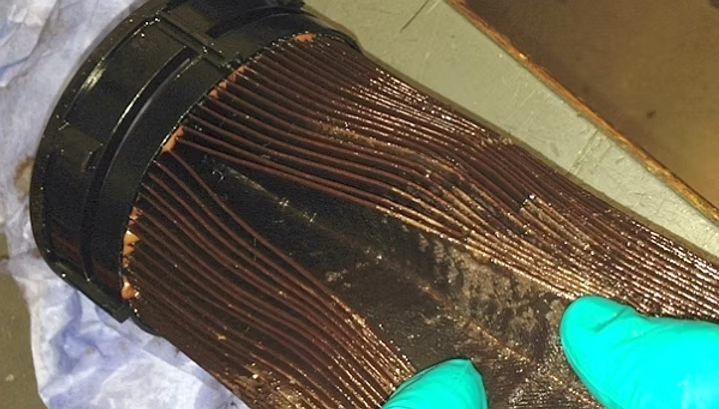
Extremely clogged Racor fuel water separator filter from a Channel Islands Harbor diesel boat showing heavy sludge and fuel contamination.
Fuel contamination is one of the most common causes of marine diesel engine failure in Santa Barbara, Ventura, Oxnard, and Channel Islands Harbor. Before assuming the problem is injectors, turbochargers, sensors, or engine wear, start with the Master Marine Diesel Troubleshooting Guide to determine whether your symptoms are caused by contaminated fuel, clogged filters, air intrusion, or actual mechanical failure.
Warm water, humid marine air, seasonal use, and long idle periods at the slip create ideal conditions for water buildup and microbial growth inside diesel tanks. This is why local boats often develop symptoms tied to diesel algae contamination, marine diesel fuel contamination, fuel contamination and filtration issues, and Racor filter restriction.
Why Fuel Contamination Is Worse in Warm Coastal Harbors
Boats in Santa Barbara and Ventura operate in a climate where fuel tanks are exposed to temperature swings, marine-layer moisture, and long periods of inactivity. Every temperature cycle can create condensation inside the tank. Once water settles below the fuel, microbial growth can form at the fuel/water interface.
Southern California boats that sit for weeks between trips are especially vulnerable. The problem is not just age; newer boats can develop contamination if fuel turnover is low and tanks are not inspected. This is why routine maintenance planning, like the service approach outlined in Boat Maintenance Made Easy With Santa Barbara’s Expert Mechanics, is directly tied to fuel system reliability.
- Warm harbor conditions accelerate biological growth inside tanks.
- Humidity and marine layer increase condensation risk.
- Low fuel turnover allows sludge and water to settle.
- Older tanks may contain rust, scale, or legacy debris.
- Infrequent operation allows contamination to concentrate at the tank bottom.
How Microbial Contamination Forms Inside Diesel Tanks
Microbial contamination, often called diesel bug, forms when water is present in the tank. Microbes feed on diesel hydrocarbons and create dark sludge that clogs filters, coats bowls, restricts fuel lines, and eventually starves the engine under load.
Early contamination may only show as small dark particles in the Racor bowl. Moderate contamination can create intermittent power loss during throttle-up. Severe contamination can clog new filters rapidly, cause the engine to stall offshore, or prevent restart after filter service.
- Stage 1 — Mild contamination: small dark residue in bowls or filters.
- Stage 2 — Moderate contamination: filter restriction under load or throttle-up.
- Stage 3 — Severe contamination: engine shutdown, repeated filter clogging, or no-start.
These stages often connect with symptoms described in Racor fuel filter upgrades, Detroit Diesel fuel contamination and filtration failures, and Caterpillar marine diesel low power and RPM loss.
Symptoms of Diesel Fuel Contamination
Fuel contamination usually appears when fuel demand increases. An engine may start and idle normally, then lose power when the throttles are advanced. This makes contamination easy to confuse with turbo lag, propeller overload, or injector problems.
- Loss of power when throttling up
- Rough running under load
- Surging or RPM fluctuation
- Dark, cloudy, or layered fuel in Racor bowls
- Multiple filter changes in a short period
- Engine shutting down offshore
- No-start after fuel filter service
- Hard starting after sitting
When the engine loses power, compare symptoms with marine diesel low power and loss of RPM diagnosis, loss of power under load, surging at cruise RPM, and marine diesel won’t reach full RPM.
Why Santa Barbara, Ventura, and Channel Islands Boats Need More Frequent Fuel Checks
Fuel systems in warm coastal harbors should be checked more often than boats in colder climates. Local boats may sit unused during weather windows, then run hard to the Channel Islands. That combination allows contamination to form slowly and then surface suddenly under heavy load.
High-risk boats include vessels with older fuel tanks, infrequent use, poor fuel turnover, warm engine rooms, or a history of repeat filter changes. Boats that run offshore should not wait for symptoms before inspecting filters, bowls, and tank samples.
- Boats that sit at the slip for long periods
- Older tanks with unknown internal condition
- Low-turnover marina fuel sources
- Warm, humid engine rooms
- Vessels with repeated filter restriction
- Boats preparing for longer Channel Islands runs
Fuel contamination may also show up during startup and smoke diagnosis. If you see smoke after sitting, rough start-up, or delayed combustion, compare findings with marine diesel smoke after startup, white smoke at startup, and marine diesel smoke diagnosis.
How We Diagnose Fuel Contamination
A proper fuel contamination diagnosis should confirm both the contamination level and the reason it occurred. Replacing filters without checking the tank often creates a temporary fix that fails again under load.
- Sample fuel from multiple tank levels
- Inspect Racor bowls and secondary filters
- Check for water separation, sludge, and dark residue
- Measure fuel restriction with vacuum gauges
- Inspect fuel hoses, valves, and pickup tubes
- Check lift pump pressure and delivery stability
- Verify injector performance if contamination reached the engine
If the engine will not start after a filter change, use no-start after fuel filter change diagnosis and how to prime a marine diesel fuel system. If the engine cranks but produces no smoke, review engine turns over but no smoke from exhaust and marine diesel cranks but won’t start.
Key Considerations for Your Fuel Filtration System
Choosing the correct fuel filtration setup matters just as much as cleaning the tank. In warm harbor conditions, properly sized Racor-style systems, vacuum monitoring, and clean manifold routing can be the difference between a safe trip and a shutdown offshore.
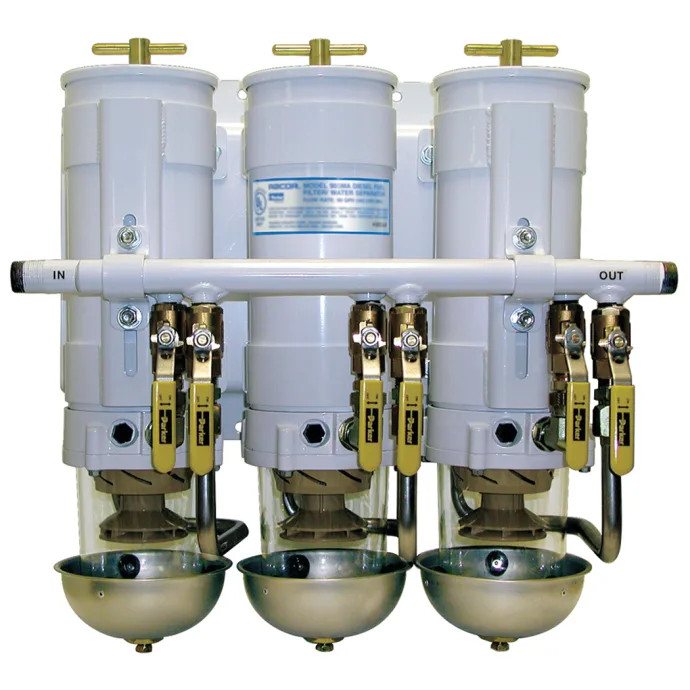
Replacement Racor turbine series fuel/water separator element used for marine diesel contamination control.
Flow Rate
The filtration system must meet or exceed engine fuel flow requirements. Undersized filters can create restriction under load, even when the fuel is clean. Larger engines, generators, and twin-engine vessels often need higher-capacity primary filters.
Micron Rating
Micron rating must match the engine’s filtration strategy. A filter that is too fine at the primary stage may plug quickly, while one that is too coarse may allow debris forward. Modern common-rail engines are especially sensitive to fine contamination.
Monitoring
Vacuum gauges and clear bowls allow early detection of restriction or water. A rising vacuum reading shows the filter is loading before the engine loses power. Monitoring turns filter service into planned maintenance instead of an emergency.
For system planning, compare options with Racor fuel filters, choosing your yacht fuel filtration, and marine diesel fuel system problems.
Preventing Fuel Contamination in Southern California
Prevention is far less expensive than injector damage, injection pump repair, or offshore towing. The best prevention plan combines clean fuel, tank monitoring, filter inspection, water removal, and regular operation.
- Inspect the fuel system at least once or twice per year
- Keep tanks at least 70 percent full when practical
- Drain water from Racor bowls regularly
- Use high-turnover fuel docks when possible
- Replace filters before heavy use periods
- Inspect tank vents, fills, and seals
- Plan fuel polishing when contamination is confirmed
Fuel health should also be reviewed during broader engine maintenance. That includes checking cooling system condition, raw water flow, heat exchanger clogging, and fresh water flushing because fuel and cooling problems often appear together on neglected boats.
When Fuel Contamination Becomes a Safety Problem
Fuel contamination becomes a safety issue when it causes unstable running, shutdowns offshore, or repeated inability to restart. A boat that runs fine at the dock can still be unsafe if the filters load up under throttle during a Channel Islands crossing.
If symptoms include smoke, rough running, overheating, or power loss, the technician should also compare findings with black smoke under load, blue smoke causes, high exhaust temperature, and boost pressure testing.
Serving Santa Barbara, Ventura, Oxnard, and Channel Islands Harbor
805 Marine Diesel Mechanic provides local fuel contamination inspections, Racor service, filter upgrades, tank sampling, fuel polishing recommendations, and complete fuel system troubleshooting throughout Santa Barbara, Ventura, Oxnard, and Channel Islands Harbor.
We also support brand-specific fuel system and maintenance planning for Perkins marine diesel service, Yanmar marine diesel service, Yanmar marine diesel FAQ, and Caterpillar marine diesel fuel system problems.
External Authority Resources
Parker Racor Marine Filtration |
Fleetguard Filtration
Fuel Contamination in Warm Coastal Harbors — FAQ
1. Why is fuel contamination common in Santa Barbara and Ventura?
2. What is diesel bug?
3. What are the first signs of fuel contamination?
4. Can contaminated fuel cause loss of power?
5. Can contaminated fuel cause smoke after startup?
6. How often should I inspect my fuel system?
7. Do newer boats get fuel contamination?
8. Can Racor filters prevent fuel contamination?
9. What does a clogged Racor filter look like?
10. Can fuel polishing fix contamination?
11. Should I keep my fuel tanks full?
12. What happens if water reaches the injectors?
13. Can fuel contamination cause a no-start?
14. Can fuel contamination damage the lift pump?
15. What micron filter should I use?
16. Can fuel contamination mimic turbo problems?
17. Why do filters clog after a rough crossing?
18. When should I call a technician?
19. Can fuel contamination return after service?
20. What is the best prevention plan?
805 Marine Diesel Mechanic provides fuel contamination inspection, Racor filter service, diesel algae troubleshooting, fuel system diagnosis, and mobile marine diesel service throughout Ventura, Oxnard, Channel Islands Harbor, and Santa Barbara.
2 Responses