
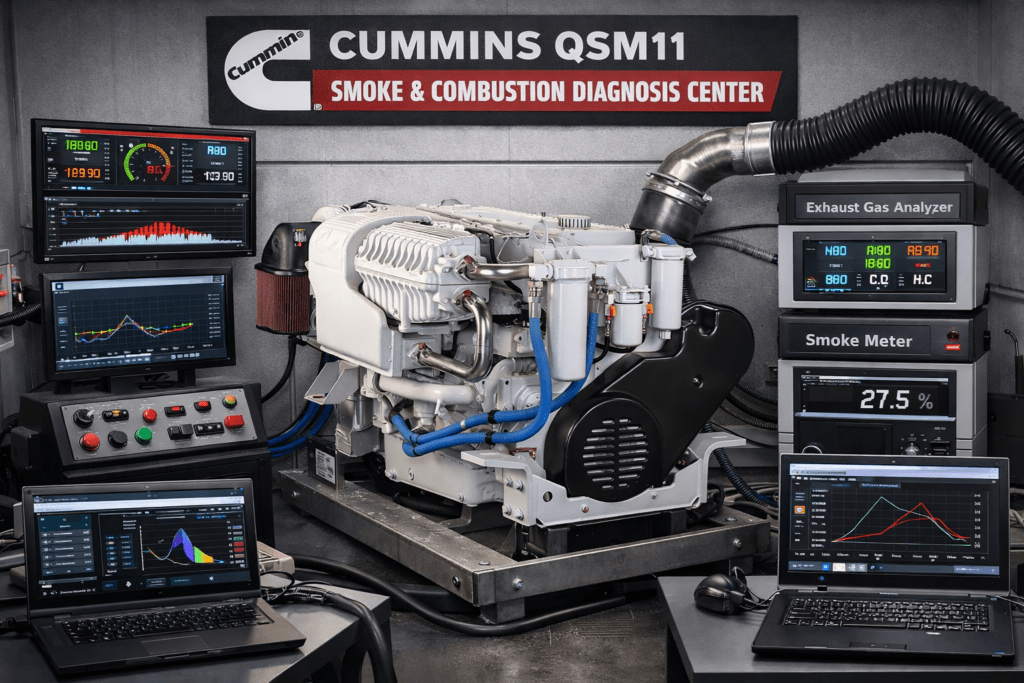
Smoke from a Cummins QSM11 is one of the most useful diagnostic clues you can get because black smoke, white smoke, and blue smoke each point toward a different type of combustion problem. This guide explains how to diagnose QSM11 smoke correctly by separating fuel-system faults, turbocharger airflow problems, oil-burning issues, cooling-related combustion imbalance, and internal mechanical wear before the wrong parts get replaced.
Cummins QSM11 Marine Diesel Smoke & Combustion Problems: Complete Diagnosis Guide
The Cummins QSM11 marine diesel engine is widely used in larger yachts, sportfishing boats, commercial vessels, and high-performance cruisers because it delivers excellent torque and dependable power. When combustion efficiency starts to decline, however, the engine usually gives clear warning signs. Smoke appears, throttle response changes, power falls off, or the engine begins behaving differently under load. That is why smoke should never be treated as just an annoyance. On a QSM11, it is one of the best early warning signals that the engine is moving away from balanced combustion.
Smoke diagnosis matters because different smoke colors point toward different systems. Black smoke usually means too much fuel or not enough air. White smoke usually means unburned fuel or poor combustion quality. Blue smoke usually means oil is being burned. Those sound simple, but in real marine diesel diagnosis each of those categories still has multiple possible causes. That is why the color, timing, load condition, and engine behavior all have to be evaluated together.
At 805 Marine Diesel Mechanic, Cummins QSM11 smoke and combustion problems are diagnosed throughout Ventura, Oxnard, Channel Islands Harbor, and Santa Barbara. With over 30 years of marine diesel experience, the focus is on analyzing fuel delivery, air supply, injector performance, turbocharger behavior, and compression quality as one complete system. This page expands from your Master Marine Diesel Troubleshooting Guide and fits directly into your broader diagnostic authority structure.
Understanding Marine Diesel Exhaust Smoke
Diesel exhaust smoke appears when the air-fuel mixture inside the combustion chamber does not burn correctly. Modern Cummins engines like the QSM11 are designed to run with minimal visible smoke when everything is healthy. When smoke appears, it means the combustion process is out of balance.
That imbalance commonly comes from one or more of these conditions:
- Improper fuel atomization
- Restricted airflow
- Injector problems
- Turbocharger performance loss
- Low compression or mechanical wear
- Oil entering the combustion chamber
- Engine temperature outside proper range
Because smoke often overlaps with reduced performance, this topic also connects naturally to Low Power Loss of RPM Diagnosis Center, Boat Engine Losing Power, Boat Engine Won’t Reach Full RPM, and Engine Surging at Cruise RPM.
Black Smoke Causes on a Cummins QSM11
Black smoke is the most common smoke type seen on marine diesel engines. It happens when more fuel is being injected than the available air can burn cleanly. On the Cummins QSM11, black smoke often shows up under throttle, during acceleration, while climbing onto plane, or under sustained load.
Common causes include:
- Turbocharger boost problems
- Restricted air filters
- Dirty charge-air coolers
- Injector over-fueling
- High engine load or propeller overload
- Exhaust restriction
Black smoke is one of those symptoms that is easy to misread. Many owners immediately assume “bad injectors,” but airflow and turbocharger problems are just as common, and sometimes more common. That is why airflow pages belong in this diagnostic path, including the Marine Diesel Turbo Diagnosis Center and deeper turbo-related pages across your site.
White Smoke Causes on a Cummins QSM11
White smoke is usually associated with unburned fuel leaving the combustion chamber before ignition is completed properly. On a cold engine, some light white smoke can be expected briefly. Persistent white smoke, especially under warm conditions or load, deserves closer attention because it points toward combustion inefficiency.
Common causes include:
- Cold engine startup
- Low compression
- Injector spray pattern problems
- Water contamination in fuel
- Poor fuel atomization
This is where fuel quality, injector condition, and cylinder health start overlapping. White smoke can be one of the first signs that the engine is not burning fuel completely, even if it is still running. Related pages include Fuel Contamination & Filtration Issues Center, Boat Engine Blowing White Smoke, and Hard to Start When Cold.
Blue Smoke Causes on a Cummins QSM11
Blue smoke usually means oil is entering the combustion chamber and burning with the fuel. This is a different path from black or white smoke because it points away from pure fuel-air imbalance and toward oil control problems. Blue smoke should never be dismissed, especially on larger engines where the cost of continued oil-burning damage can grow quickly.
This may occur due to:
- Turbocharger seal failure
- Worn piston rings
- Valve guide wear
- Excessive crankcase pressure
- Oil entering the intake side
Turbo-related oil leaks should be cross-checked with the Turbocharger Diagnosis Center and deeper blue-smoke and oil-burning pages such as Boat Engine Blowing Blue Smoke.
Fuel System Influence on Combustion
The fuel system is responsible for delivering the right amount of clean diesel at the right pressure and spray quality. If fuel pressure drops, if injectors lose spray quality, or if contamination disrupts delivery, combustion quality falls immediately. On a Cummins QSM11, this can show up as smoke, weak power, hard starting, rough running, or unstable response under load.
Fuel-related combustion problems can originate from:
- Contaminated fuel
- Clogged fuel filters
- Injector wear
- Fuel pump pressure issues
- Air intrusion on the supply side
Full fuel-delivery troubleshooting is explained in the Fuel System Diagnosis Center. This path also connects naturally to Marine Diesel Fuel Contamination, Racor Filter Troubleshooting Guide, and Marine Diesel Air in Fuel System.
Air Supply and Turbocharger Effects
The Cummins QSM11 relies heavily on turbocharger boost pressure and unrestricted air supply to maintain clean combustion. If boost drops, the engine gets less oxygen and combustion becomes incomplete. That often results in black smoke, reduced power, higher exhaust temperatures, and slower RPM gain.
Airflow and turbocharger diagnosis should consider:
- Boost pressure under load
- Charge-air leaks
- Dirty intake filters
- Charge-air cooler cleanliness
- Exhaust-side energy reaching the turbo
Turbocharger airflow diagnosis is covered deeper in the Marine Diesel Turbo Diagnosis Center. For more crossover logic, this topic also relates to Turbocharger Failure Symptoms and black-smoke performance pages in your site network.
Cooling System Effects on Combustion
Engine temperature plays a major role in combustion quality. A Cummins QSM11 that is running too cool or too hot can develop smoke complaints because combustion balance changes with temperature. Cooling problems may not seem like a combustion issue at first, but they often become one.
Cooling-related pages that belong in this path include:
If the engine is running hotter than normal or showing cooling restrictions, that problem has to be part of the smoke diagnosis too.
Professional Cummins QSM11 Combustion Diagnosis
Diagnosing combustion problems correctly means evaluating multiple systems at the same time. Looking only at injectors, or only at the turbo, often misses the bigger picture. The combustion process depends on fuel quality, injection quality, boost, airflow, temperature, and cylinder condition all working together.
A structured diagnostic process includes:
- Injector performance testing
- Fuel pressure analysis
- Turbo boost inspection
- Exhaust temperature monitoring
- Compression testing
- Smoke pattern analysis under real load
Advanced engine performance diagnostics are also available through the Computerized Marine Engine Survey Diagnostics Center, which strengthens the bridge between smoke symptoms and deeper engine-condition testing.
Cummins QSM11 Service in Ventura & Channel Islands Harbor
805 Marine Diesel Mechanic provides Cummins QSM11 smoke and combustion diagnostics throughout:
- Ventura Harbor
- Channel Islands Harbor
- Oxnard
- Santa Barbara
If your Cummins QSM11 engine is producing unusual exhaust smoke, losing power, smoking under load, or showing changes in combustion behavior, professional diagnostics can quickly identify whether the root cause is fuel-related, turbo-related, oil-related, cooling-related, or mechanical.
Cummins QSM11 Smoke & Combustion FAQ
1. Why is my Cummins QSM11 producing black smoke?
Black smoke usually means too much fuel compared to the available air. Common causes include turbocharger problems, clogged air filters, dirty charge-air coolers, injector over-fueling, or high engine load.
2. What causes white smoke on a marine diesel engine?
White smoke is commonly caused by unburned fuel, low compression, injector spray problems, cold combustion, or water contamination in the fuel.
3. Is blue smoke dangerous for marine engines?
Yes. Blue smoke indicates oil burning inside the engine, often caused by worn piston rings, valve guides, turbocharger seal failure, or crankcase pressure issues.
4. How is marine diesel combustion diagnosed professionally?
Technicians analyze injector performance, boost pressure, exhaust temperature, compression, and fuel-system condition together to determine the root cause.
5. Can turbocharger problems cause black smoke on a QSM11?
Absolutely. If boost pressure drops, the engine receives less air and combustion becomes incomplete. Related page: Marine Diesel Turbo Diagnosis Center.
6. Can contaminated fuel create smoke problems?
Yes. Bad fuel can reduce injector performance and upset combustion quality. Related page: Fuel Contamination & Filtration Issues Center.
7. Can white smoke mean the injectors are not atomizing fuel correctly?
Yes. Poor injector spray pattern is one of the most common causes of persistent white smoke on diesel engines.
8. Can black smoke happen with low power?
Yes. Incomplete combustion often causes both smoke and reduced performance at the same time. Related page: Low Power Loss of RPM Diagnosis Center.
9. Can cooling problems influence combustion quality?
Yes. Engines running too hot or too cool can develop combustion imbalance and smoke complaints. Related page: Cooling System Diagnosis Center.
10. What does blue smoke make you suspect first on a turbocharged engine?
On a turbocharged engine, blue smoke often makes turbo oil-seal leakage one of the first things to inspect.
11. Can restricted air filters cause smoke?
Yes. Dirty or restricted air filters reduce airflow and can cause black smoke, sluggish response, and loss of efficiency.
12. Can a QSM11 smoke more under load than at idle?
Yes. Load raises fuel demand, boost demand, and cylinder pressure, which often exposes combustion problems more clearly than idle operation.
13. Can low compression cause white smoke?
Yes. Low compression reduces combustion heat and can leave fuel partially burned, especially during startup or under weak-cylinder conditions.
14. Does black smoke always mean bad injectors?
No. Black smoke can also come from turbocharger issues, intake restriction, exhaust restriction, or load-related overfueling relative to available air.
15. Can smoke problems overlap with loss of RPM?
Yes. Smoke and RPM loss often come from the same fuel-air imbalance or turbo-related restriction. Related page: Boat Engine Won’t Reach Full RPM.
16. Can fuel filter restriction change smoke behavior?
Yes. Fuel restriction can destabilize injection quality and change the way the engine burns fuel, especially under load.
17. When should I worry most about blue smoke?
Blue smoke deserves urgent attention when it is persistent, worsening, or paired with increasing oil consumption or reduced power.
18. Is mobile diagnosis useful for smoke problems?
Yes. Smoke behavior is often most revealing under real vessel load, making mobile diagnosis very useful for confirming the operating pattern.
19. When should I call a mechanic for Cummins QSM11 smoke issues?
If smoke is persistent, worsening, or paired with low power, abnormal noise, or oil use, it is time for professional diagnosis through the contact page.
20. Where should I start if I want the full Cummins QSM11 smoke pathway?
Start with the Master Marine Diesel Troubleshooting Guide, then move through the linked low-power, turbo, fuel, cooling, and smoke pages from there.
3 Responses