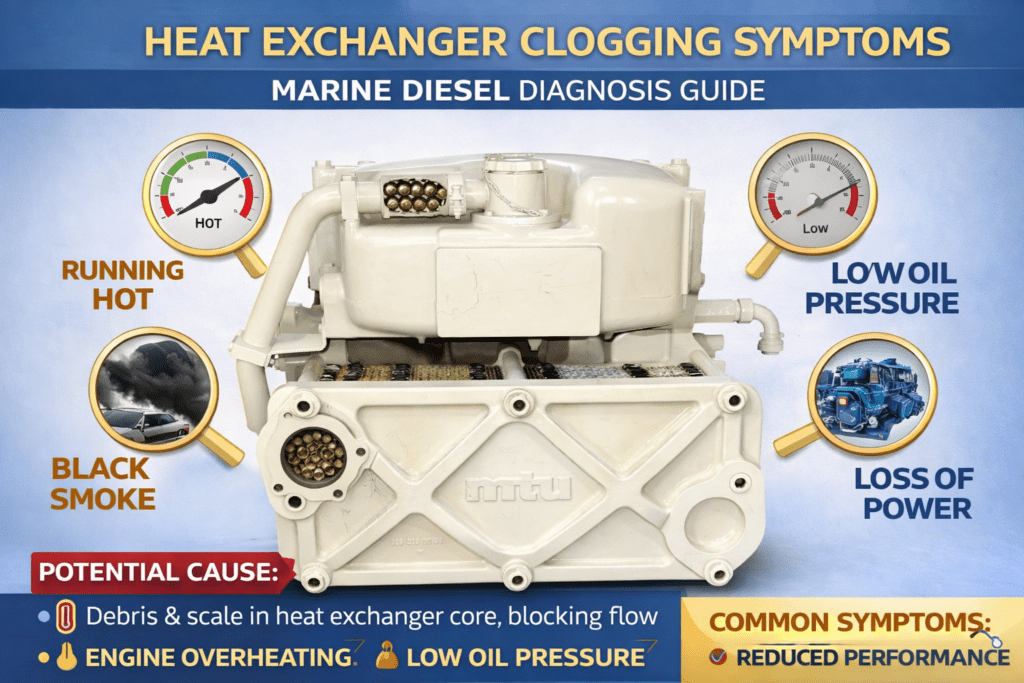
A clogged marine diesel heat exchanger is one of the most common hidden causes of overheating, especially when engines run fine at idle but begin to overheat under load. Before replacing pumps, thermostats, or chasing electrical issues, start with the Master Marine Diesel Troubleshooting Guide to confirm whether cooling capacity is being lost due to restricted raw water flow or reduced heat transfer efficiency.
At 805 Marine Diesel Mechanic, heat exchanger restriction is frequently misdiagnosed as overheating under load, raw water pump failure, or even turbo-related issues. In reality, the root cause is often debris, scale, or blockage inside the heat exchanger tube bundle restricting proper cooling flow.
What a Heat Exchanger Actually Does
The marine diesel heat exchanger transfers heat from the closed coolant loop to raw seawater. When functioning properly, it maintains stable operating temperature across all load conditions.
However, when tubes begin to clog, the system loses cooling margin. This shows up first during higher demand conditions such as engine load increase and high RPM operation.
Primary Heat Exchanger Clogging Symptoms
1. Overheating Under Load
This is the most common pattern. The engine runs at normal temperature at idle but begins to climb when throttle is applied. This often overlaps with load-based overheating diagnosis.
2. Intermittent Temperature Spikes
Debris can shift within the exchanger, causing temperature spikes that come and go. These symptoms are often confused with high EGT conditions.
3. Weak Exhaust Water Flow
Reduced discharge at the exhaust outlet indicates restricted raw water flow. This can also appear alongside raw water flow problems.
4. Overheating After Impeller Failure
Impeller fragments often travel downstream and lodge inside the heat exchanger. This is one of the most common causes following impeller damage events.
5. Gradual Temperature Increase Over Time
Scaling and mineral buildup reduce efficiency slowly, causing baseline temperatures to rise over weeks or months.
What Causes Heat Exchanger Clogging?
- Zinc debris from neglected anodes
- Impeller fragments after failure
- Salt scale buildup inside tubes
- Marine growth (barnacles, algae, silt)
- Rust particles from aging components
These causes often overlap with issues found in the Cooling System Diagnosis Center and combustion efficiency problems.
Restriction vs Circulation — Critical Diagnosis
Not all overheating is caused by restriction. Technicians must separate:
- Restriction problems → clogged heat exchanger, blocked passages
- Circulation problems → pump failure, belt slip, impeller damage
This distinction is critical and is often confirmed through load-based testing and engine data analysis.
Technician Diagnostic Workflow
- Verify raw water intake and strainer condition
- Inspect raw water pump and impeller integrity
- Check for missing impeller vanes
- Remove heat exchanger end caps
- Inspect tube bundle condition
- Flush or clean exchanger as required
- Perform sea trial under load
This workflow often overlaps with exhaust restriction testing and aftercooler inspection.
Preventing Heat Exchanger Clogging
- Replace zincs on schedule
- Service impellers annually
- Flush cooling system regularly
- Clean heat exchanger every 2–3 years
Preventive maintenance is directly tied to long-term reliability and helps avoid conditions such as engine instability and power loss under load.
External Authority Resources
Cummins Marine Engines |
Caterpillar Marine Systems
Heat Exchanger Clogging — FAQ
1. What are the first signs of a clogged heat exchanger?
The earliest signs include rising engine temperature under load and weak exhaust water flow. These symptoms may not appear at idle, which makes them easy to overlook. Early detection prevents severe overheating damage.
2. Why does overheating happen more at cruise than idle?
At higher RPM, the engine produces more heat and requires greater cooling capacity. A partially clogged exchanger cannot keep up with the demand. This results in temperature rise only under load conditions.
3. Can a heat exchanger be partially clogged?
Yes, many exchangers are only partially blocked. Some tubes remain open while others are restricted. This creates reduced cooling efficiency without complete failure.
4. Do impeller pieces clog heat exchangers?
Yes, impeller fragments frequently lodge in heat exchanger tubes after failure. These pieces restrict water flow and must be removed. This is one of the most common post-impeller issues.
5. How often should a heat exchanger be cleaned?
Most systems should be serviced every 2–3 years depending on usage and environment. Saltwater and heavy use may require more frequent cleaning. Preventive service reduces long-term damage.
6. Can zincs cause clogging?
Yes, deteriorating zinc anodes can break apart and travel into the exchanger. These fragments block tubes and reduce flow. Regular zinc replacement helps prevent this issue.
7. What is the difference between scaling and debris blockage?
Scaling is mineral buildup inside the tubes, while debris blockage comes from foreign material like impeller pieces. Both restrict flow but require different cleaning methods. Proper diagnosis determines the correct repair approach.
8. Can a clogged heat exchanger cause engine damage?
Yes, prolonged overheating can damage internal engine components. This includes head gaskets, pistons, and cylinder heads. Addressing restriction early prevents costly repairs.
9. How do technicians confirm a clog?
Technicians remove end caps and inspect the tube bundle directly. Visual inspection reveals blocked tubes and debris. This is the most reliable confirmation method.
10. Can marine growth clog a heat exchanger?
Yes, barnacles, algae, and marine organisms can accumulate inside the exchanger. This is especially common in warm saltwater environments. Growth reduces flow and heat transfer efficiency.
11. Can a clogged exchanger reduce engine performance?
Yes, overheating can cause the engine to lose efficiency and power. In severe cases, engines may derate or shut down. Proper cooling is essential for performance.
12. Why does temperature slowly increase over time?
Gradual buildup of scale and debris reduces cooling efficiency. This causes baseline temperatures to creep upward. It is often mistaken for sensor issues.
13. Can flushing fix a clogged heat exchanger?
Flushing may remove light debris but often cannot clear severe blockage. Physical cleaning or chemical descaling may be required. Inspection determines the best approach.
14. What happens if I ignore clogging symptoms?
Ignoring symptoms can lead to severe overheating and engine damage. Components may fail under excessive heat. Early service prevents major repair costs.
15. Can exhaust restrictions cause similar symptoms?
Yes, exhaust restrictions can also cause overheating and reduced performance. Proper diagnosis separates exhaust issues from cooling system problems. Both systems must be evaluated.
16. How long does cleaning take?
Cleaning time depends on the level of clogging and engine accessibility. Most services can be completed within a day. Severe cases may require additional time.
17. Can freshwater flushing prevent clogging?
Yes, flushing removes salt and debris from the cooling system. This helps prevent buildup inside the exchanger. It is a valuable preventive step.
18. Is overheating always caused by the heat exchanger?
No, overheating can also be caused by pump failure, thermostat issues, or airflow problems. A full diagnostic is required to confirm the cause. The exchanger is just one part of the system.
19. When should I call a technician?
If you notice rising temperatures, weak discharge, or overheating under load, a technician should inspect the system. Early diagnosis prevents major failures. Professional testing ensures accurate results.
20. What is the fastest way to diagnose a clogged heat exchanger?
The fastest method is to compare temperature behavior under load and inspect the exchanger directly. Removing end caps provides visual confirmation. This ensures accurate diagnosis and repair.

14 Responses