
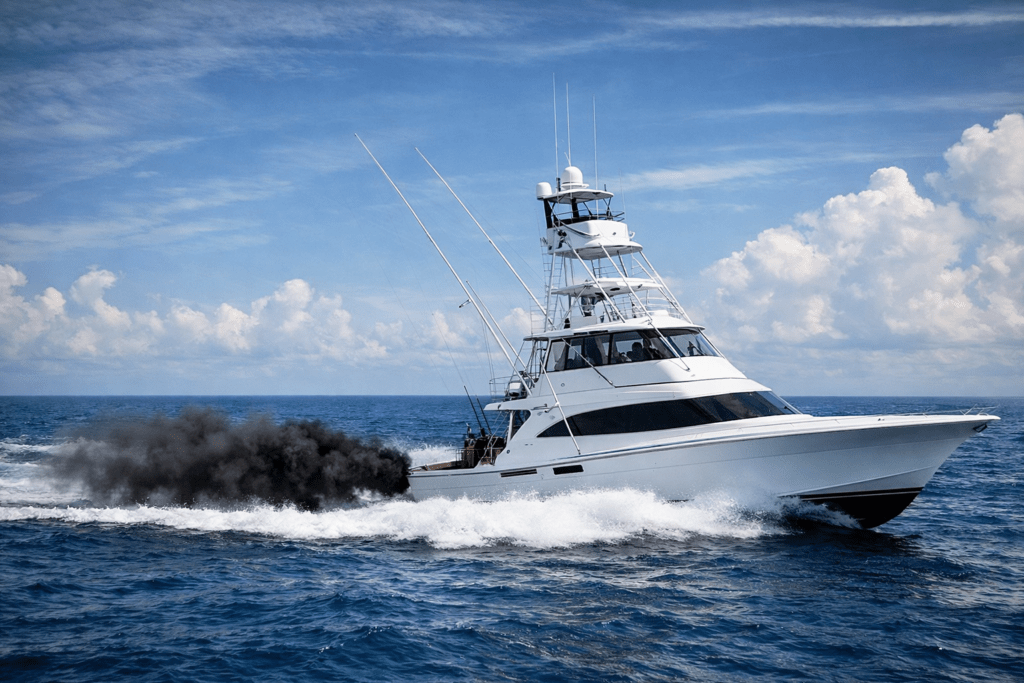
What Causes Black Smoke From a Boat Engine Under Load? (Marine Diesel Guide)
If your boat produces thick black smoke when accelerating or running at cruise speed, it’s a clear sign your engine is running too rich — meaning there is more fuel than available air for proper combustion.
After 30+ years diagnosing marine diesel engines throughout Ventura, Oxnard, Channel Islands Harbor, and Santa Barbara, we can tell you this is one of the most common — and most misunderstood — performance issues.
Black smoke is not just a nuisance — it’s a warning sign of inefficiency, lost power, and potential engine damage.
Start with the full diagnostic system here:
Marine Diesel Troubleshooting Guide
What Black Smoke Actually Means
Black smoke is caused by incomplete combustion. The engine is injecting more fuel than it can burn efficiently due to lack of air or poor combustion conditions.
Common Symptoms That Accompany Black Smoke
- Loss of power under load
- Poor fuel economy
- Slow acceleration
- Excessive exhaust soot
- Turbo lag or weak boost
👉 Related: Low Power Diagnosis Center
1. Restricted Air Intake (Top Cause)
Diesel engines require large amounts of clean air. If airflow is restricted, fuel cannot burn completely.
- Clogged air filter
- Collapsed intake hose
- Restricted intake silencer
👉 Related: Fuel vs Air Restriction Diagnosis
2. Turbocharger Not Producing Proper Boost
Turbochargers increase air supply. If boost is low, the engine runs rich and produces black smoke.
- Worn turbo bearings
- Boost leaks
- Sticking wastegate
👉 Related: Turbo Systems Diagnosis Center
Turbochargers play a critical role in diesel efficiency and power output
3. Over fueling (Too Much Fuel Delivery)
If the engine is injecting too much fuel, even a healthy air system won’t keep up.
- Faulty injectors
- Injection pump calibration issues
- Electronic fuel control problems
👉 Related: Smoke & Combustion Diagnosis Center
4. Dirty or Failing Fuel Injectors
Injectors that don’t atomize fuel properly create uneven combustion and excessive smoke.
- Poor spray pattern
- Dripping injectors
- Uneven fuel distribution
Fuel injection quality directly impacts combustion efficiency ([dieselnet.com](https://dieselnet.com/tech/diesel_fi.php?utm_source=chatgpt.com)).
5. Aftercooler or Intercooler Restriction
Aftercoolers reduce intake air temperature. If restricted, air density drops — reducing available oxygen.
- Internal corrosion
- Salt buildup
- Oil contamination
6. Exhaust System Restriction
Restricted exhaust flow traps heat and reduces engine efficiency.
- Clogged mixing elbow
- Carbon buildup
- Collapsed exhaust hose
7. Engine Overloading
If the engine is overloaded, it demands more fuel than it can burn efficiently.
- Over-propped vessel
- Dirty hull or prop
- Excess weight onboard
👉 Related: Engine Losing Power Under Load
8. Fuel Quality Issues
Poor fuel quality affects combustion and can increase smoke output.
- Water contamination
- Algae growth
- Low-quality diesel
👉 Related: Fuel System Diagnosis Center
Real-World Diagnosis (Ventura Offshore Case)
We recently diagnosed a sportfishing yacht off Ventura producing heavy black smoke under load.
The cause was a combination of restricted air filters and a fouled aftercooler.
After cleaning both systems, smoke disappeared and full power was restored immediately.
Step-By-Step Professional Diagnosis
- Inspect air intake system
- Check turbo boost pressure
- Inspect injectors and fuel system
- Check aftercooler condition
- Inspect exhaust system
- Evaluate engine load and prop setup
👉 Advanced diagnostics: Mechanical Failure Diagnostics
Why Black Smoke Should Not Be Ignored
Ignoring black smoke can lead to:
- Increased fuel consumption
- Carbon buildup (wet stacking)
- Turbocharger damage
- Long-term engine wear
Professional Marine Diesel Smoke Diagnosis in Ventura
At 805 Marine Diesel Mechanic, we specialize in diagnosing combustion and performance issues with over 30 years of experience.
We provide mobile service throughout Ventura, Oxnard, Channel Islands Harbor, and Santa Barbara.
Black Smoke Under Load Is a System Imbalance — Not Just a “Smoke Problem”
Black smoke under load is one of the clearest signs that a marine diesel engine is being asked to burn more fuel than the available air and combustion conditions can support. That imbalance can come from restricted intake flow, low turbo boost, leaking charge-air plumbing, aftercooler fouling, exhaust backpressure, injector imbalance, or a boat-and-prop load condition that is simply too heavy for the engine at that RPM.
That is why black smoke should never be diagnosed in isolation. A trained technician connects the smoke to the full symptom pattern: low top RPM, poor acceleration, hotter running, sluggish turbo response, excessive soot, or a boat that used to run cleanly at the same throttle setting but no longer does. If the smoke appears only when the engine is heavily loaded, that is a very different diagnostic path from black smoke that appears across the whole RPM range.
Fast Black Smoke Decision Path
- Black smoke + low top RPM: airflow restriction, low boost, overload, or exhaust backpressure move higher on the list. Continue with Low Power / Loss of RPM Diagnostics Center and Engine Losing Power Under Load.
- Black smoke + lazy turbo response: inspect charge-air piping, boost integrity, and turbo performance. See Turbocharger Failure Symptoms, Boost Pressure Testing on Marine Diesel Engines, and Turbo Lag & Slow Spool-Up.
- Black smoke + dirty intake / AirSep / aftercooler concerns: compare with Aftercooler & Intercooler Problems and Fuel Restriction vs Air Restriction Diagnosis.
- Black smoke + prop or hull load suspicion: overload, dirty running gear, or drag can make a healthy engine smoke under demand. Compare with Excessive Vibration Diagnosis and Knock or Ticking Noise Diagnosis when load-related drivetrain issues are also present.
- Black smoke + smoke color changes or rough running: fuel quality, injector balance, or broader combustion issues may be involved. Continue with Smoke & Combustion Diagnosis Center and Fuel System Diagnosis Center.
Why Black Smoke Gets Misdiagnosed
Many black smoke complaints get blamed on injectors too early. In real-world marine diesel service, airflow loss and load problems are extremely common. A dirty intake path, failing turbo response, leaking charge-air boot, fouled aftercooler, clogged mixing elbow, or excessive prop demand can all produce thick smoke without the injectors being the real root cause.
Across Ventura, Oxnard, Channel Islands Harbor, and Santa Barbara, black smoke often overlaps with low-power complaints that only show up under real load on the water. That is why 805 Marine Diesel Mechanic treats black smoke as a loaded-system diagnosis, not just a dockside idle observation. If the engine revs freely in neutral but smokes and falls off in gear, that usually points toward a load-dependent restriction or imbalance rather than a simple single-part failure.
Related Systems That Commonly Trigger Black Smoke
The most common linked systems are turbocharger performance, aftercooler efficiency, exhaust backpressure, air filter restriction, hull and prop load, and fuel atomization quality. If one side of that system falls behind, the engine can no longer burn fuel cleanly. In some cases, multiple smaller problems stack together: a slightly dirty bottom, partially fouled aftercooler, aging turbo response, and restricted intake may all combine into one major black-smoke complaint.
For broader troubleshooting, compare this page with Marine Diesel Smoke Diagnosis Guide, Marine Diesel Exhaust Backpressure Problems, Marine Diesel Wastegate Problems, and How to Diagnose Marine Diesel Engine Problems.
What Causes Black Smoke From a Boat Engine Under Load? – FAQ
These frequently asked questions help boat and yacht owners understand what black smoke under load usually means on a marine diesel engine and how to follow the right diagnostic path before replacing expensive parts unnecessarily.
What does black smoke mean on a boat engine under load?
Is black smoke always caused by too much fuel?
Can a dirty air filter cause black smoke?
Can turbocharger problems cause black smoke?
Can aftercooler or intercooler problems make a diesel smoke black?
Can a boost leak cause black smoke without a turbo failure?
Can a clogged mixing elbow or exhaust restriction cause black smoke?
Why does my engine smoke black only when accelerating?
Why does my boat smoke black at cruise RPM?
Can hull fouling or prop overload cause black smoke?
Can bad fuel or injector problems cause black smoke?
What if my engine has black smoke and low top RPM together?
Can black smoke damage the engine if ignored?
Can wastegate problems contribute to black smoke?
What if my engine reaches RPM in neutral but not in gear?
Can cooling system problems overlap with black smoke complaints?
Should I assume injectors are the first cause of black smoke?
When should I call a marine diesel technician for black smoke?
Where should I continue if I suspect the problem is airflow-related?
Where should I continue if I suspect broader loaded-performance problems?
Related Black Smoke, Turbo, Load & Performance Diagnosis Guides
- Marine Diesel Smoke Diagnosis Guide
- Yacht Engine Black Smoke Under Load
- Marine Diesel Turbocharger Failure Symptoms
- Marine Diesel Turbo Lag & Slow Spool-Up
- Marine Diesel Wastegate Problems
- Marine Diesel Exhaust Backpressure Problems
- Marine Diesel Aftercooler & Intercooler Problems
- How to Diagnose Marine Diesel Engine Problems
805 Marine Diesel Mechanic provides mobile marine diesel black smoke, turbo, aftercooler, exhaust backpressure, and loaded-performance diagnostics throughout Ventura, Oxnard, Channel Islands Harbor, and Santa Barbara, helping boat owners identify the real cause before expensive parts are replaced.
One Response