
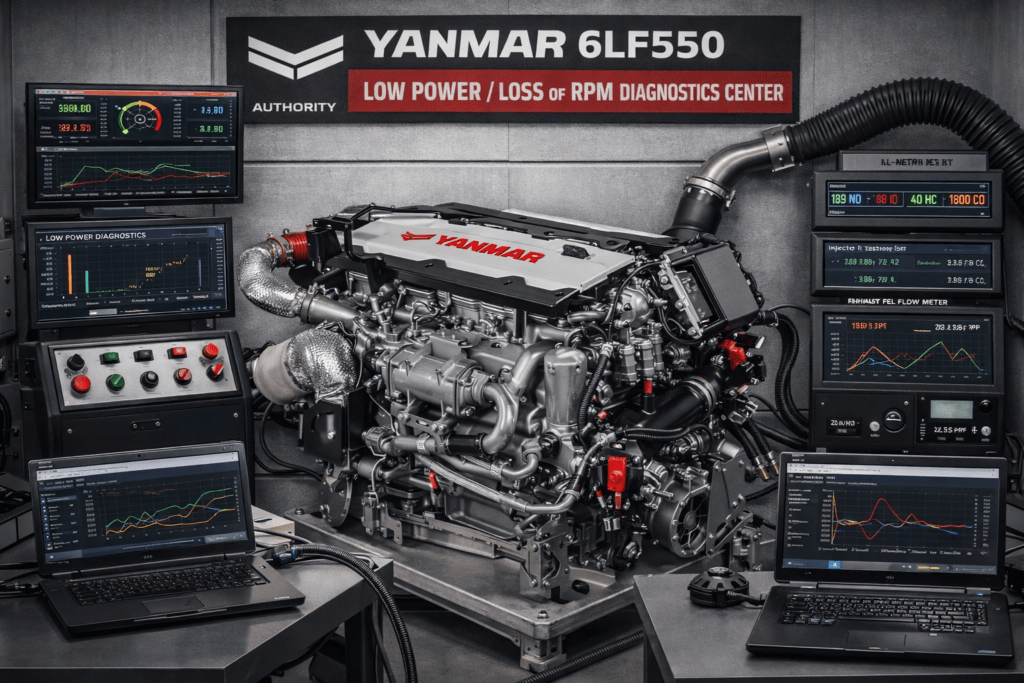
The Yanmar 6LF550 is a powerful common-rail marine diesel, but when it starts losing power the drop in performance is usually obvious fast. This guide explains how to diagnose low power, reduced RPM, slow acceleration, and heavy-load complaints on the Yanmar 6LF550 by separating fuel restriction, turbo and airflow problems, cooling limitations, sensor faults, and load-related issues before expensive parts get replaced unnecessarily.
Yanmar 6LF550 Marine Diesel Low Power & Loss of RPM: Complete Diagnosis Guide
The Yanmar 6LF550 marine diesel engine is a modern high-performance common-rail diesel used in sportfishing boats, fast cruisers, and other applications where strong acceleration and full rated RPM matter. Because this engine is designed to make substantial horsepower from a compact package, even a moderate restriction in fuel, air, cooling, or electronic control can create a very noticeable drop in performance. Owners usually feel it immediately as slower acceleration, reduced top speed, lower maximum RPM, or the sense that the engine is working much harder than it should.
That is what makes low-power complaints so important. They are rarely random. A Yanmar 6LF550 that will not pull correctly is usually telling you that one of its major support systems is no longer doing its job. The challenge is that multiple failures can create the same complaint. Fuel restriction, charge-air leakage, turbo weakness, high engine temperature, sensor faults, exhaust backpressure, and excessive hull load can all produce very similar symptoms.
At 805 Marine Diesel Mechanic, Yanmar 6LF550 performance issues are diagnosed throughout Ventura, Oxnard, Channel Islands Harbor, and Santa Barbara. With over 30 years of marine diesel experience, the goal is to identify whether the real cause is fuel pressure loss, airflow restriction, turbocharger weakness, cooling-related derate behavior, or an electronic control issue. This article is part of your wider diagnostic structure and expands from the Master Marine Diesel Troubleshooting Guide.
Understanding Low Power on Marine Diesel Engines
Marine diesel engines need the correct balance of fuel delivery, airflow, compression, and temperature control to make full rated power. On a common-rail engine like the 6LF550, fuel pressure and sensor accuracy matter even more because the engine depends on electronically controlled injection events and precise feedback from multiple systems.
Low-power conditions usually show up as:
- Engine unable to reach rated RPM
- Slow acceleration
- Reduced vessel speed
- Heavy engine load at lower RPM
- Increased exhaust smoke
- Weak performance under sustained throttle
These symptoms often overlap with pages deeper in your site structure such as Boat Engine Won’t Reach Full RPM, Boat Engine Losing Power, Black Smoke Under Load, and the Smoke & Combustion Diagnosis Center. That crossover is important because a low-power complaint is usually not a single isolated symptom. It is part of a broader engine-balance problem.
Fuel System Restrictions
Fuel system problems are one of the most common causes of marine diesel power loss, and on the Yanmar 6LF550 they can become noticeable quickly because the engine depends on clean fuel and stable high-pressure common-rail injection. If low-pressure supply is restricted or contaminated, the high-pressure side cannot perform correctly and the engine begins to lose power.
Common fuel-system causes include:
- Clogged primary fuel filters
- Restricted secondary fuel filters
- Fuel contamination
- Injector performance issues
- High-pressure fuel pump problems
- Air intrusion on the supply side
Complete fuel system troubleshooting can be explored in the Fuel System Diagnosis Center, while contamination-specific issues are covered in Fuel Contamination & Filtration Issues Center, Marine Diesel Fuel Contamination, and Marine Diesel Air in Fuel System.
On real boats, restricted fuel flow may first appear as mild hesitation or reduced top RPM, then become a stronger low-power complaint as the filters continue loading up or the contamination reaches more sensitive components.
Turbocharger and Airflow Restrictions
The Yanmar 6LF550 depends heavily on turbocharger boost pressure and stable airflow to achieve full horsepower. If airflow becomes restricted, if the turbo is weak, or if the charge-air side leaks boost pressure, combustion efficiency drops and the engine loses output fast.
Common airflow-related causes include:
- Clogged air filters
- Dirty charge-air coolers
- Turbocharger wear
- Boost pressure leaks
- Exhaust restrictions
Turbo and airflow problems are especially common when low power is paired with black smoke, sluggish acceleration, or reduced maximum RPM. This topic connects naturally with the Marine Diesel Turbo Diagnosis Center, Turbocharger Failure Symptoms, and Yanmar Turbo Problem Pages deeper in your content network.
Cooling System Limitations and Power Derate
If the cooling system is restricted or malfunctioning, the engine may reduce power output to protect itself from overheating. This is especially relevant on a modern common-rail engine with protective logic. Many owners describe this as “the engine just feels like it is holding back,” when in reality the control system may be limiting fueling because the engine is seeing temperature-related risk.
Cooling-related low-power causes include:
- Restricted heat exchangers
- Seawater pump failure
- Aftercooler fouling
- Thermostat malfunction
- Weak raw-water flow
Cooling diagnostics connect naturally with the Cooling System Diagnosis Center, Boat Engine Overheating, Overheating at Idle, and Heat Exchanger Cleaning. When cooling efficiency drops, power-loss symptoms often follow before the engine reaches a full overheat alarm.
Electronic Engine Management Issues
The Yanmar 6LF550 uses electronic control modules to regulate injection timing, fuel quantity, and protective operating limits. That means sensor faults and electronic errors can create true power-loss complaints even when the mechanical systems are still mostly functional.
Common electronic causes include:
- Sensor calibration errors
- Fuel pressure sensor faults
- Boost pressure sensor errors
- ECU protection limits
- Communication or harness-related faults
Because this engine depends on accurate data from multiple sensors, false readings can make the engine behave as though a mechanical restriction exists even when the underlying problem is electronic. That is why electrical and control-system pages still matter here, including Electrical & Starting System Diagnosis Center and the Computerized Marine Engine Survey Diagnostics Center.
Load, Hull, and Propeller Factors
Not every low-power complaint starts inside the engine. Excess hull fouling, propeller damage, incorrect propeller pitch, or overload conditions can make a healthy engine feel weak and heavy. On high-output engines like the 6LF550, even modest extra drag can make the engine fall short of target RPM.
That is why low-power diagnosis should always keep vessel-side load in mind. A boat that feels underpowered may actually be over-propped or carrying enough drag that the engine is effectively being lugged. This is one reason the symptom also links naturally with your Low Power Loss of RPM Diagnosis Center and broader propulsion-related content.
Professional Yanmar 6LF550 Power Loss Diagnosis
Diagnosing marine diesel power loss requires looking at several systems simultaneously. On a common-rail engine, you cannot solve low power by focusing on only one guess. Fuel pressure, injector behavior, airflow, boost, cooling efficiency, and control data all have to be evaluated together.
A structured diagnostic process typically includes:
- Fuel pressure testing
- Injector performance analysis
- Turbo boost measurement
- Airflow inspection
- Electronic diagnostic scanning
- Load and RPM verification
Advanced engine testing is part of your wider site authority network through the Computerized Marine Engine Survey Diagnostics Center, which helps connect common-rail performance complaints with deeper electronic and data-driven diagnosis.
Yanmar 6LF550 Marine Diesel Service in Ventura & Channel Islands Harbor
805 Marine Diesel Mechanic provides Yanmar 6LF550 diagnostics and repair services throughout:
- Ventura Harbor
- Channel Islands Harbor
- Oxnard
- Santa Barbara
If your Yanmar 6LF550 marine diesel engine is experiencing loss of power, reduced RPM, slow acceleration, or heavy-load behavior, professional diagnostics can quickly determine whether the root cause is fuel-related, airflow-related, cooling-related, or electronic.
Yanmar 6LF550 Low Power FAQ
1. Why is my Yanmar 6LF550 losing power?
Power loss is commonly caused by restricted fuel filters, turbocharger airflow problems, injector issues, charge-air leaks, cooling-system limitations, or electronic sensor faults.
2. Why can’t my marine diesel engine reach full RPM?
Engines may fail to reach rated RPM because of restricted fuel delivery, limited airflow, excessive vessel load, cooling-system restrictions, or electronic derate behavior.
3. Can turbocharger problems cause low engine power?
Yes. If the turbocharger cannot build proper boost pressure, the engine does not get enough air for efficient combustion and power drops quickly.
4. How are marine diesel power-loss problems diagnosed?
Technicians evaluate fuel pressure, boost pressure, airflow restriction, injector behavior, temperature trends, and electronic control data together rather than guessing at one part.
5. Can clogged primary fuel filters make a Yanmar 6LF550 feel weak?
Absolutely. Primary fuel restriction is one of the most common reasons common-rail engines lose power under load.
6. Can contaminated fuel create low-power complaints?
Yes. Contaminated fuel can reduce pressure stability, damage injector performance, and clog the filtration system. Related page: Fuel Contamination & Filtration Issues Center.
7. Can a charge-air leak make the engine smoke and lose RPM?
Yes. Charge-air leaks reduce available boost and commonly create both low-power and black-smoke symptoms.
8. Does black smoke always mean the turbo is bad?
No. Black smoke can also come from dirty air filters, exhaust restriction, over-fueling, or load-related problems. Related page: Black Smoke Under Load.
9. Can cooling problems make the Yanmar 6LF550 lose power before overheating badly?
Yes. Modern engines often begin protecting themselves before a full overheating event, which can show up as low-power or low-RPM behavior.
10. Can aftercooler fouling reduce horsepower?
Yes. If the charge-air cooler becomes fouled, airflow quality drops and the engine cannot make full power efficiently.
11. Can sensor faults really make the engine feel weak?
Yes. Bad boost, fuel-pressure, or temperature sensor data can push the ECU into protective behavior that limits engine output.
12. Can low power and smoke happen together?
Yes. Low power often overlaps with smoke because both symptoms come from poor combustion balance. Related page: Smoke & Combustion Diagnosis Center.
13. Can a common-rail injector problem reduce top speed?
Yes. If injectors are not delivering fuel properly, the engine may lose output, run unevenly, or fail to achieve full performance.
14. Can hull or propeller load make the engine seem underpowered?
Yes. Propeller condition, bottom fouling, and vessel load all affect whether the engine can achieve rated RPM and normal performance.
15. Can electrical faults affect performance even when starting seems normal?
Yes. Electronic control faults can affect running performance independently of the starting system. Related page: Electrical & Starting System Diagnosis Center.
16. Why does the engine feel heavy at lower RPM?
That usually means the engine is not making normal torque for the load it is carrying, often because of fuel, boost, or load-related restrictions.
17. Can low-power issues cause poor acceleration before top speed drops badly?
Yes. Slow acceleration is often one of the earliest signs of a developing low-power or low-boost condition.
18. Is mobile diagnosis useful for Yanmar 6LF550 performance problems?
Yes. Power-loss problems are often easiest to confirm under real vessel load with live data, boost behavior, and actual RPM performance observed on the boat.
19. When should I call a mechanic for Yanmar 6LF550 low power?
If the engine cannot reach rated RPM, accelerates slowly, loses speed, or shows smoke under load, it is time for professional diagnosis through the contact page.
20. Where should I start if I want the full Yanmar 6LF550 low-power pathway?
Start with the Master Marine Diesel Troubleshooting Guide, then move through the linked fuel, turbo, cooling, smoke, and electrical pages from there.