
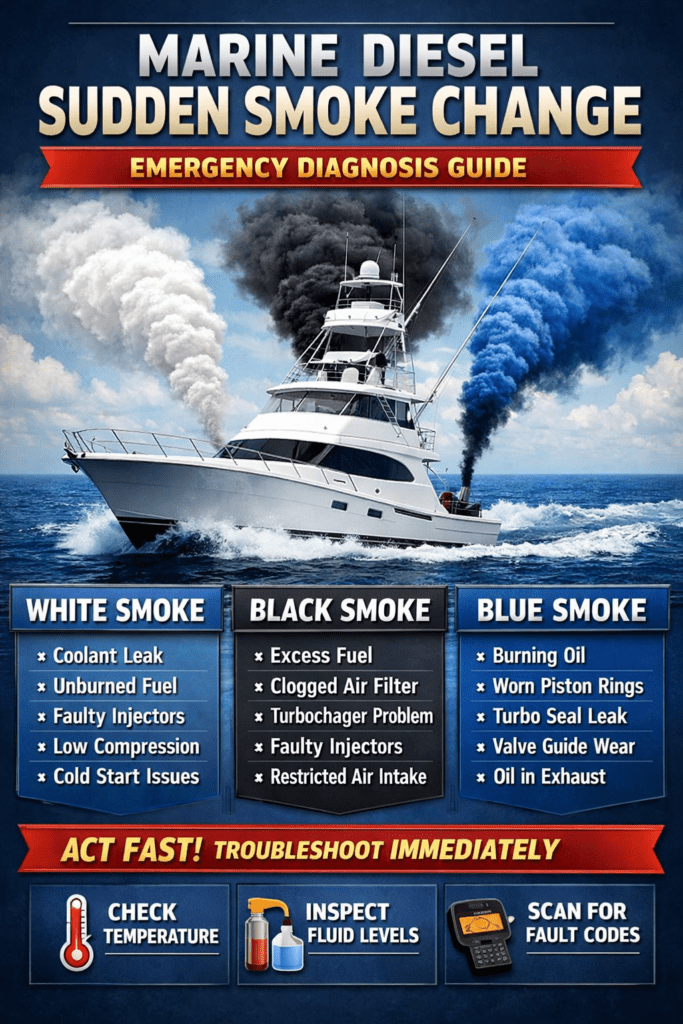
Marine diesel exhaust smoke is one of the fastest and most accurate diagnostic indicators available. Before replacing injectors, tearing into the engine, or assuming catastrophic failure, start with the Master Marine Diesel Troubleshooting Guide to identify whether the issue is fuel-related, airflow-related, or mechanical. Smoke color—white, black, or blue—directly reflects combustion conditions and can quickly narrow down the root cause.
At 805 Marine Diesel Mechanic, smoke diagnosis is often used as the first step when evaluating power loss issues, engine instability, or turbocharger problems. Understanding how smoke behaves under different conditions—startup, idle, and load—is key to accurate diagnosis.
Why Smoke Color Matters in Diesel Engines
Diesel engines rely on compression ignition and a precise balance of fuel, air, and temperature. Any imbalance creates visible exhaust changes.
- White smoke: unburned fuel or coolant
- Black smoke: too much fuel or not enough air
- Blue smoke: oil burning inside combustion chamber
These patterns often overlap with issues found in fuel vs air restriction diagnosis and high exhaust temperature conditions.
WHITE SMOKE — Unburned Fuel or Coolant Intrusion
White smoke typically indicates incomplete combustion or fluid entering the cylinder.
Common Causes
- Cold start combustion issues
- Injector spray pattern failure
- Low compression
- Injection timing errors
- Coolant intrusion
- Air in fuel system
Diagnostic Pattern
If white smoke disappears as the engine warms up, the issue is usually normal cold combustion or minor inefficiency. Persistent white smoke often indicates deeper problems like compression loss or injector failure.
This pattern overlaps with no-start after service issues and cranking problems.
BLACK SMOKE — Overfueling or Air Restriction
Black smoke occurs when the engine receives more fuel than it can burn efficiently.
Common Causes
- Air intake restriction
- Dirty air filters
- Turbocharger inefficiency
- Aftercooler restriction
- Propeller overload
- Injector overfueling
Diagnostic Pattern
Black smoke is most visible under acceleration or heavy load. If smoke increases with throttle, the issue is usually airflow limitation or excess fuel delivery.
This often appears alongside RPM limitation and power loss under load.
BLUE SMOKE — Oil Burning Inside Engine
Blue smoke indicates oil entering the combustion chamber.
Common Causes
- Worn piston rings
- Cylinder wear
- Turbo seal failure
- Valve guide wear
- Crankcase ventilation problems
- Overfilled oil
Diagnostic Pattern
Blue smoke is often continuous and may increase with RPM. It is usually accompanied by oil consumption and exhaust odor.
This is often linked with excessive oil consumption and blow-by issues.
Advanced Smoke Pattern Diagnosis
Smoke behavior changes depending on operating conditions:
- Smoke only at startup → combustion or injector issue
- Smoke under load → airflow, fuel, or overload problem
- Constant smoke → mechanical or severe system fault
These patterns must be evaluated alongside cooling system performance and exhaust flow conditions.
Technician Diagnostic Workflow
- Identify smoke color and timing
- Evaluate load vs idle behavior
- Inspect fuel system and injectors
- Check air intake and turbo operation
- Evaluate compression and mechanical condition
- Confirm exhaust and cooling system performance
This process integrates advanced engine diagnostics and boost/load testing.
External Authority Resources
Cummins Marine Engines |
Caterpillar Marine Systems