
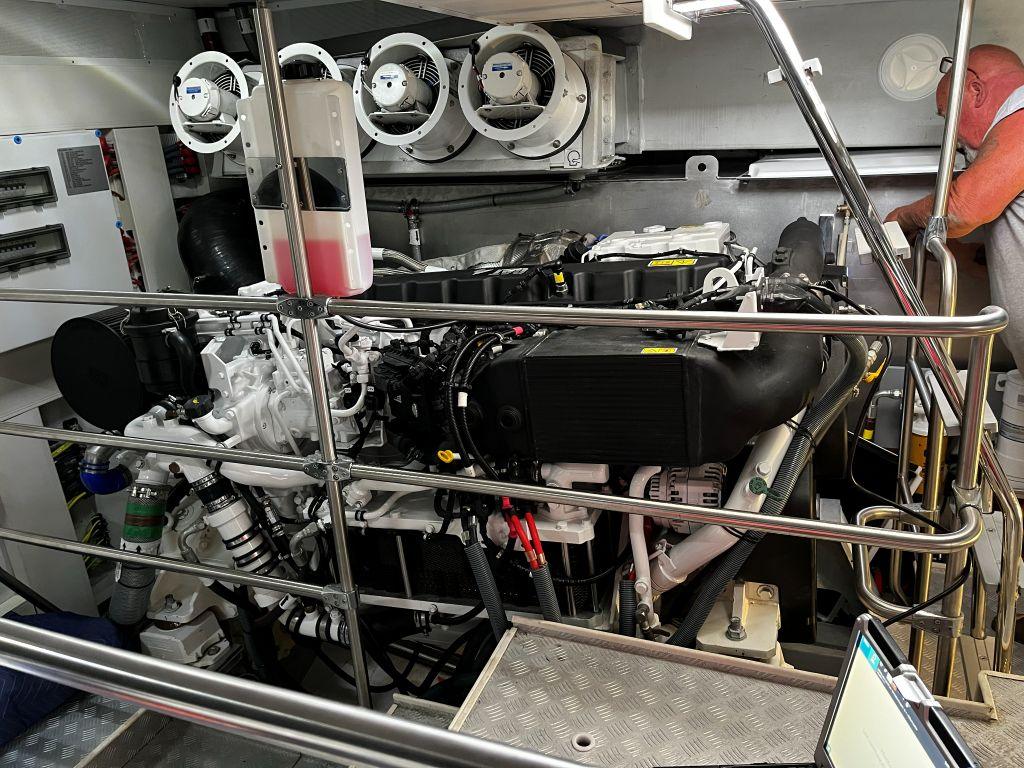
Marine diesel engines that lose power under load almost always point to a restriction, imbalance, or limitation in fuel delivery, airflow, exhaust flow, or vessel load conditions. Before replacing injectors or assuming engine failure, start with the Master Marine Diesel Troubleshooting Guide to determine whether the limitation is fuel-related, air-related, mechanical, or external to the engine.
At 805 Marine Diesel Mechanic, loss of power is one of the most common complaints across Ventura, Oxnard, Channel Islands Harbor, and Santa Barbara. It is frequently misdiagnosed as injector failure when the real issue is often fuel restriction, turbo inefficiency, or cooling system imbalance.
Why Engines Lose Power Under Load
At idle, engines require minimal fuel and airflow. Under load, both must increase significantly. Any restriction or imbalance limits output, causing the engine to struggle to reach RPM.
This is why engines can run perfectly at idle yet fail under throttle. The problem is not starting or running—it is capacity under demand.
This behavior overlaps with RPM limitation issues and surging conditions.
1. Fuel System Restriction (Most Common Cause)
Fuel delivery must increase with load. Any restriction causes starvation.
- Clogged primary filters
- Restricted secondary filters
- Fuel contamination
- Air intrusion
Fuel starvation often causes gradual power loss and may worsen over time.
This frequently appears after filter service issues or improper priming.
2. Turbocharger or Air Intake Problems
Engines require sufficient air to burn fuel efficiently. Reduced airflow limits power.
- Dirty or clogged air filters
- Aftercooler restriction
- Boost leaks
- Turbo wear or inefficiency
This often results in black smoke under load and reduced acceleration.
3. Exhaust System Restriction
Exhaust flow must remain unrestricted to allow proper airflow through the engine.
- Excessive backpressure
- Collapsed exhaust hoses
- Carbon buildup
Restricted exhaust reduces turbo efficiency and limits engine output.
4. Propeller or Vessel Load Issues
External load is often overlooked.
- Incorrect prop pitch
- Hull fouling
- Excess vessel weight
These conditions increase resistance and prevent engines from reaching full RPM.
5. Cooling System Problems and Engine Derate
Modern engines reduce power when overheating is detected.
- Overheating under load
- Restricted raw water flow
- Heat exchanger inefficiency
This protective derate limits output even if fuel and air systems are functioning.
6. Fuel Injection or Governor Issues
Fuel delivery must increase proportionally with throttle input.
- Injector wear
- Injection pump problems
- Governor miscalibration
This can limit maximum fuel delivery and cap engine output.
7. Electronic Engine Protection Modes
Modern engines may enter derate mode based on sensor input.
- Boost sensor faults
- Temperature sensor errors
- ECU protection logic
This often requires advanced diagnostics to confirm.
How to Identify the Root Cause
Technicians use pattern-based diagnosis:
- Gradual loss → fuel restriction
- Sudden loss → air or mechanical issue
- Load-only → airflow or load problem
This prevents unnecessary component replacement.
Technician Diagnostic Workflow
- Verify fuel pressure stability
- Inspect intake and airflow
- Measure boost under load
- Evaluate exhaust flow
- Check cooling system performance
- Analyze load vs engine output
This process integrates boost testing and combustion analysis.
External Authority Resources
Cummins Marine Engines |
Caterpillar Marine Systems
5 Responses