
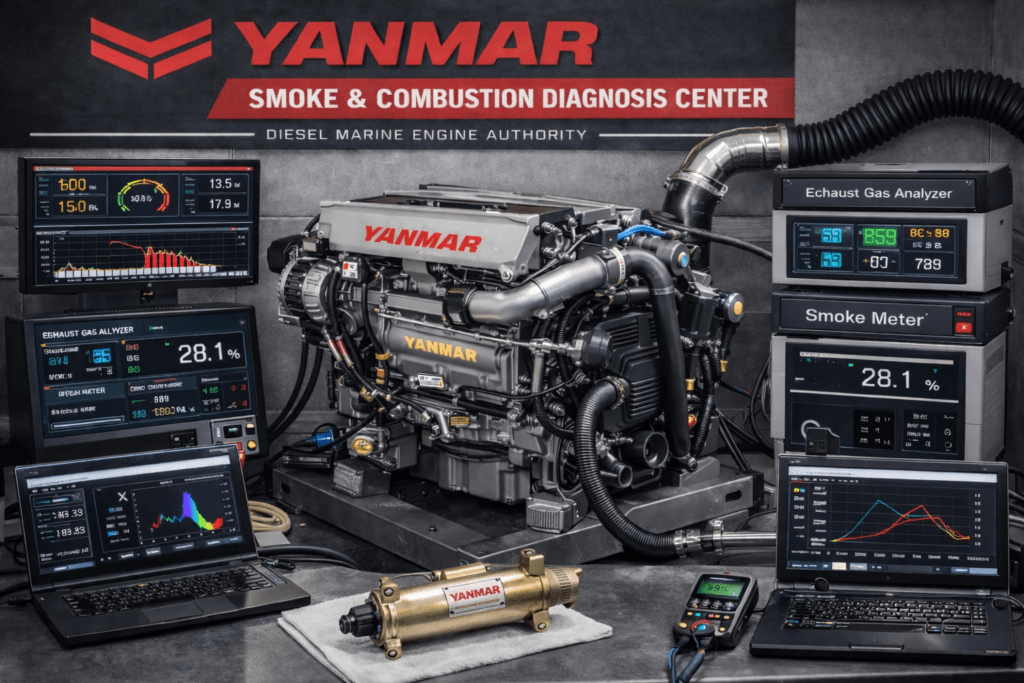
Excessive exhaust smoke from a Yanmar marine diesel engine is one of the clearest warning signs that combustion is out of balance. This guide explains how to diagnose black smoke, white smoke, and blue smoke on Yanmar engines using real system-based logic so you can separate fuel delivery problems, turbocharger issues, oil burning, compression loss, and cooling-related combustion faults before they turn into expensive damage.
Yanmar Marine Diesel Smoke Problems: Complete Smoke & Combustion Diagnosis Guide
Visible smoke is one of the most valuable symptoms in marine diesel diagnosis because it gives you a direct clue about what is happening inside the cylinders. A Yanmar engine that begins producing black, white, or blue smoke is telling you that fuel delivery, air supply, oil control, compression, or temperature is no longer where it should be. The mistake many owners make is treating all smoke the same. In reality, the color, timing, and operating conditions behind the smoke matter just as much as the fact that smoke is visible.
On Yanmar marine diesel engines, smoke problems often begin subtly. It may be a little haze at startup, a puff of black smoke when throttling up, or faint blue smoke under load. Over time, those small signs can grow into major symptoms such as low RPM, loss of power, overheating, hard starting, or heavy oil consumption. That is why combustion diagnosis should start early, before the problem spreads across multiple systems.
At 805 Marine Diesel Mechanic, Yanmar smoke and combustion problems are diagnosed throughout Ventura, Oxnard, Channel Islands Harbor, and Santa Barbara. With over 30 years of marine diesel experience, the goal is to determine whether the smoke is coming from excess fuel, weak airflow, oil entering the chambers, or incomplete combustion caused by deeper engine wear. This page works as part of your full troubleshooting authority structure and expands from the Master Marine Diesel Troubleshooting Guide.
Understanding Marine Diesel Combustion on Yanmar Engines
Diesel combustion depends on precise balance. Fuel has to be injected at the right time, in the right amount, and in the right spray pattern. The engine also needs enough clean air, proper turbo boost where applicable, strong compression, and the correct operating temperature. If one of those conditions drifts out of range, the result is incomplete or unstable combustion.
That unstable combustion shows up as smoke. Sometimes it happens because too much fuel is being injected for the available air. Sometimes the fuel is not burning because cylinder heat is too low. Sometimes engine oil is getting into the combustion chamber and burning with the fuel. Sometimes the problem is a combination of multiple systems, which is why smoke diagnosis should never stop at just “change the filters and see what happens.”
Good smoke diagnosis on a Yanmar should always consider:
- Fuel injection timing and injector condition
- Airflow and turbocharger performance
- Compression and cylinder sealing
- Fuel quality and contamination
- Engine temperature and cooling efficiency
- Load-related symptoms such as low RPM or poor acceleration
Black Smoke on a Yanmar Marine Diesel
Black smoke usually means the engine is receiving more fuel than it can burn cleanly. That happens when there is excess fueling, insufficient airflow, restricted exhaust flow, turbocharger weakness, or vessel load that is too high for the available engine output. Black smoke is one of the most common Yanmar smoke complaints because it can show up in many different conditions: throttle-up, climbing onto plane, sustained cruise, or full load.
Common causes of black smoke include:
- Clogged air filters
- Turbocharger boost problems
- Over-fueling injectors
- Restricted exhaust systems
- Dirty hull or overloaded propeller conditions
If a Yanmar is smoking black and also feels slow or overloaded, the problem may overlap with Boat Engine Won’t Reach Full RPM, Boat Engine Losing Power, or Black Smoke Under Load. Airflow and turbocharger problems are explored further in the Marine Diesel Turbo Diagnosis Center.
White Smoke on a Yanmar Marine Diesel
White smoke usually means unburned or partially burned fuel is leaving the cylinder. On a cold engine, a small amount of white smoke may be normal, especially if it clears quickly after warm-up. Persistent white smoke, however, deserves attention because it can indicate injector problems, low compression, incorrect timing, or in more serious cases coolant-related issues or poor cylinder sealing.
Common causes include:
- Cold engine startup
- Injector malfunction or weak atomization
- Low cylinder compression
- Incorrect injection timing
- Poor combustion temperature
If the smoke stays after warm-up, it often connects with pages such as Boat Engine Blowing White Smoke, Hard to Start When Cold, or No Smoke When Cranking. White smoke diagnosis on Yanmar engines should always include injector behavior, cranking speed, compression quality, and engine temperature.
Blue Smoke on a Yanmar Marine Diesel
Blue smoke generally means engine oil is entering the combustion process and burning during operation. This is a different diagnostic path from black or white smoke. Blue smoke points toward oil control problems rather than just fuel or air imbalance. In some cases, the cause is external to the rotating assembly, such as turbocharger oil seal failure. In other cases, it signals deeper wear like worn piston rings or valve guide issues.
Possible causes include:
- Worn piston rings
- Valve guide wear
- Turbocharger oil seal failure
- Crankcase ventilation issues
- Overfilled oil or oil control problems
Blue smoke should never be ignored, especially if it is paired with rising oil consumption, heavy crankcase fumes, or power loss. Related pages include Boat Engine Blowing Blue Smoke and Marine Diesel Turbo Failure Symptoms.
Fuel System Influence on Yanmar Smoke Problems
Fuel system condition plays a major role in combustion quality. Injectors that do not atomize properly, filters that partially restrict flow, weak fuel delivery, or contaminated diesel can all make smoke worse. Even when the visible symptom looks like an air or turbo issue, fuel quality and injector performance still need to be part of the diagnosis.
Fuel-related smoke problems should be investigated alongside:
- Fuel System Diagnosis Center
- Fuel Contamination & Filtration Issues Center
- Marine Diesel Fuel Contamination
- Marine Diesel Air in Fuel System
This matters because a dirty or unstable fuel system can produce black smoke from poor combustion efficiency, white smoke from weak atomization, or starting-related smoke behavior that points toward broader injector or delivery problems.
Turbocharger, Airflow, and Exhaust Influence
On turbocharged Yanmar engines, airflow and exhaust energy are critical. If the turbo is not building proper boost, the engine may run rich and smoke black. If the exhaust side is restricted, the turbo may not spool correctly and combustion quality falls off. If the turbo seals are leaking oil, blue smoke may appear. That is why smoke diagnosis should never isolate the turbo as a single part. It has to be seen as part of the complete air and exhaust system.
Related diagnostic pages include:
- Marine Diesel Turbo Diagnosis Center
- Marine Diesel Turbo Failure
- Boat Engine Overheating
- Mixing Elbow Restriction and Exhaust Flow Diagnosis
Cooling System Interaction with Combustion
Engine temperature has a direct effect on combustion. A Yanmar that is running too cold, too hot, or inconsistently can develop smoke patterns that seem fuel-related but are actually tied to cooling efficiency. Overheating can alter combustion balance and create abnormal smoke. Incomplete warm-up can leave the engine producing white smoke longer than normal. That is why cooling system condition belongs in the smoke diagnosis path.
Cooling-related issues can be investigated here:
Professional Combustion Diagnosis on Yanmar Marine Diesels
Diagnosing smoke correctly means evaluating multiple systems together. A Yanmar that smokes under load may need boost testing, injector evaluation, and fuel pressure verification all at the same time. A Yanmar that smokes at startup may need compression analysis, fuel timing review, and cold-start assessment. A Yanmar with blue smoke may need turbo seal inspection, crankcase evaluation, and oil consumption review before deeper engine tear-down is assumed.
Professional smoke diagnosis typically includes:
- Exhaust gas analysis
- Injector performance testing
- Turbo boost pressure testing
- Fuel pressure and supply testing
- Compression analysis
- Cooling and exhaust system review
Advanced engine diagnostics are also tied into your broader diagnostic network through the Computerized Marine Engine Survey Diagnostics Center.
Yanmar Marine Diesel Service in Ventura & Channel Islands Harbor
805 Marine Diesel Mechanic provides Yanmar smoke and combustion diagnostics throughout:
- Ventura Harbor
- Channel Islands Harbor
- Oxnard
- Santa Barbara
If your Yanmar marine diesel engine is producing black smoke, white smoke, or blue smoke, professional diagnostics can quickly identify whether the cause is fuel-related, air-related, oil-related, compression-related, or load-related. That matters because smoke is usually not just a cosmetic issue. It is one of the clearest warning signs that the engine is moving away from healthy combustion.
Marine Diesel Smoke FAQ
1. What causes black smoke from a Yanmar marine diesel engine?
Black smoke is usually caused by excess fuel or insufficient airflow. Common causes include turbocharger problems, dirty air filters, exhaust restriction, or overload conditions. Related reading: Black Smoke Under Load.
2. Why does my Yanmar diesel produce white smoke?
White smoke usually indicates unburned fuel. That can be caused by cold startup, injector problems, low compression, or poor combustion timing.
3. What causes blue smoke in diesel engines?
Blue smoke usually means engine oil is entering the combustion chamber due to worn piston rings, valve guide wear, turbo seal failure, or oil control problems.
4. How do technicians diagnose Yanmar smoke problems?
Technicians analyze smoke color and operating pattern, then test injectors, fuel pressure, boost pressure, exhaust behavior, and compression to isolate the real cause.
5. Is a little smoke at startup normal on a Yanmar?
Sometimes, yes. A small amount of smoke during cold startup may be normal if it clears quickly. Persistent smoke after warm-up deserves diagnosis.
6. Can fuel contamination cause smoke problems?
Yes. Contaminated fuel can reduce combustion quality, clog filters, and interfere with injector performance. Related page: Marine Diesel Fuel Contamination.
7. Can air in the fuel system make a Yanmar smoke?
Yes. Air intrusion can destabilize injection and cause rough combustion, white smoke, hard starting, and inconsistent performance. Related page: Marine Diesel Air in Fuel System.
8. Can turbo failure cause black smoke?
Absolutely. If the turbo is not providing enough boost, the engine may receive more fuel than the available air can burn cleanly. See the Turbo Diagnosis Center.
9. Can a bad turbo seal cause blue smoke?
Yes. Turbocharger oil seal failure is one of the most common causes of blue smoke on turbocharged marine diesels.
10. Why does my Yanmar smoke more under load?
Load increases fuel demand, airflow demand, boost demand, and heat. That often exposes injector issues, turbo weakness, overload, or exhaust restriction more clearly than idle operation.
11. Can overheating change the color of exhaust smoke?
Yes. Combustion balance changes when engine temperature is wrong, so cooling system problems can influence smoke behavior. Related page: Boat Engine Overheating.
12. Can low compression cause white smoke?
Yes. Low compression reduces combustion heat and can leave fuel partially burned, especially during cold start or when the engine is worn.
13. Can injector problems cause all three smoke colors?
Injector problems most commonly cause black or white smoke, but they can also worsen overall combustion and make other issues more visible.
14. Does black smoke always mean the turbo is bad?
No. Black smoke can also come from dirty air filters, over-fueling, exhaust restriction, hull load, or propeller overload.
15. When should blue smoke worry me the most?
Blue smoke deserves urgent attention when it is persistent, paired with rising oil use, or appears under load. Related page: Boat Engine Blowing Blue Smoke.
16. Can a Yanmar that smokes also lose power?
Yes. Smoke and power loss often go together because both symptoms can come from the same airflow, fuel, exhaust, or compression fault. Related page: Boat Engine Losing Power.
17. Can smoke problems lead to low RPM?
Yes. Engines with turbo, fuel, or exhaust issues often fall short of rated RPM. Related page: Boat Engine Won’t Reach Full RPM.
18. Can exhaust restriction affect Yanmar combustion?
Yes. A restricted mixing elbow or exhaust path increases backpressure and can disrupt turbo response and combustion quality. Related page: Mixing Elbow Restriction Diagnosis.
19. When should I call a mechanic for smoke problems?
If smoke is persistent, getting worse, appearing under load, or paired with power loss, hard starting, overheating, or oil consumption, it is time for professional diagnosis through the contact page.
20. Where should I start if I want the full Yanmar smoke pathway?
Start with the Master Marine Diesel Troubleshooting Guide, then move through the linked turbo, fuel, cooling, smoke, and diagnostics center pages from there.
One Response