
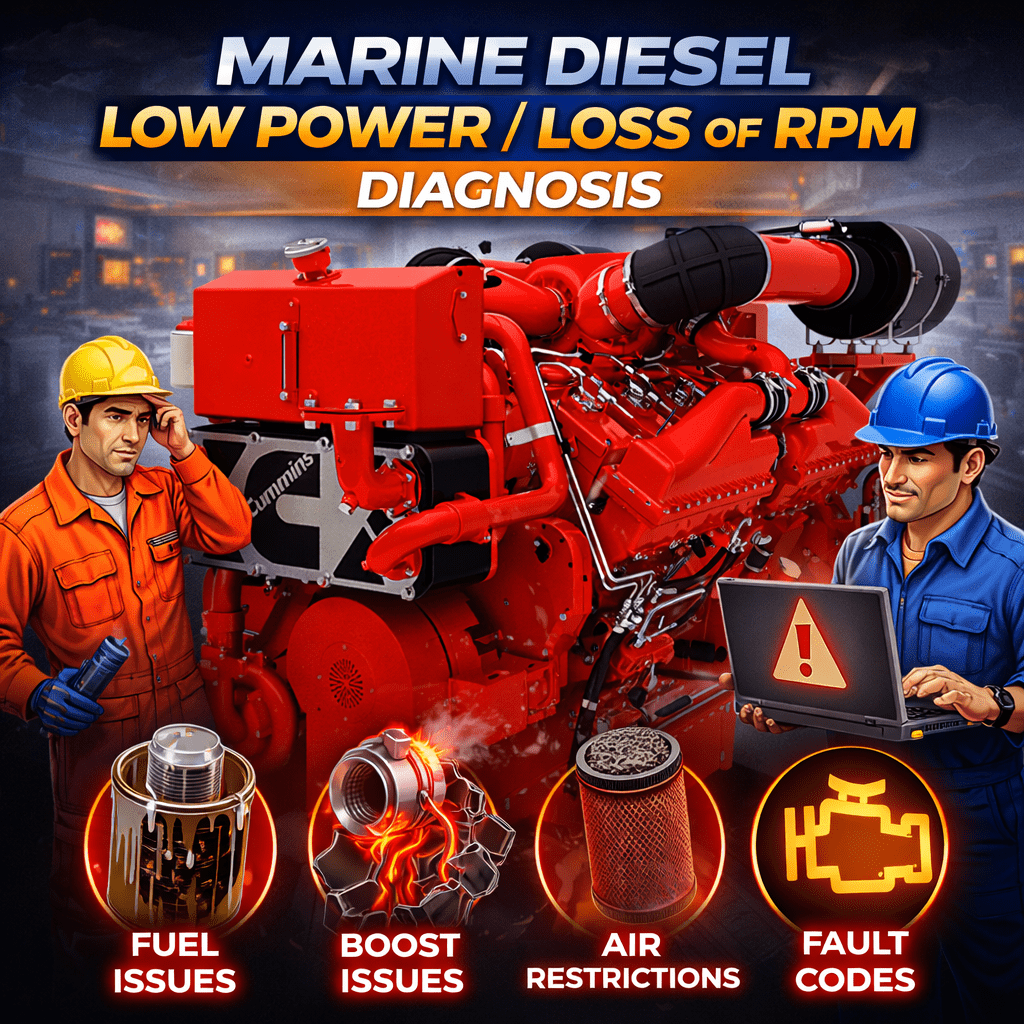
If your marine diesel runs fine at idle but won’t reach rated RPM, feels lazy under load,
or falls on its face at cruise, you’re dealing with one of a handful of root causes:
fuel restriction, air restriction, cooling/aftercooler issues, exhaust backpressure, turbo/boost faults,
prop/load mismatch, or engine wear.
This page walks you through a step-by-step diagnosis used by our trained technician team at
805 Marine Diesel Mechanic across Ventura, Oxnard, Channel Islands Harbor, and Santa Barbara.
Use it like a checklist and stop as soon as you find the “smoking gun.”
Before You Diagnose: Confirm the Complaint (2-Minute Checks)
- Is it both engines or one? If both, suspect fuel quality, load/prop, or common intake/exhaust restrictions.
- Does it happen only under load? If yes, think fuel delivery, boost, aftercooler, exhaust, or prop/load.
- Any new changes? Bottom growth, new props, fuel filter change, recent overheating, or long storage matter.
- Check basics: Throttle actually hits full travel, transmission fully engages, and no alarm/derate is active.
Symptoms That Point You in the Right Direction
- Black smoke under throttle: air restriction / boost leak / aftercooler / over-fueling / overload
- No smoke, just low RPM: fuel restriction / derate / prop overload / weak boost
- Surging at cruise: air leak on suction side, clogged filters, unstable governor, fuel aeration
- Temp creeps up as RPM drops: cooling flow issue or aftercooler/heat exchanger restriction
Step-by-Step Low Power / Loss of RPM Diagnosis
Step 1: Rule Out Prop/Load Issues (The Most Overlooked Cause)
A perfectly healthy engine can’t reach rated RPM if it’s overloaded.
Bottom growth, bent wheels, incorrect pitch, waterlogged gear, or a new prop can drop RPM fast.
- Inspect bottom/gear for growth and drag (especially after sitting).
- Confirm props are correct size/pitch and not damaged.
- Compare port vs starboard RPM and boost (if available). Big differences can indicate load or an engine-side restriction.
Step 2: Check Fuel Supply Restrictions (Primary + Secondary + Lift Pump)
Most “won’t hit RPM” problems are fuel delivery issues. Start at the tank and work forward.
- Primary filter (Racor): confirm bowl is clean and the element isn’t loaded.
- Vacuum gauge (best tool): a rising vacuum under load is a restriction clue.
- Secondary filters: if primaries look clean but symptoms remain, suspect secondaries or a collapsing line.
- Lift pump supply: weak lift pump may idle fine but starves under load.
Related: Marine Diesel Troubleshooting Guide category and
Master Marine Diesel Troubleshooting Guide.
If you run Racor turbines, see our:
Racor Filter Troubleshooting Guide and
Diesel Algae Contamination Signs.
Step 3: Separate Fuel Restriction vs Air Restriction (Fast “Fork in the Road”)
When power drops, your exhaust smoke (or lack of it) is a huge clue:
- Black smoke + low boost: air restriction, aftercooler, boost leak, turbo issue, or overload.
- No smoke + RPM capped: fuel restriction, ECM derate, or prop/load issue.
- Surging / hunting: aerated fuel, suction leak, clogged filters, or unstable governor.
Deep dive: Fuel Restriction vs Air Restriction Diagnosis.
Step 4: Inspect Air Intake + Filtration (Including AirSep / Silencers)
A restricted intake can allow the engine to run, but it won’t make full power.
If you see black smoke while RPM won’t climb, do not skip this step.
- Check air filter element condition and housing seals.
- Inspect AirSep units for oil saturation, collapsed media, and blocked drains.
- Confirm intake hoses are not delaminating internally.
Step 5: Verify Turbo Boost + Charge Air System Integrity
Boost leaks are sneaky: the engine may feel “flat,” smoke more, and never reach WOT.
- Inspect charge air boots/clamps for oil mist tracks (leak indicator).
- Look for soft spots, splits, or loose clamps.
- If you have boost readings, compare actual boost to baseline/spec under load.
Step 6: Aftercooler / Intercooler / Heat Exchanger Restrictions
Cooling system restrictions can cause low power two ways:
higher intake air temps (less oxygen) and overheat/derate.
- Check for rising engine temps at cruise (even small increases matter).
- Inspect heat exchanger core condition and end caps.
- Confirm raw water flow (strainer, pump, impeller, hoses, and discharge).
Related: Heat Exchanger Clogging Symptoms and
Marine Engine Raw Water Flow Problems.
Step 7: Exhaust Restriction / Backpressure Checks
Exhaust restrictions can mimic fuel starvation: the engine feels strangled under load.
Common culprits include a collapsing exhaust hose, blocked mixing elbow, or carbon buildup.
- Inspect mixing elbow / riser for carbon and salt restriction.
- Check hoses for soft/collapsing sections.
- Confirm water injection flow is normal and not flooding the elbow.
Step 8: Electrical / Sensor / Derate (Electronic Engines)
On electronically controlled engines (common-rail and ECM-managed), the engine may “feel okay” but be in a
power derate due to sensor readings, high temp, low boost, or fuel pressure faults.
- Scan for active/inactive codes and review freeze-frame data.
- Verify rail pressure / commanded vs actual (if applicable).
- Confirm throttle input reaches 100% at the ECM.
Step 9: Mechanical Fuel System Issues (Injectors, Pump, Timing)
If restrictions and intake/exhaust check out, move to mechanical causes:
worn injectors, weak injection pump, incorrect timing, or governor issues.
- Injector balance / pop testing (where applicable).
- Check for fuel dilution or contaminated fuel damaging components.
- Confirm rack travel (mechanical systems) and governor linkage integrity.
Step 10: Compression / Blow-By / Engine Wear
Finally, if the engine cannot make cylinder pressure, it cannot make power.
Excessive blow-by, oil consumption, and persistent smoke patterns can point to wear.
- Compression test / leak-down (as applicable).
- Inspect crankcase breather output and oil mist.
- If you suspect end-of-life, see: Signs Your Marine Diesel Engine Is Beyond Rebuild.
Fast “What Should I Check First?” Shortlist
- Bottom/prop/load (growth and overload are common)
- Racor vacuum / restriction (filters and suction leaks)
- Air filter / AirSep (black smoke clue)
- Boost leak (boots/clamps/oil tracks)
- Cooling restriction (aftercooler/heat exchanger/raw water)
- Exhaust restriction (elbow/hose)
- Derate/codes (electronic engines)
Low Power Under Load Is Always a System Problem — Not Just One Component
When a marine diesel engine won’t reach rated RPM, the mistake most people make is focusing on a single component too early. In reality, low power is almost always the result of a system imbalance — fuel, air, cooling, exhaust, load, or mechanical condition falling out of sync under real operating demand.
The key diagnostic advantage you have is this: low power almost always shows up under load. That means the engine is telling you exactly when the system is failing. The job is to identify which system cannot keep up when fuel demand increases.
Advanced Low Power Diagnostic Patterns
- Low RPM + black smoke: airflow problem, turbo issue, aftercooler restriction, or overload.
- Low RPM + no smoke: fuel restriction, ECM derate, or prop/load issue.
- Low RPM + rising temperature: cooling system restriction or heat exchanger issue.
- Low RPM + surging: fuel aeration, suction leak, or unstable supply.
- Low RPM + vibration: drivetrain, prop damage, or imbalance.
Cross-check with:
Black Smoke Under Load,
Engine Surging at Cruise RPM, and
Excessive Vibration Diagnosis.
The “Under Load Only” Rule
If your engine revs freely in neutral but cannot reach RPM in gear, the problem is almost never internal engine failure first. It is almost always:
- Fuel delivery restriction
- Airflow or boost limitation
- Cooling system inefficiency
- Exhaust restriction
- Propeller or hull overload
This is why dockside diagnosis alone often misses the real cause — the engine must be evaluated under actual propulsion load.
Hidden Causes Most People Miss
- Partial boost leaks: not enough to fail, but enough to lose power
- Aftercooler fouling: invisible but reduces air density
- Fuel line collapse: only happens under suction
- Exhaust backpressure: mimics fuel starvation
- Bottom growth: adds load without obvious signs
Deep dive:
Fuel vs Air Restriction,
Exhaust Backpressure,
Aftercooler Problems.
Marine Diesel Low Power / Loss of RPM — FAQ
Why won’t my boat engine reach full RPM?
What is the most common cause of low power?
Why does my engine run fine in neutral but not in gear?
Can dirty fuel filters cause low RPM?
What does black smoke with low RPM mean?
What if there is no smoke but RPM is low?
Can turbo problems cause low power?
Can aftercooler problems reduce engine power?
Can exhaust restriction cause low RPM?
Can bottom growth affect engine RPM?
What is a boost leak?
Can overheating reduce power?
Can fuel contamination cause power loss?
What if the engine surges at cruise?
Can injectors cause low power?
What if only one engine is affected?
Can electronic engines derate power?
What is the first thing I should check?
When should I call a technician?
Where do I go next for full troubleshooting?
805 Marine Diesel Mechanic provides mobile low-power, fuel system, turbo, cooling, and performance diagnostics throughout Ventura, Oxnard, Channel Islands Harbor, and Santa Barbara.
5 Responses