
Low Power / Loss of RPM Diagnostics Center
A marine diesel engine that cannot reach rated RPM or struggles to maintain speed under load is almost always suffering from restriction, imbalance, or efficiency loss somewhere in the system. Low power problems are among the most common service calls because multiple systems — fuel, air, cooling, exhaust, and mechanical load — all influence engine output.
This diagnostic center provides a structured troubleshooting path used by trained technicians to isolate performance issues quickly and avoid unnecessary parts replacement.
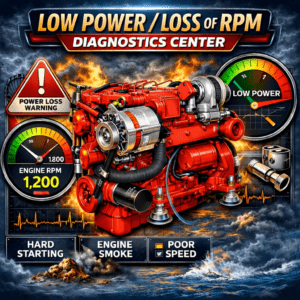
Primary Symptoms of Low Power or RPM Loss
- Engine cannot achieve manufacturer-rated RPM
- Slow acceleration or reduced vessel speed
- Heavy smoke under load
- Turbo boost below expected range
- Engine feels “loaded down” or sluggish
- Increased fuel consumption
- Frequent filter clogging
Step-by-Step Diagnostic Process
Accurate diagnosis requires following a logical order. Many engines receive unnecessary turbo or injector replacements when the root cause is actually fuel restriction or airflow limitation.
- Start with fuel supply integrity via Fuel System Diagnosis Center.
- Inspect primary filtration and Racor assemblies using the Racor Filter Troubleshooting Guide.
- Check for air intrusion using Air in Fuel System Diagnostics.
- Evaluate fuel contamination risks at the Fuel Contamination & Filtration Issues Center.
- Measure turbo boost and inspect charge air system through the Turbo System Diagnosis Center.
- Compare exhaust smoke patterns via the Smoke & Combustion Diagnosis Guide.
- Assess injector health using Injector Troubleshooting.
- Verify cooling system performance through the Cooling System Diagnosis Center.
- Inspect exhaust backpressure and mixing elbow restrictions.
- Confirm results with Computerized Marine Engine Diagnostic Surveys.
Fuel Restriction vs Air Restriction — Understanding the Difference
Low power problems often originate from either insufficient fuel delivery or inadequate airflow. Distinguishing between the two early saves significant diagnostic time.
- Fuel Restriction: rising vacuum readings, RPM drop under load, engine recovers when throttle reduced.
- Air Restriction: black smoke, slow turbo spool, reduced boost pressure.
Common Root Causes Found During Service
- Clogged or waterlogged fuel filters
- Microbial growth (“diesel bug”)
- Collapsed fuel hoses
- Dirty aftercooler reducing airflow
- Restricted heat exchanger limiting engine output
- Exhaust elbow carbon buildup
- Improper propeller load
- Hull fouling increasing resistance
Professional Diagnostic Tools Used
- Fuel vacuum measurement
- Fuel pressure monitoring
- Boost pressure testing
- Thermal temperature comparison
- Live engine data logging
- Injector return flow testing
Preventative Upgrades to Reduce Future Power Loss
- Dual Racor filtration systems
- Vacuum gauge installation
- Remote fuel polishing systems
- High-efficiency air filters
- Aftercooler service intervals
- Fuel manifold upgrade systems
For a full troubleshooting roadmap, return to the Master Marine Diesel Troubleshooting Guide.
2 Responses