
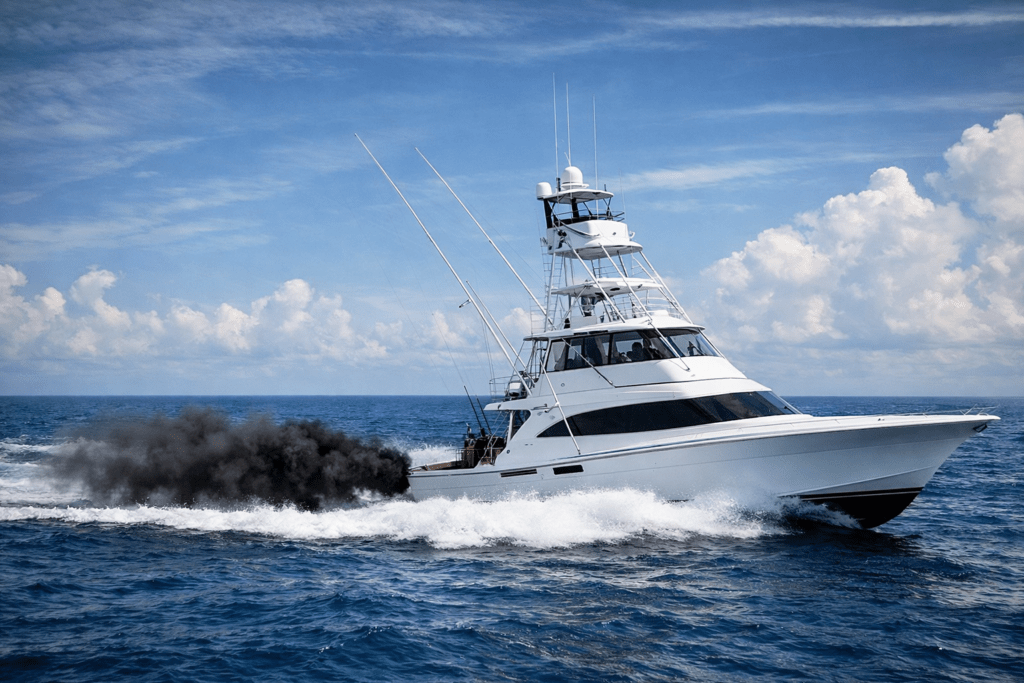
Yacht Engine Black Smoke Under Load – Marine Diesel Diagnosis Guide
If your yacht engine produces black smoke under load, it is one of the clearest indicators that combustion is incomplete. In simple terms, the engine is receiving more fuel than it has air to burn efficiently. This imbalance is almost always tied to turbocharger performance, restricted airflow, fuel delivery issues, or excessive engine load.
After 30+ years diagnosing marine diesel engines across Ventura, Oxnard, Channel Islands Harbor, and Santa Barbara, one truth stands out: black smoke is not just a nuisance—it is a performance warning that the engine is operating inefficiently.
Start here:
Master Marine Diesel Troubleshooting Guide
What Black Smoke Under Load Really Means
Black smoke is unburned fuel exiting the exhaust. Diesel engines rely on precise air-to-fuel ratios. When airflow is reduced or fuel delivery becomes excessive, combustion becomes incomplete and soot forms.
This often becomes visible only under load because fuel demand increases dramatically. At idle, the system may appear normal, masking the issue until throttle is applied.
Diesel combustion depends on correct air/fuel balance (diesel fundamentals) and proper system maintenance (marine diesel maintenance).
1. Turbocharger Performance Failure
The turbocharger supplies the additional air required for combustion under load. If boost pressure is low, fuel cannot burn efficiently, resulting in black smoke.
Common issues include worn bearings, damaged compressor wheels, boost leaks, or slow spool-up.
👉 Turbo Failure Diagnosis
👉 Loss of Power Under Load
2. Air Intake Restriction
Restricted airflow reduces oxygen availability, forcing the engine into a rich condition.
👉 Air System Interaction
👉 Won’t Reach Full RPM
3. Fuel System Imbalance
Excess fuel delivery or poor atomization results in incomplete combustion.
👉 Fuel System Diagnosis
👉 Fuel Contamination
4. Exhaust Restriction
Restricted exhaust increases backpressure and reduces efficiency.
👉 Overheating Diagnosis
👉 Overheating at Idle
5. Engine Overload Condition
Excessive load forces the engine to inject more fuel than it can burn cleanly.
👉 Propeller Problems
👉 Excessive Vibration
6. Mechanical & Combustion Factors
Internal wear and poor combustion efficiency can amplify smoke conditions.
⚠️ Related Local Service
For professional inspection and troubleshooting:
Step-by-Step Professional Diagnosis
- Identify when smoke occurs
- Inspect turbo performance
- Check air intake system
- Evaluate fuel delivery
- Inspect exhaust system
- Check vessel load conditions
- Test overall system performance
Frequently Asked Questions
1. What causes black smoke under load?
It is caused by incomplete combustion due to air/fuel imbalance. Start with the Master Guide.
2. Can turbo failure cause black smoke?
Yes, low boost reduces airflow.
3. Can dirty fuel cause black smoke?
Yes, see Fuel Contamination.
4. Can air restriction cause this?
Yes, reduces oxygen for combustion.
5. Why does it happen at cruise?
Load increases fuel demand.
6. Where should I start?
Start with fuel system diagnosis.
7. Can exhaust restriction cause this?
Yes, affects airflow.
8. Can overload cause smoke?
Yes, excessive load creates imbalance.
9. Is this dangerous?
Yes, indicates inefficiency.
10. Should I keep running?
No, diagnosis recommended.
11. Can this worsen?
Yes, carbon buildup increases.
12. Can turbo cleaning help?
Sometimes, depending on wear.
13. Can injectors cause this?
Yes, poor atomization contributes.
14. Can maintenance prevent it?
Yes, see service page.
15. What is fastest diagnosis?
System-based testing.
16. Do you service Ventura?
Yes, mobile service available.
17. Can fuel filters fix it?
Often yes.
18. When should I call?
When smoke persists.
19. Can this reduce power?
Yes, significantly.
20. Where is full guide?
Use the Master Guide.
2 Responses