
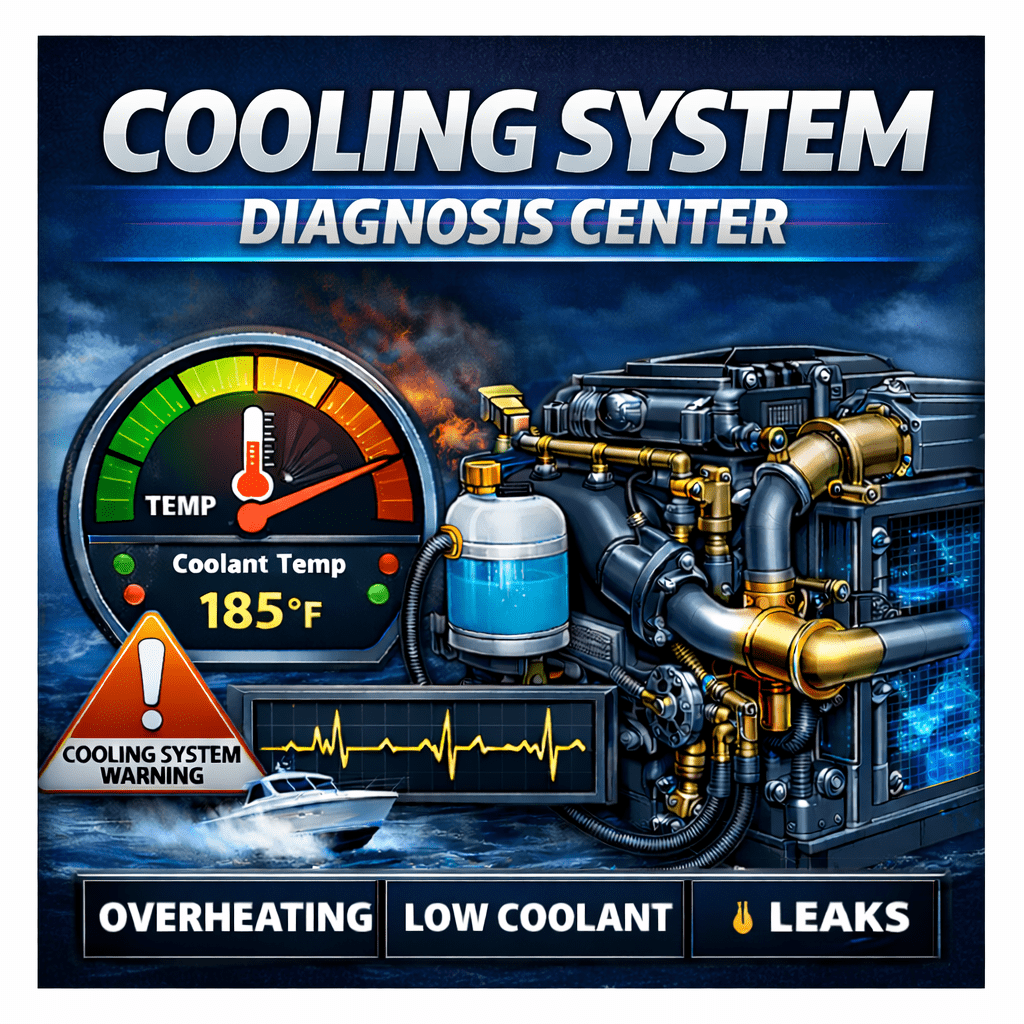
Marine Diesel Cooling System Center: Complete Overheating Diagnosis Hub
Marine diesel cooling system failures are one of the most dangerous and misunderstood problems in the marine environment. Unlike fuel or electrical issues that may cause inconvenience, cooling failures can quickly lead to catastrophic engine damage if not diagnosed correctly.
At 805 Marine Diesel Mechanic, serving Ventura, Oxnard, Channel Islands Harbor, and Santa Barbara, cooling system diagnosis is approached as a complete system—not a single component failure. Before replacing parts, symptoms should be mapped through the Master Marine Diesel Troubleshooting Guide to understand how cooling interacts with fuel, air, combustion, and load.
Cooling System Flow — Where Problems Actually Begin
Marine diesel cooling systems depend entirely on flow. From the raw water intake to the exhaust discharge, any restriction reduces cooling capacity. This is why engines showing overheating symptoms often have underlying flow limitations rather than a single failed part.
When cooling flow drops, combustion temperatures rise, leading to performance loss. This often mirrors loss of power under load, even though the root cause is thermal imbalance.
Raw Water Intake & Strainer Restrictions
Cooling failures frequently begin at the intake. Marine growth, debris, and restricted strainers reduce water flow before it reaches the engine.
This restriction can create symptoms that overlap with not reaching full RPM, because increased temperature reduces engine efficiency.
Seawater Pump & Impeller Failures
The seawater pump maintains flow throughout the system. When impellers wear or lose vanes, flow becomes inconsistent.
These conditions match seawater pump failure patterns and often lead to overheating under load rather than at idle.
Engines may also begin showing hesitation under throttle when cooling capacity drops suddenly.
Heat Exchanger Restrictions
Heat exchangers are one of the most common failure points. Internal buildup reduces heat transfer efficiency over time.
This aligns with heat exchanger clogging symptoms, where temperature gradually rises during extended operation.
As efficiency drops, engines may also show black smoke under load due to combustion imbalance.
Aftercooler & Intake Air Temperature
Aftercoolers regulate intake air temperature. When restricted, they increase combustion heat and add stress to the cooling system.
This often overlaps with aftercooler problems, creating combined performance and temperature issues.
Cooling & Fuel System Interaction
Cooling directly affects combustion efficiency. When temperatures rise, fuel atomization changes, leading to instability.
This is why overheating should be cross-checked with the Fuel System Diagnosis Center when symptoms include power loss or smoke.
Cooling & Turbo System Interaction
Turbochargers rely on stable exhaust temperatures. Overheating increases stress on turbo components.
This can lead to symptoms similar to turbo system failures, including reduced boost and noise.
Electrical & Sensor Misdiagnosis
Faulty sensors can create false overheating readings. This is why temperature issues should also be checked against the Electrical Diagnosis Center.
Shutdown & Thermal Protection
Severe overheating can cause shutdowns. These often align with engine shutdown conditions, where protection systems activate.
Advanced Cooling Diagnostics
Professional diagnostics includes flow testing, infrared temperature mapping, and pressure testing.
Advanced evaluation through the Computerized Diagnostics Center helps identify root causes accurately.
Prevention & Maintenance
Regular inspection of strainers, pumps, and exchangers prevents most failures.
Systems like fresh water flushing reduce salt buildup.
Routine service through marine diesel services ensures reliability.
Local Cooling System Specialists
805 Marine Diesel Mechanic provides mobile cooling diagnostics across Ventura, Oxnard, Channel Islands Harbor, and Santa Barbara, using system-based logic built on 30+ years of experience.
FAQ
1. What causes marine diesel overheating?
Restriction, reduced flow, or heat imbalance across the cooling system.
2. Why does my engine overheat at cruise?
This matches overheating at cruise RPM, often caused by exchanger restriction.
3. Can impellers fail partially?
Yes, causing reduced flow under load.
4. Can cooling issues cause power loss?
Yes, reduced efficiency lowers output.
5. Why is there steam at the exhaust?
Cooling water is not absorbing heat effectively.
6. Can overheating cause smoke?
Yes, especially when combustion becomes unstable.
7. What is exchanger restriction?
Internal buildup limiting heat transfer.
8. Can sensors be wrong?
Yes, faulty sensors can mislead diagnosis.
9. Can overheating damage engines?
Yes, quickly and severely.
10. Does intake blockage matter?
Yes, it reduces total system flow.
11. Can turbo issues relate to cooling?
Yes, overheating affects turbo performance.
12. What is aftercooler failure?
Restricted airflow increasing intake temp.
13. Can cooling affect fuel?
Yes, it impacts combustion efficiency.
14. Should I flush my engine?
Yes, to prevent salt buildup.
15. Can overheating cause shutdown?
Yes, protective systems may activate.
16. What is flow testing?
Measuring water movement through system.
17. Can hoses collapse internally?
Yes, restricting flow.
18. Is overheating always cooling?
No, load and fuel can contribute.
19. Who should diagnose?
A trained marine diesel technician.
20. Where to start?
Start with the Master Guide.
3 Responses