
Why Does My Boat Engine Vibrate Excessively? (Marine Diesel Vibration Guide)
If your boat engine is vibrating more than normal, it’s not just uncomfortable — it’s a sign something is out of balance, misaligned, or wearing out.
After 30+ years diagnosing inboard marine diesel engines throughout Ventura, Oxnard, Channel Islands Harbor, and Santa Barbara, we’ve found that excessive vibration is one of the most overlooked issues that can lead to serious damage if ignored.
In most cases, vibration comes down to engine mounts, alignment, or drivetrain imbalance.
Start with the full diagnostic system here:
Marine Diesel Troubleshooting Guide
What Excessive Vibration Means
Marine diesel engines are designed to run smoothly when properly installed and aligned. Engines from manufacturers like
Caterpillar Marine and
Cummins Marine Engines rely on precise alignment between the engine, transmission, and propeller shaft.
When something shifts or wears, vibration increases — and damage follows.
Common Vibration Symptoms
- Shaking at idle or cruise
- Vibration felt through deck or steering
- Noise increases with RPM
- Visible engine movement
- Uneven wear on components
👉 Related: Engine Losing Power Under Load
1. Worn or Failed Engine Mounts (Most Common Cause)
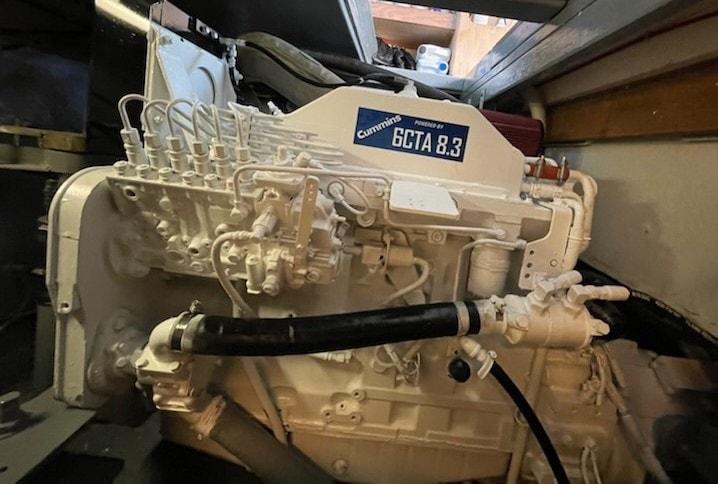
The mounts shown above isolate engine vibration. When they wear out, vibration transfers directly into the hull.
- Rubber deterioration
- Collapsed mounts
- Uneven mount height
👉 Related: Mechanical Failure Diagnostics
2. Engine Misalignment
Improper alignment between engine and shaft is a major cause of vibration.
- Shaft coupling misalignment
- Engine movement over time
- Mount settling
Even slight misalignment can cause severe vibration and damage.
3. Propeller Damage or Imbalance
A damaged or unbalanced propeller creates vibration that travels through the drivetrain.
- Bent blades
- Marine growth buildup
- Improper pitch
4. Shaft Issues or Bent Shaft
A bent or worn shaft causes constant vibration.
- Shaft runout
- Bearing wear
- Improper installation
5. Cutlass Bearing Wear
The cutlass bearing supports the shaft. When worn, it allows movement and vibration.
- Excessive shaft play
- Noise and vibration under load
6. Transmission or Coupling Problems
Drivetrain issues can cause imbalance.
- Worn coupling
- Transmission wear
- Loose hardware
7. Engine Imbalance or Internal Issues
Internal engine problems can also create vibration.
- Misfiring cylinder
- Injector imbalance
- Combustion irregularities
👉 Related: Combustion Diagnosis Center
8. Loose Engine or Mounting Hardware
Loose bolts or brackets allow movement and amplify vibration.
9. Hull or Structural Resonance
Certain RPM ranges can amplify vibration due to hull resonance.
10. Improper Load or Balance
Uneven weight distribution can affect how vibration is transmitted.
👉 Related: Low Power Diagnosis Center
👉 Related: Fuel vs Air Restriction
Real-World Diagnosis (Channel Islands Harbor Case)
We recently diagnosed a vessel in Channel Islands Harbor with severe vibration at cruise speed.
The issue was worn engine mounts combined with slight shaft misalignment.
After replacing mounts and performing alignment, the vibration was completely eliminated.
Step-By-Step Professional Diagnosis
- Inspect engine mounts
- Check shaft alignment
- Inspect propeller condition
- Measure shaft runout
- Inspect cutlass bearing
- Check coupling and transmission
👉 Related: Engine Shutdown Guide
👉 Related: Overheating Guide
Why Vibration Should Not Be Ignored
Ignoring vibration can lead to:
- Shaft damage
- Transmission wear
- Mount failure
- Structural damage
- Loss of efficiency
Professional Marine Diesel Vibration Diagnosis in Ventura
At 805 Marine Diesel Mechanic, we specialize in vibration analysis, alignment, and drivetrain diagnostics with over 30 years of experience.
We provide mobile service throughout Ventura, Oxnard, Channel Islands Harbor, and Santa Barbara.
4 Responses