
Schedule a Computerized Engine Survey
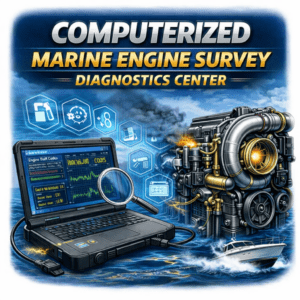
Computerized Marine Diesel Engine Survey Diagnosis Center
Computerized diagnostics is the bridge between what an engine is doing and why it is doing it. When symptoms don’t match obvious mechanical failures—or only appear under load—scan data, live monitoring, and sea-trial verification allow trained technicians to diagnose the problem accurately instead of guessing.
At 805 Marine Diesel Mechanic, serving Ventura, Oxnard, Channel Islands Harbor, and Santa Barbara, diagnostics always start with system-based logic. Before diving into scan data, symptoms should be mapped through the Master Marine Diesel Troubleshooting Guide so electronic data is interpreted in the correct context.
Electronic Data vs Real Engine Behavior
A scan tool shows what the ECU detects, not the root cause. A low boost code may point toward turbo issues, but real-world testing often reveals airflow restriction, which is why problems like this should be verified through boost pressure testing instead of replacing parts prematurely.
Temperature alarms can point toward overheating, but they may also be caused by exchanger restriction, airflow imbalance, or load issues. That is why overheating conditions should always be compared with heat exchanger clogging symptoms before assuming the cooling system is failing.
Live Data Under Load — Where Diagnosis Becomes Clear
Most marine diesel problems occur under load, not at idle. Live data reveals how the engine behaves when demand increases.
Engines that lose power under load often show fuel or airflow imbalance, which is why those patterns should be compared with low power and loss of RPM scenarios.
Cooling-related issues become visible when temperature rises at cruise, aligning with cooling system diagnosis conditions rather than idle performance.
Smoke behavior also changes under load. If black smoke appears during acceleration, it should be evaluated alongside black smoke under load where airflow, fuel, and temperature all interact.
Sea Trial Verification
Without a sea trial, many issues remain hidden. Engines that appear normal at the dock may fail under real conditions.
For example, an engine that struggles to reach full RPM during operation should be compared with not reaching full RPM patterns where load, fuel, and airflow must all be evaluated together.
Similarly, hesitation during throttle-up often appears only under load and can overlap with hesitation when throttling up, which requires real-world testing to confirm.
Mechanical Confirmation
Scan data points to a system, but physical testing confirms the cause.
Fuel delivery issues must be verified through processes like fuel system priming and air removal when symptoms suggest instability.
Cooling flow must be verified when temperature rises, especially when patterns resemble seawater pump failure.
Airflow issues must be confirmed when performance drops, particularly when symptoms align with aftercooler restriction problems.
Pre-Purchase Engine Surveys
Computerized diagnostics is critical during a pre-purchase marine engine survey, where hidden issues must be identified before ownership changes hands.
Live data reveals whether the engine reaches rated RPM, maintains stable temperature, and performs correctly under load.
Why Accurate Diagnostics Saves Money
Replacing parts based on codes alone leads to wasted time and expense. Accurate diagnostics identifies the real cause, preventing unnecessary repairs and ensuring the engine is restored correctly.
Local Marine Diesel Diagnostics
805 Marine Diesel Mechanic provides mobile diagnostics across Ventura, Oxnard, Channel Islands Harbor, and Santa Barbara, using real-world testing and system-based analysis to identify root causes quickly and accurately.
FAQ
1. Can scan tools diagnose everything?
No. Scan tools show data, but diagnosis requires comparing that data with real engine behavior.
2. Why do I have codes but no symptoms?
Some faults are intermittent or early-stage issues.
3. Why do I have symptoms but no codes?
Many issues like restriction or airflow problems do not trigger codes.
4. Can boost codes be misleading?
Yes. They often require boost testing to confirm cause.
5. Can overheating trigger false assumptions?
Yes. It must be compared with cooling restriction issues.
6. Why is sea trial important?
Because most failures only appear under load.
7. Can fuel issues mimic turbo failure?
Yes. Systems overlap significantly.
8. Can diagnostics prevent repairs?
Yes, by identifying root cause first.
9. What is live data?
Real-time engine performance data.
10. Why does RPM matter?
It shows load and system efficiency.
11. Can airflow issues cause smoke?
Yes, especially when combined with heat imbalance.
12. Can cooling issues affect power?
Yes, reduced efficiency lowers output.
13. Can electrical faults affect readings?
Yes, especially sensors.
14. Can fuel priming fix issues?
Yes, in cases of air intrusion, see fuel priming.
15. Can diagnostics detect early failures?
Yes, before major damage occurs.
16. Should I test before replacing parts?
Always.
17. Can injectors fail without codes?
Yes, especially with contamination.
18. Can overheating damage multiple systems?
Yes, cascading damage is common.
19. Who should diagnose?
A trained marine diesel technician.
20. Where should I start?
Start with the Master Guide.
6 Responses