
Why Does My Boat Engine Have White Smoke at Startup? (Marine Diesel Guide)
If your boat produces white smoke when starting up, especially when cold, you’re seeing one of the most common marine diesel symptoms: incomplete combustion.
After 30+ years diagnosing marine diesel engines throughout Ventura, Oxnard, Channel Islands Harbor, and Santa Barbara, we can tell you that white smoke is usually a sign that fuel is entering the cylinder but not burning properly.
Unlike black smoke (too much fuel) or blue smoke (oil burning), white smoke tells you the engine is struggling to ignite fuel — especially during cold starts.
Start with the full diagnostic system here:
Marine Diesel Troubleshooting Guide
What White Smoke Means
White smoke is typically unburned or partially burned diesel fuel exiting the exhaust. This happens when combustion temperatures are too low or ignition is delayed.
Diesel engines rely on compression heat to ignite fuel (diesel combustion basics). When that heat is insufficient, fuel vapor exits as white smoke.
Common White Smoke Symptoms
- White smoke at cold startup
- Smoke disappears as engine warms up
- Rough idle after starting
- Extended cranking before startup
- Strong diesel smell in exhaust
👉 Related: Hard Starting Cold Guide
1. Poor Fuel Injector Atomization (Top Cause)
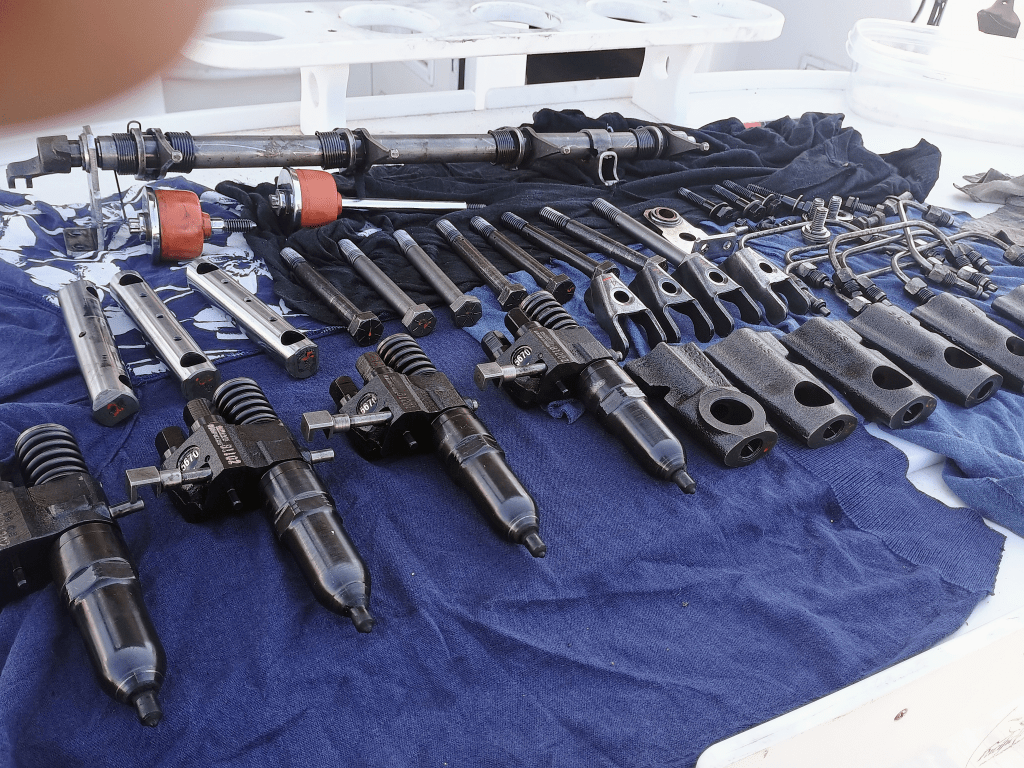
The injectors shown above play a critical role in startup performance. If they don’t atomize fuel properly, combustion will be delayed or incomplete.
- Worn injector tips
- Clogged nozzles
- Leaking injectors
👉 Related: Smoke & Combustion Diagnosis Center
2. Low Compression (Major Cause on Older Engines)
Diesel engines rely entirely on compression heat. If compression is low, fuel will not ignite efficiently.
- Worn piston rings
- Valve leakage
- Cylinder wear
Low compression reduces combustion temperature — especially when the engine is cold.
👉 Related: Mechanical Failure Diagnostics
Caterpillar Marine Diesel Engines
3. Cold Engine / Insufficient Heat
Cold engines absorb heat quickly, making ignition harder.
- Cold ambient temperatures
- Engine sitting overnight
- Lack of preheating
4. Glow Plug or Intake Heater Failure
On engines equipped with glow plugs or intake heaters, failure will lead to poor cold combustion.
- Hard starting
- White smoke during cranking
- Rough initial operation
👉 Related: Electrical Diagnosis Center
5. Air in the Fuel System
Air disrupts injection timing and reduces fuel pressure, leading to incomplete combustion.
- Loose fittings
- Fuel system leaks
- Improper priming
👉 Related: Fuel System Air Leak Guide
6. Incorrect Injection Timing
If fuel is injected too early or too late, combustion efficiency drops.
- Timing drift
- Injection pump issues
- Electronic timing faults
Proper timing is critical for efficient combustion (marine diesel fuel system overview).
7. Fuel Quality Issues
Poor fuel quality can affect combustion.
- Water contamination
- Low-quality diesel
- Algae growth
👉 Related: Fuel Contamination Center
8. Low Cranking Speed
If the engine doesn’t spin fast enough, compression heat is reduced.
- Weak batteries
- Starter issues
- Voltage drops
👉 Related: Cranks But Won’t Start Guide
9. Coolant or Water Intrusion (Less Common but Serious)
In some cases, white smoke can indicate coolant entering the combustion chamber.
- Head gasket failure
- Cracked head
- Aftercooler leak
10. Normal Cold Start Behavior (Short Duration Only)
A small amount of white smoke at startup can be normal — especially in colder conditions — but it should disappear quickly.
Real-World Diagnosis (Channel Islands Case)
We recently diagnosed a vessel in Channel Islands Harbor producing heavy white smoke at startup.
The issue was worn injectors combined with weak glow plugs.
After replacement, the engine started clean with no visible smoke.
Step-By-Step Professional Diagnosis
- Inspect injectors
- Check compression
- Test glow plugs or intake heater
- Inspect fuel system for air leaks
- Verify injection timing
- Check fuel quality
👉 Related: Engine Shutdown Guide
Why White Smoke Should Not Be Ignored
Persistent white smoke can lead to:
- Fuel system damage
- Carbon buildup
- Poor engine performance
- Increased wear
Professional Marine Diesel Diagnosis in Ventura
At 805 Marine Diesel Mechanic, we specialize in combustion and startup diagnostics with over 30 years of experience.
We provide mobile service throughout Ventura, Oxnard, Channel Islands Harbor, and Santa Barbara.
White Smoke at Startup Is a Timing-and-Temperature Clue
White smoke at startup is one of the most useful diagnostic clues on a marine diesel because it usually means fuel is present, but the engine is not creating the right conditions to burn it cleanly yet. That can happen because cylinder temperature is too low, cranking speed is weak, injector atomization is poor, preheat support is weak where equipped, compression is marginal, or timing-related delivery is not happening when it should.
The most important question is not just what color is the smoke? but when does it happen, how long does it last, and what else is the engine doing at the same time? White smoke that appears only at cold startup and clears quickly usually follows a very different path than white smoke that persists after warm-up, continues under load, or comes with coolant loss, shutdown complaints, or rough running.
Fast White Smoke Decision Path
- White smoke only when cold, then clears: start with combustion support, injector spray quality, preheat performance, and cold-start cranking speed. Compare with Yacht Engine Hard Starting When Cold and Boat Engine Hard Starting – Marine Diesel Diagnosis Guide.
- White smoke with long crank time: weak cranking speed, air in fuel, fuel drain-back, or marginal combustion temperature become more likely. Continue with Marine Diesel Cranks But Won’t Start and Boat Engine Air in Fuel System – Marine Diesel Diagnosis Guide.
- White smoke plus rough idle after startup: injector imbalance, poor atomization, weak cylinder contribution, or compression-related concerns move higher on the list. See Smoke & Combustion Diagnosis Center.
- White smoke that does not clear warm: do not assume it is “normal cold start smoke.” Timing-related issues, injector problems, incomplete combustion, or coolant intrusion deserve more serious attention. Compare with Marine Engine Mechanical Failure Diagnostics.
- White smoke followed by shutdown, stumbling, or unstable running: broaden the path into fuel supply and support-system diagnosis using Engine Shutdown Guide and Fuel Contamination & Filtration Issues Center.
Why White Smoke Gets Misread
One of the biggest mistakes owners make is assuming white smoke always means coolant or head gasket failure. Sometimes it does, but on many marine diesels white smoke is more directly tied to unburned fuel and weak cold combustion. That is especially true when the smoke has a raw diesel smell, the engine is rough while it is smoking, and the symptom improves as temperature builds.
Across Ventura, Oxnard, Channel Islands Harbor, and Santa Barbara, white smoke complaints often overlap with hard starting, slow cranking, fuel drain-back, injector wear, and compression-related concerns on older engines. That is why 805 Marine Diesel Mechanic treats startup smoke as part of a broader combustion-support diagnosis rather than chasing only one component first.
Related Systems That Commonly Influence White Smoke
The most common related systems are injector condition, cranking RPM, glow plug or intake heater support where equipped, fuel delivery stability, compression, and in some cases coolant or aftercooler leakage. If the engine also starts hard, runs rough, or changes smoke behavior after service or storage, those clues matter just as much as the smoke itself.
For broader comparison, use this page together with Marine Diesel Smoke Diagnosis Guide, Electrical & Starting System Diagnosis Center, Fuel System Diagnosis Center, and How to Diagnose Marine Diesel Engine Problems.
Why Does My Boat Engine Have White Smoke at Startup? – FAQ
These frequently asked questions help boat and yacht owners understand what white smoke at startup usually means on a marine diesel engine and how to follow the right diagnostic path before replacing expensive parts unnecessarily.
What does white smoke at startup mean on a marine diesel engine?
Is white smoke at startup always a head gasket problem?
Why does my engine smoke white only when cold?
Why does the white smoke go away after warm-up?
Can bad injectors cause white smoke at startup?
Can low compression cause white smoke?
Can weak glow plugs or intake heaters cause white smoke?
Can air in the fuel system cause white smoke?
Can low cranking speed make a diesel smoke white?
What if the engine cranks a long time and then smokes white?
Can poor fuel quality cause white smoke?
What if the engine smells strongly of raw diesel while smoking white?
When is white smoke more serious?
Can coolant intrusion cause white smoke?
Can aftercooler leaks contribute to white smoke symptoms?
What if white smoke comes with rough idle after startup?
Should I ignore a small amount of white smoke on cold mornings?
When should I call a marine diesel technician for white smoke?
Where should I continue if I suspect startup support or electrical issues?
Where should I continue if I suspect broader combustion or internal issues?
Related White Smoke, Hard Start, Fuel & Combustion Diagnosis Guides
- Marine Engine White Smoke at Startup Diagnosis
- Boat Engine Hard Starting – Marine Diesel Diagnosis Guide
- Yacht Engine Hard Starting When Cold
- Boat Engine Air in Fuel System – Marine Diesel Diagnosis Guide
- Fuel Contamination & Filtration Issues Center
- Marine Diesel Cranks But Won’t Start
- Why Does My Boat Engine Keep Shutting Off While Running?
- How to Diagnose Marine Diesel Engine Problems
805 Marine Diesel Mechanic provides mobile marine diesel startup, combustion, hard-start, fuel-system, and white-smoke diagnostics throughout Ventura, Oxnard, Channel Islands Harbor, and Santa Barbara, helping boat owners identify the real cause before expensive parts are replaced.
One Response