
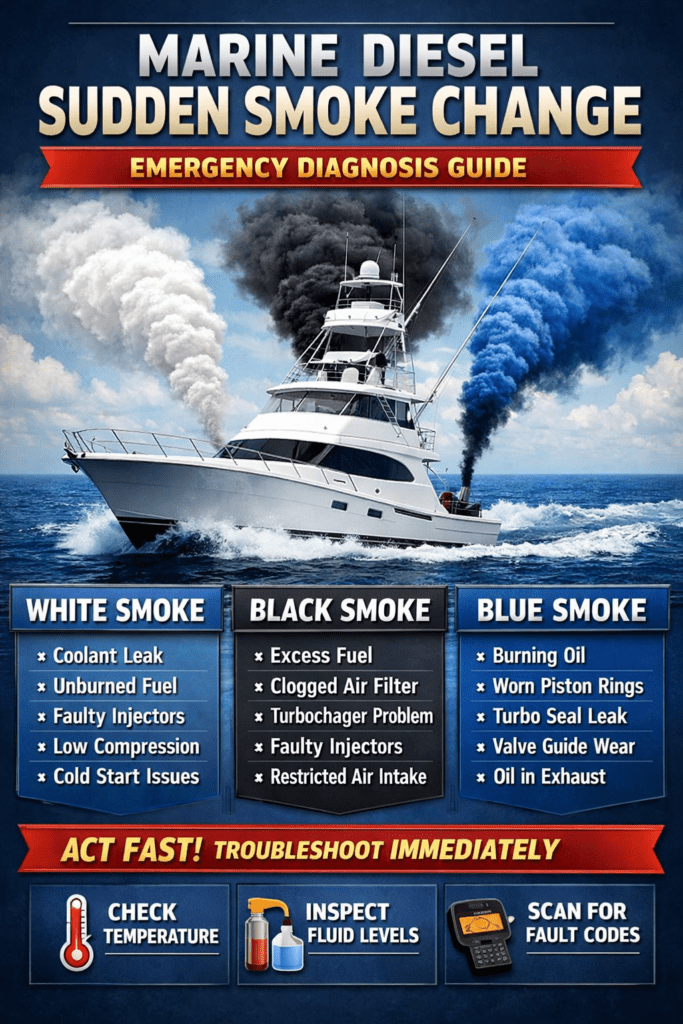
Sudden Smoke Change Emergency Guide
A sudden change in exhaust smoke from a marine diesel engine is one of the clearest warning signs that something has changed immediately inside the system. Unlike gradual smoke conditions, sudden black, white, or blue smoke indicates an active imbalance or failure that can escalate quickly if ignored.
At 805 Marine Diesel Mechanic, serving Ventura, Oxnard, Channel Islands Harbor, and Santa Barbara, sudden smoke is treated as an emergency diagnostic condition. The priority is always the same: protect the engine first, then isolate the root cause.
Always begin by referencing the Master Marine Diesel Troubleshooting Guide to identify the correct diagnostic path before continuing operation.
Immediate Action — Protect the Engine First
- Reduce throttle immediately
- Remove engine load
- Monitor oil pressure and temperature
- Listen for new noise
- Prepare to shut down if conditions worsen
Many engines are lost not from the initial failure—but from continuing to run under load after the warning appears.
Sudden Smoke by Color — Fast Diagnosis
Black Smoke (Air/Fuel Imbalance)
Sudden black smoke means the engine is receiving more fuel than available air. This often indicates airflow or boost failure.
- Turbocharger failure or boost loss
- Air intake restriction
- Aftercooler fouling
- Exhaust restriction
- Engine overload
Compare with Black Smoke Under Load and confirm using Boost Pressure Testing.
White Smoke (Combustion Failure / Water)
- Cooling system failure
- Injector malfunction
- Timing issues
- Compression loss
Cross-check with White Smoke Diagnosis and the Cooling System Diagnosis Center.
Blue Smoke (Oil Burning)
- Turbo oil seal failure
- Restricted oil drain
- Crankcase pressure issues
- Internal wear
Compare with Turbo Oil System Problems.
System Crossover — Why Smoke Is Never One Problem
Sudden smoke is rarely isolated. It usually overlaps with multiple system failures:
The correct diagnosis comes from identifying the combination—not just the smoke.
Emergency Diagnostic Checklist
- Identify smoke color
- Check oil pressure
- Check engine temperature
- Evaluate power output
- Inspect boost performance
- Check fuel delivery
- Listen for abnormal noise
Advanced testing through the Computerized Diagnostics Center confirms the limiting system under load.
When to Shut Down Immediately
- Loss of oil pressure
- Rapid overheating
- Knocking or mechanical noise
- Severe power loss with dense smoke
If these occur together, shut down immediately to prevent catastrophic damage.
External Authority References
Local Emergency Marine Diesel Diagnostics
805 Marine Diesel Mechanic provides rapid-response diagnostics throughout Ventura, Oxnard, Channel Islands Harbor, and Santa Barbara. With over 30 years of experience, every diagnosis follows a system-based approach to prevent unnecessary damage.
Bottom Line
Sudden smoke means something changed immediately. Reduce load, observe the symptoms, and diagnose before continuing operation. Acting early is what prevents major engine damage.
FAQ
1. What causes sudden smoke?
Sudden smoke is caused by rapid system imbalance in fuel, air, cooling, turbo, or mechanical systems.
2. Should I reduce throttle immediately?
Yes. Removing load protects the engine while diagnosing.
3. Is sudden smoke dangerous?
Yes, it often indicates active failure.
4. What does black smoke mean?
Air/fuel imbalance, often airflow or turbo related.
5. What does white smoke mean?
Combustion or coolant-related issues.
6. What does blue smoke mean?
Oil entering combustion.
7. Can turbo failure cause sudden smoke?
Yes, especially black or blue smoke.
8. Can fuel contamination cause sudden smoke?
Yes, unstable combustion from contamination.
9. Can overheating cause smoke?
Yes, through combustion inefficiency.
10. Should I keep running the engine?
No, not under load.
11. Can injectors cause sudden smoke?
Yes, injector failure can change combustion instantly.
12. Can exhaust restriction cause smoke?
Yes, it limits airflow.
13. Can overload cause smoke?
Yes, excessive load creates imbalance.
14. What is the first check?
Oil pressure, temperature, smoke color.
15. Can smoke damage the engine?
Yes, through heat and carbon buildup.
16. Should I replace parts immediately?
No, diagnose first.
17. Can multiple systems fail together?
Yes, very common.
18. When should I call a technician?
If symptoms persist or worsen.
19. What tests confirm the cause?
Boost, fuel, and live-data diagnostics.
20. Where do I start?
Start with the Master Troubleshooting Guide.