
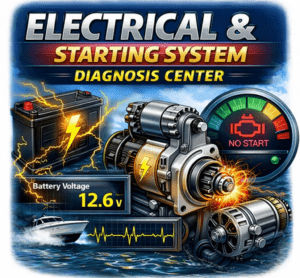
Electrical & Starting System Diagnosis Center
If your marine diesel won’t crank, cranks slow, starts only sometimes, or keeps killing batteries, this hub gives you the fastest symptom-first pathway to the real cause — without random parts swapping.
805 Marine Diesel Mechanic provides mobile marine diesel diagnostics and repair throughout Ventura, Oxnard, Channel Islands Harbor, and Santa Barbara.
Start Here: What Is Your Symptom?
1) No Crank (Key turns, nothing happens)
- Battery disconnect / selector switch / main fuse issue
- Low battery voltage or bad battery cables/ends
- Ignition switch / neutral safety switch / start relay
- Starter solenoid not engaging
2) Slow Crank (Struggles to turn over)
- Weak battery under load (voltage drop)
- Corroded/undersized cables or loose grounds
- Starter drawing excessive amps (internal failure)
- Mechanical drag (hydrolock, seized accessory, tight engine)
3) Cranks But Won’t Start
- Fuel delivery issue (air intrusion, restriction, priming problem)
- Glow plug / intake heater system problem (if equipped)
- ECU power / sensor / shutdown circuit on electronically controlled engines
4) Starts, Then Dies / Intermittent No-Start
- Low voltage to ECU, failing relay, loose grounds
- Charging system not maintaining battery
- Harness rub-through, moisture intrusion, poor connectors
Related Diagnostic Centers
Electrical No-Start Checklist (5-Minute Pro Workflow)
Step 1: Confirm Battery State (Resting Voltage)
- 12V systems: ~12.6V fully charged (rested), ~12.2V is weak, ~12.0V is basically dead
- 24V systems: ~25.2V fully charged (rested), ~24.4V weak, ~24.0V very low
Tip: Resting voltage is only half the story — the real truth is voltage under cranking load.
Step 2: Perform a Voltage Drop Test While Cranking
- Measure from battery positive post to starter B+ terminal while cranking
- Measure from starter case to battery negative post while cranking
- High drop = resistance (corrosion, loose connection, failing cable, bad ground)
Step 3: Verify Control Circuit (Start Signal)
- Key switch “START” output present?
- Neutral safety switch / transmission interlock closed?
- Start relay clicking and passing power?
- Starter solenoid receiving a strong trigger signal?
Step 4: Check Charging System (After It Starts)
- Alternator output is not “nice to have” — it’s what prevents repeat no-starts
- Look for belt slip, loose alternator wiring, failing regulator, bad sense wire
Most Common Causes of Marine Diesel Starting Problems
Battery + Cable Problems
- Hidden corrosion inside cable lugs (especially in salt air)
- Loose grounds to block/bellhousing
- Undersized cables or long runs causing cranking voltage loss
Starter + Solenoid Issues
- Solenoid contacts burnt (clicks but won’t crank)
- Starter draws high amperage (slow crank, hot cables)
- Heat soak causing intermittent no-crank
Relay / Switch / Harness Faults
- Neutral safety switch misadjusted
- Failing start relay (intermittent)
- Harness chafe or moisture intrusion at connectors
Mechanical Drag (Electrical Symptoms, Mechanical Cause)
- Hydrolock, seized accessory, tight engine, or internal failure
- If the starter can’t rotate the engine, stop and verify mechanically
Helpful next steps:
When to Stop Cranking Immediately
- Battery cables getting hot or smoking
- Starter grinding or abnormal mechanical noise
- Engine stops rotating suddenly (possible hydrolock or mechanical interference)
- Repeated cranking with no progress — risk of starter damage and overheated wiring
Mobile Electrical & Starting Diagnostics (Ventura, Oxnard, Channel Islands Harbor, Santa Barbara)
When basic checks don’t isolate the fault, a trained technician can test cranking voltage drop, starter amperage draw, charging output, and control-circuit integrity — then confirm the fix with repeatable results.
Recommended References (Boat Owners)
- BoatUS (boating safety, maintenance, and owner resources)
- Yachting Magazine (systems, maintenance, and troubleshooting articles)
- ABYC (marine electrical standards and best practices)
- NMEA (marine electronics and wiring guidance)
Electrical & Starting System FAQs
What battery voltage should I see before cranking?
On a rested 12V system, ~12.6V is fully charged. The more important number is what voltage remains during cranking — low cranking voltage points to weak batteries or high resistance in cables/grounds.
Why does my engine start fine sometimes, then won’t crank later?
Intermittent no-crank is often a heat-soaked starter, failing relay, loose ground, battery switch issue, or corroded cable ends that open up with vibration and heat.
My starter clicks but doesn’t turn the engine. What does that mean?
Usually the solenoid is engaging but the main contacts are burnt, battery voltage collapses under load, or there’s high resistance in the cable/ground path.
Can a fuel problem look like an electrical problem?
Yes. “Cranks but won’t start” is commonly fuel delivery (air intrusion, restriction, lost prime). Use the Fuel System Diagnosis Center pathway next.
What’s the fastest way to find cable corrosion?
Voltage drop testing under cranking load. It identifies resistance you can’t see — even when cables look “fine” on the outside.
3 Responses