
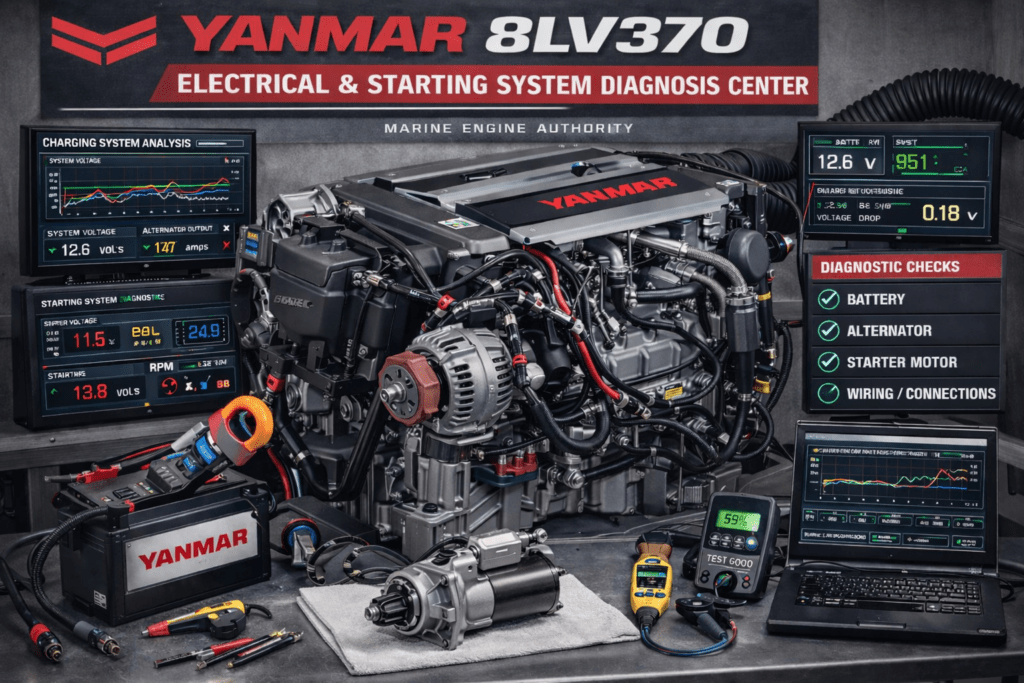
The Yanmar 8LV370 is a modern electronically controlled marine diesel that depends heavily on clean voltage, strong cranking power, and stable electronic communication to start and run correctly. This guide explains how to diagnose slow cranking, no-start complaints, battery drain, starter faults, and charging system problems on the Yanmar 8LV370 using real system-based logic instead of guessing and replacing parts blindly.
Yanmar 8LV370 Marine Diesel Electrical & Starting System Problems: Complete Diagnosis Guide
The Yanmar 8LV370 marine diesel engine is a high-performance electronically controlled V8 used in sport cruisers, performance boats, and luxury vessels where reliable starting and stable electrical system behavior are critical. Unlike older purely mechanical diesels, the 8LV370 relies on more than just battery power and a starter motor. It also depends on engine control modules, sensors, charging system stability, and healthy wiring paths that can support modern electronic management.
When electrical or starting system problems develop, the symptoms may begin subtly. The engine may crank a little slower than normal, start intermittently, trigger warning lights, or act unpredictable after sitting for a short time. In other cases, the engine may suddenly fail to start at all. Because this platform is electronically managed, diagnosis must include both the heavy-current starting side and the low-voltage electronic control side.
At 805 Marine Diesel Mechanic, Yanmar electrical and starting system problems are diagnosed throughout Ventura, Oxnard, Channel Islands Harbor, and Santa Barbara. With over 30 years of marine diesel experience, the goal is to determine whether the real cause is battery condition, cable resistance, starter performance, charging weakness, panel and relay faults, or an engine-control-related problem. This page works as part of your full authority network and expands from the Master Marine Diesel Troubleshooting Guide.
How the Yanmar 8LV370 Starting System Works
A marine diesel starting system has one simple job: rotate the engine fast enough for the cylinders to build enough heat for combustion. On the Yanmar 8LV370, that job still depends on traditional high-current components like batteries, cables, a starter motor, and a starter solenoid. But because the engine is electronically controlled, the system also depends on stable voltage supply to sensors, control modules, and engine electronics that influence whether the engine will actually start and continue running.
The primary starting and electrical path includes:
- Engine starting batteries
- Battery switches and cable connections
- Starter motor
- Starter solenoid
- Battery cables and grounds
- Alternator and voltage regulation
- Electronic engine control systems
- Related relays, fuses, and panel circuits
If any of these components develop high resistance, weak output, poor continuity, or unstable voltage behavior, starting performance will suffer. That is why modern marine diesel electrical diagnosis has to look at the complete chain instead of blaming just the starter or just the batteries.
Common Yanmar 8LV370 Starting Problems
Electrical and starting system issues often produce recognizable patterns. Learning to separate those patterns is what makes diagnosis faster and more accurate.
- Slow engine cranking
- Clicking starter solenoid
- Complete no-start condition
- Electrical alarms or warning lights
- Intermittent starting problems
- Low-voltage fault behavior after sitting
- Battery repeatedly going flat
Some of these overlap with broader complaint pages such as Boat Engine Won’t Start, Electrical & Starting System Diagnosis Center, Engine Starts Then Dies, and No Smoke When Cranking. Those crossover symptoms matter because a starting complaint can be caused by either electrical weakness or a system that prevents fuel and combustion once cranking begins.
Battery and Voltage Problems
Battery condition is one of the most important factors in Yanmar 8LV370 starting reliability. A battery can show acceptable voltage at rest and still collapse badly under load. That is why load testing and voltage-drop analysis are far more useful than simply checking open-circuit voltage and assuming the batteries are good.
Common battery-related problems include:
- Weak or partially discharged batteries
- Corroded battery terminals
- Loose battery connections
- Battery cable resistance
- Undersized or aging cables
- Poor ground paths
High resistance anywhere in the battery-to-starter path reduces starter performance. On a high-compression diesel, even a modest reduction in cranking speed can be the difference between a clean start and a frustrating no-start condition.
For related site structure, this symptom also ties naturally into Hard to Start When Cold and Boat Engine Won’t Start because weak voltage often becomes more obvious after sitting or during cold starts.
Starter Motor Failure
The starter motor must generate enough torque to rotate the Yanmar 8LV370 fast enough for combustion to begin. If the starter motor is worn, dragging, heat-damaged, or electrically starved, the engine may crank slowly, click without turning, or fail to crank consistently.
Common starter motor problems include:
- Worn internal brushes
- Faulty starter solenoid
- Starter overheating
- Corroded heavy-current connections
- Internal starter drag or mechanical wear
Starter motors often fail gradually before they fail completely. That is why intermittent slow cranking should be taken seriously. Many “sudden” no-start problems were actually warning the owner for weeks beforehand.
Alternator and Charging System Issues
The alternator’s job is not just to recharge the batteries. It also stabilizes system voltage while the engine is running. If the alternator is weak, the regulator is failing, or the charge circuit has poor continuity, the batteries may never fully recover between outings. The engine then begins the next start cycle already behind.
Charging system faults commonly include:
- Faulty alternator regulator
- Loose or slipping alternator belts
- Charge-circuit wiring faults
- Poor alternator output under load
- Battery isolation or charging-distribution problems
Charging problems are especially deceptive because the boat may start fine one day and struggle badly the next. In those cases the true issue is not the starting system itself, but the fact that the batteries were never brought back to proper charge in the first place.
This is why charging problems often connect to deeper electrical reliability pages like Electrical & Starting System Diagnosis Center and more general boat power-loss reliability complaints.
Electronic Control System Influence
The Yanmar 8LV370 uses advanced electronic engine controls, which means not every no-start or starting complaint is caused by heavy-current electrical hardware. Sensor faults, ECU-related faults, wiring communication issues, low-voltage logic faults, and engine-control protection behavior can all prevent starting or create warning conditions even when the batteries and starter appear mechanically capable.
Electronic faults may also interact with other systems. For example:
- A fuel delivery problem may be misread as a starting problem
- A sensor fault may trigger protective logic that affects starting behavior
- Low voltage may create false or secondary fault codes
- Turbo or fuel-related issues may appear after the engine finally starts
That is why related diagnostic pathways still matter, including the Fuel System Diagnosis Center and Marine Diesel Turbo Diagnosis Center. Modern engines do not always fail in a single neat category.
Step-by-Step Yanmar 8LV370 Electrical Diagnosis
1. Confirm the Exact Starting Pattern
Does the engine crank slowly, click once, fail completely, or crank normally but never fire? Pattern comes first. A no-crank condition is a very different path from a crank-no-start condition.
2. Load Test the Batteries
Do not stop at voltage reading. Load test the batteries and verify voltage under actual cranking demand. Weak batteries are one of the most common causes of Yanmar starting complaints.
3. Check Voltage Drop Across Cables and Grounds
High resistance in positive and ground paths can destroy starter performance even when the batteries themselves are acceptable. Voltage-drop testing is one of the fastest ways to find hidden cable or connection problems.
4. Evaluate Starter Current Draw and Cranking Speed
A dragging starter may draw abnormal current while producing poor cranking speed. This points toward internal starter wear, mechanical drag, or cable resistance.
5. Test Alternator Output and Recovery Charging
If the engine starts intermittently after sitting, the charging side needs attention. Check alternator output, regulator behavior, and whether the batteries are actually recovering after use.
6. Check Fuses, Relays, and Control Inputs
On electronically controlled engines, small control-side issues can stop the entire system. Fuse integrity, relay operation, ignition-switch behavior, and control voltage stability all matter.
7. Move Beyond Electrical if Cranking Is Normal
If the engine cranks strongly but still does not fire, move into fuel delivery, shutdown control, and combustion-related diagnosis rather than staying stuck in the starter circuit.
Professional Electrical System Diagnosis
Marine electrical problems are difficult to solve correctly without proper testing equipment. Looking at a battery terminal and saying it “looks clean” is not diagnosis. Listening to a starter click and saying “it must be the starter” is not diagnosis either. Real electrical testing has to measure system behavior under load.
Professional diagnosis typically includes:
- Battery load testing
- Starter motor current testing
- Voltage-drop analysis
- Alternator output testing
- Electrical circuit inspection
- Electronic fault and control-system review
Advanced system analysis is also supported through your broader network by the Computerized Marine Engine Survey Diagnostics Center.
Yanmar 8LV370 Marine Diesel Service in Ventura & Channel Islands Harbor
805 Marine Diesel Mechanic provides electrical and starting system diagnostics throughout:
- Ventura Harbor
- Channel Islands Harbor
- Oxnard
- Santa Barbara
If your Yanmar 8LV370 marine diesel engine is experiencing slow cranking, repeated battery issues, starter problems, intermittent starting, or electrical alarms, professional diagnostics can quickly determine whether the problem is in the batteries, starter, cables, charging circuit, or electronic controls.
Yanmar 8LV370 Electrical System FAQ
1. Why won’t my Yanmar 8LV370 start?
Common causes include weak batteries, faulty starter motors, cable resistance, corroded electrical connections, charging system weakness, or electronic control faults.
2. What causes slow cranking on marine diesel engines?
Slow cranking is usually caused by low battery voltage, high-resistance cables, poor grounds, or worn starter motors.
3. How do technicians test marine diesel electrical systems?
Technicians use battery load testing, voltage-drop testing, starter current analysis, alternator output checks, and circuit inspection to isolate the real fault.
4. Can charging system failures cause starting problems?
Yes. If the alternator cannot recharge the batteries properly, starting reliability gradually declines and intermittent no-start problems often follow.
5. Can a battery show normal voltage and still be bad?
Yes. A battery may look acceptable at rest and still collapse under load. That is why load testing matters more than resting voltage alone.
6. Can corroded battery terminals really cause a no-start?
Absolutely. Corrosion creates resistance, and resistance reduces starter performance dramatically on high-compression diesel engines.
7. Can a weak ground cable act like a bad starter?
Yes. Poor grounds often mimic starter failure because they restrict current flow and reduce cranking speed.
8. What if the starter clicks but the engine does not crank?
That often points toward low battery power, bad cable connections, poor grounds, or starter/solenoid failure.
9. Can the Yanmar 8LV370 have electronic faults that prevent starting?
Yes. Because the 8LV370 is electronically controlled, certain control-side faults, low-voltage logic problems, or ECU-related issues can interfere with starting even when the heavy-current side seems functional.
10. Why does my engine start fine one day and not the next?
Intermittent behavior often points to batteries that are not being recharged properly, loose or corroded connections, relays, or heat-sensitive starter faults.
11. Can alternator problems show up first as a starting complaint?
Yes. Many charging system problems are discovered only after repeated weak-start complaints because the batteries were never fully restored after operation.
12. Can low voltage cause false alarms or odd engine warnings?
Yes. Unstable voltage can create misleading warnings or secondary electronic symptoms, especially on modern electronically controlled engines.
13. When should I suspect the starter motor itself?
If voltage supply and cable condition are good but cranking is still weak, intermittent, or abnormally current-heavy, the starter becomes a prime suspect.
14. Can fuel system problems look like electrical no-start problems?
Yes. If the engine cranks normally but does not fire, the issue may be fuel- or shutdown-related rather than electrical. Related page: Fuel System Diagnosis Center.
15. Can a Yanmar 8LV370 start slowly because of cable size or age?
Yes. Old, undersized, or damaged cables can drop voltage under load and rob the starter of the power it needs.
16. Can repeated slow cranking damage the starter?
Yes. Prolonged or repeated weak cranking can overheat the starter and shorten its life significantly.
17. Is mobile diagnosis useful for starting problems?
Very much so. Electrical and starting problems are often easiest to diagnose on the boat with the same batteries, cables, switches, and operating conditions that produced the failure.
18. Can electrical problems overlap with turbo or fuel issues?
Yes. Once the engine is running, other systems may show faults too. Related pages include the Turbo Diagnosis Center and Fuel System Diagnosis Center.
19. When should I call a mechanic for Yanmar 8LV370 starting problems?
If the engine cranks slowly, starts intermittently, shows repeated battery drain, or displays electrical warnings, it is time for professional diagnosis through the contact page.
20. Where should I start if I want the full starting-system pathway?
Start with the Master Marine Diesel Troubleshooting Guide, then move through the linked electrical, no-start, fuel, and survey diagnostics pages from there.
One Response