
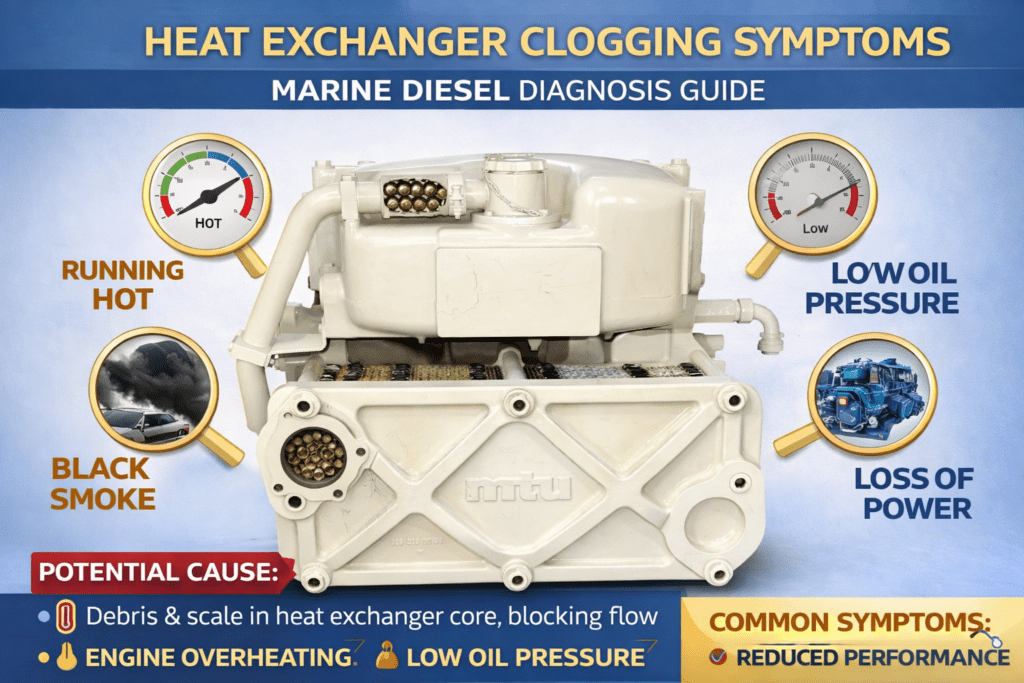
Heat Exchanger Clogging Symptoms — Marine Diesel Diagnosis Guide
Quick Technical Diagnosis Summary: A clogged marine diesel heat exchanger reduces cooling capacity by restricting raw water flow through the tube bundle. Early signs include rising temperatures under load, intermittent overheating, weak exhaust water discharge, and temperature spikes after impeller failure. Heat exchanger clogging is often caused by zinc debris, impeller fragments, salt scale, or marine growth.
At 805 Marine Diesel Mechanic, heat exchanger clogging is one of the most common hidden causes behind overheating complaints in Ventura, Oxnard, Channel Islands Harbor, and Santa Barbara—especially after raw water pump impeller damage or deferred zinc maintenance.
What a Clogged Heat Exchanger Actually Does
The heat exchanger is where raw seawater pulls heat out of the closed coolant loop. When tubes clog, the engine may run “almost normal” at idle but loses cooling margin at cruise.
Top Heat Exchanger Clogging Symptoms
1. Overheats Under Load (Cruise RPM) Before It Overheats at Idle
- Temperature climbs when you push the throttles
- May stabilize when you reduce load
- Often worsens slowly over weeks/months
2. Intermittent Overheating (Temperature Spikes Then Recovers)
- Temp rises suddenly, then drops back down
- More common when debris shifts in the tube bundle
- Can be triggered by throttle changes
3. Weak Exhaust Water Discharge
- Reduced volume at the exhaust outlet
- May appear “OK” at idle but weak at cruise
- Often paired with higher exhaust temps
4. Overheating After Impeller Failure
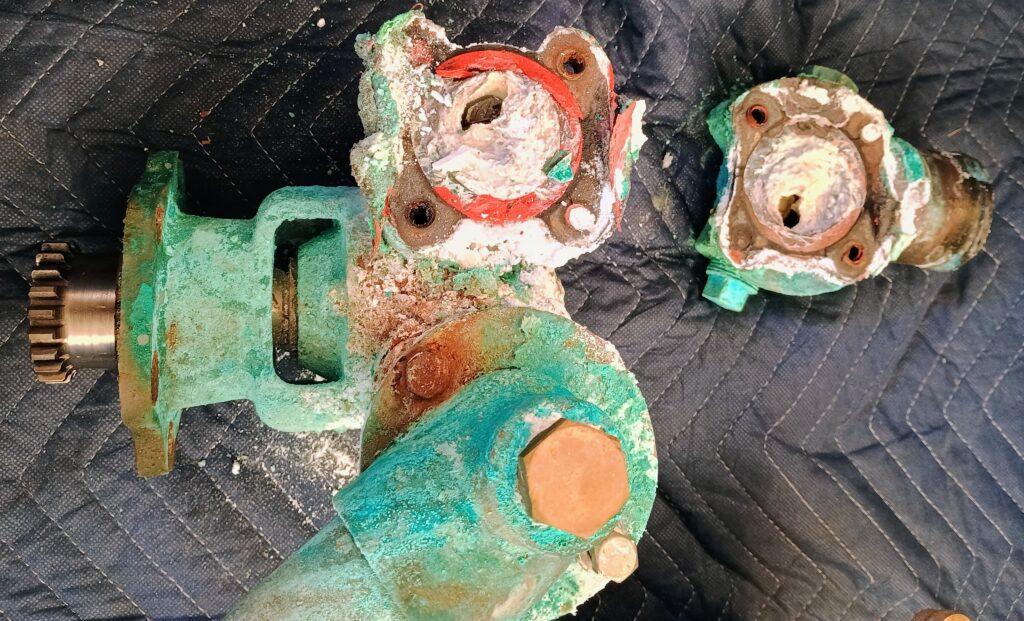
If your raw water pump impeller shed vanes, those pieces frequently lodge in the first restriction points:
- Oil cooler inlet
- Heat exchanger inlet / tube bundle
- Aftercooler (turbo engines)
5. Rising Temperature Trend Over Time (Baseline Creep)
- Normal temp slowly becomes 5–15°F hotter over time
- Often mistaken for “sensor drift”
- Usually caused by scaling or reduced tube efficiency
What Causes Heat Exchanger Clogging?
- Zinc debris (anodes breaking down and traveling)
- Impeller fragments after vane failure
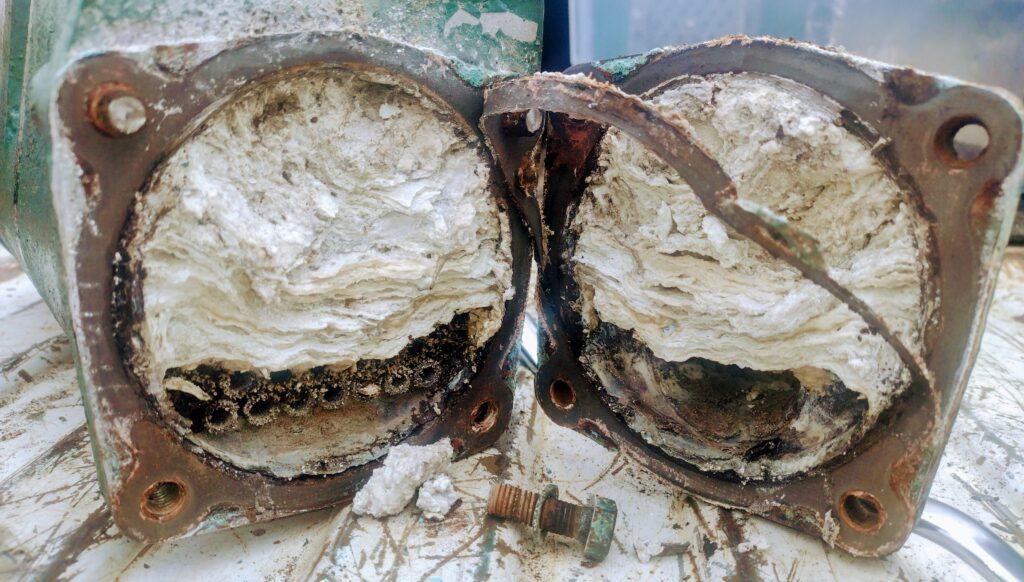
- Salt scale and mineral deposits in tubes
- Marine growth (barnacles, algae, silt)
- Rust flakes from aged housings or fittings
How to Confirm Heat Exchanger Restriction (Fast Tests)
Test A: Compare Temperature Rise by RPM
- Stable at idle but climbs at cruise = reduced cooling margin
- Climbs fast at all RPM = severe flow restriction or circulation issue
Test B: Inspect the Tube Bundle (Best Proof)
Tube bundles often show partial blockage—some tubes fully open, others scaled shut.
Test C: Check for Debris Traps Upstream
- Sea strainer condition
- Oil cooler inlet screen (if equipped)
- Heat exchanger end caps for debris
Technician Workflow: What We Do on a Service Call
- Verify raw water intake and strainer sealing
- Confirm raw water pump condition and impeller integrity
- Inspect for missing impeller vanes and retrieve debris
- Remove end caps and inspect the tube bundle
- Clean and flush as required (and replace gaskets/zincs)
- Sea trial to confirm stable temps under load
Prevent Heat Exchanger Clogging (Simple Maintenance)
- Inspect and replace zincs on schedule
- Replace raw water pump impeller annually
- Service heat exchanger every 2–3 years (more in heavy saltwater use)
- Flush after runs when possible
For general marine maintenance guidance, see BoatUS and Yachting Magazine.
Continue Troubleshooting
- Marine Engine Raw Water Flow Problems
- Marine Diesel Overheating at Idle vs Cruise
- Fresh Water Flushing
- Perkins Marine Diesel Service
- Yanmar Marine Diesel Service
- Master Marine Diesel Troubleshooting Guide – 805 Marine Diesel Mechanic
Mobile Marine Diesel Cooling System Service
If your engine is overheating, running hotter over time, or you suspect impeller debris or zinc blockage, our trained technicians can diagnose and service your cooling system quickly. We provide mobile marine diesel service in Ventura, Oxnard, Channel Islands Harbor, and Santa Barbara.
FAQ
Can a heat exchanger be partially clogged and still look “okay”?
Yes. Partial clogging often causes overheating only under load because the engine loses cooling margin at higher RPM.
Do missing impeller blades cause heat exchanger clogs?
Very often. Impeller fragments frequently lodge in oil coolers and heat exchanger inlets and must be removed to restore full flow.
How often should marine diesel heat exchangers be cleaned?
Typically every 2–3 years, but more often in saltwater, high-use, or if zinc/impeller debris issues occur.
4 Responses