
Marine heat exchanger cleaning, diesel cooling-system descaling, aftercooler maintenance, and raw-water circuit restoration for Ventura Harbor, Oxnard, Channel Islands Harbor, and Santa Barbara. Start with the Master Marine Diesel Troubleshooting Guide when your diesel engine develops overheating under load, elevated coolant temperatures, restricted raw-water flow, steam at the exhaust, or inconsistent offshore operating temperatures. 805 Marine Diesel Mechanic specializes in marine heat exchanger cleaning, cooling-system restoration, Barnacle Buster circulation descaling, and complete diesel cooling diagnostics.
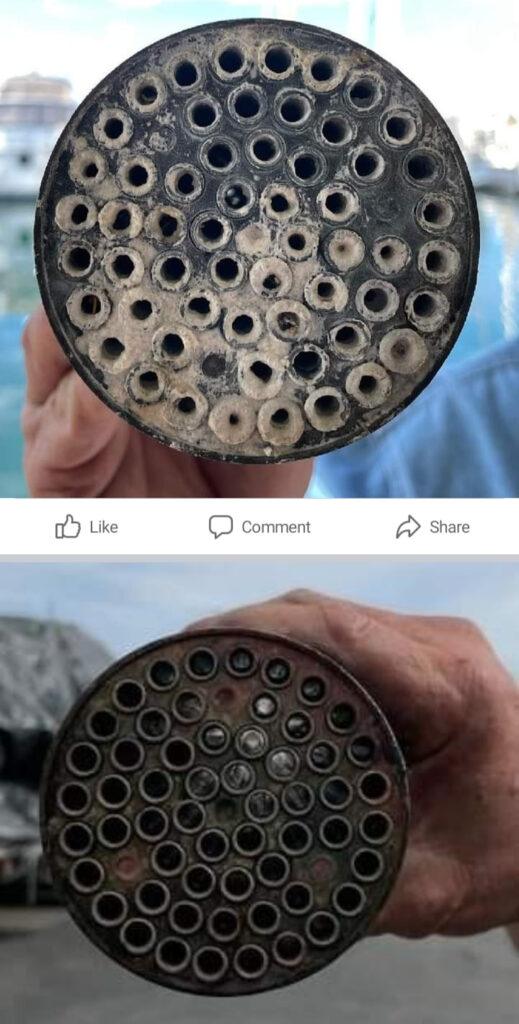
Professional Marine Heat Exchanger Cleaning for Offshore Reliability
Marine diesel heat exchangers operate in one of the harshest environments onboard a vessel. Saltwater, scale, rust, shell growth, and mineral buildup slowly reduce cooling efficiency until the engine can no longer maintain safe temperatures under offshore load.
At 805 Marine Diesel Mechanic, our trained technicians service marine cooling systems for vessels operating between Ventura Harbor, Oxnard, Channel Islands Harbor, and Santa Barbara. Our focus is restoring unrestricted cooling flow while protecting expensive diesel-engine components from heat-related failure.
How Marine Heat Exchangers Become Restricted
Raw-water cooling circuits constantly circulate seawater through coolers, aftercoolers, oil coolers, and heat exchangers. Over time, deposits begin forming inside these passages.
Common restriction sources include:
- Calcium and mineral scale
- Salt crystallization
- Shell growth and barnacles
- Rust contamination
- Sand and silt buildup
- Internal corrosion debris
Even light buildup significantly reduces heat transfer efficiency and raises engine operating temperatures.
For overheating diagnostic support, review the verified Overheating at High RPM page.
Why Heat Exchanger Cleaning Matters Offshore
Engines running offshore between Ventura and the Channel Islands operate under extended heavy load. Small cooling restrictions that go unnoticed at idle often become serious overheating problems during long runs at cruise RPM.
Restricted heat exchangers can contribute to:
- Turbocharger overheating
- Coolant temperature spikes
- Reduced engine efficiency
- Head gasket stress
- Exhaust manifold overheating
- Transmission cooler overload
Preventive heat exchanger maintenance protects the entire propulsion system.
For broader cooling-system support information, owners often review the verified Marine Engine Seawater System Descaling page.
Professional Marine Heat Exchanger Cleaning Process
805 Marine Diesel Mechanic uses a structured inspection and cleaning process designed specifically for marine diesel cooling systems.
Typical service includes:
- Raw-water system inspection
- Heat exchanger disassembly
- Tube-bundle inspection
- Marine-safe descaling treatment
- Pressure testing
- Zinc inspection and replacement
- Coolant-condition inspection
- System flow verification
Each cooling system is evaluated individually depending on engine age, operating hours, saltwater exposure, and vessel usage patterns.
Barnacle Buster Descaling & Circulation Cleaning
Many cooling systems can be cleaned using circulation-based descaling with marine-safe solutions such as Barnacle Buster.
This process allows cleaning solution to circulate through the raw-water side of the system, dissolving scale and marine growth with minimal component disassembly.
Compared to aggressive acid cleaning used decades ago, modern circulation descaling is significantly safer for seals, O-rings, cooler housings, and soft metals.
For freshwater-flushing support information, owners often review the verified Marine Engine Fresh Water Flushing System page.
Heat Exchanger Inspection & Pressure Testing
Cleaning alone is not enough. During service, we also inspect for:
- Pinhole leaks
- Tube erosion
- Corrosion damage
- Failed gaskets
- Weak end caps
- Zinc deterioration
- Coolant contamination
Pressure testing helps verify separation between coolant and raw-water circuits before the exchanger is returned to service.
For advanced diesel diagnostic support, owners frequently review the verified Marine Diesel Engine Diagnostics page.
Supporting Modern Marine Diesel Cooling Systems
Modern diesel engines operate with tighter temperature tolerances and higher power density than older marine engines. Cooling systems must perform efficiently even during extended offshore operation.
805 Marine Diesel Mechanic supports heat exchanger and cooling-system service for:
- Cummins Marine
- Yanmar Marine Diesel
- Perkins Marine Diesel
- Caterpillar Marine
- Volvo Penta Diesel
- Detroit Diesel
- Scania Marine
- MAN Marine
We routinely integrate cooling-system maintenance into larger service plans involving drivetrain inspections, turbocharger diagnostics, and offshore reliability preparation.
Heat Exchanger Maintenance for Older Diesel Engines
Older diesel vessels frequently suffer from neglected cooling systems because many internal restrictions remain invisible until temperatures begin rising under load.
During inspection we commonly find:
- Old zinc fragments
- Collapsed internal hoses
- Heavy mineral buildup
- Coolant contamination
- Corroded end caps
- Restricted aftercoolers
Many older systems can still be restored successfully with proper descaling and preventive maintenance.
For diesel survey support, owners often review the verified Marine Engine Survey page.
Local Marine Heat Exchanger Service Coverage
- Ventura Harbor: Dockside heat exchanger cleaning and cooling-system service.
- Oxnard: Raw-water diagnostics and aftercooler descaling.
- Channel Islands Harbor: Offshore overheating diagnostics and zinc replacement.
- Santa Barbara Harbor: Marine diesel cooling-system restoration and inspection.
Verified Marine Cooling-System Resources
- Marine Engine Seawater System Descaling
- Marine Engine Fresh Water Flushing System
- Marine Diesel Engine Diagnostics
- Marine Engine Survey
- Marine Diesel Troubleshooting Guide
- 805 Marine Diesel Mechanic Contact
- Racor Filtration Systems
- Fleetguard
Protect your diesel engine from overheating and offshore cooling-system failure with professional marine heat exchanger cleaning and descaling from 805 Marine Diesel Mechanic.
Marine Heat Exchanger Cleaning FAQ
Why is marine heat exchanger cleaning important?
Heat exchanger cleaning removes scale, marine growth, and mineral deposits that reduce cooling efficiency and contribute to overheating.
How often should a marine heat exchanger be serviced?
Many marine diesel cooling systems benefit from inspection every 1–2 years depending on operating hours, saltwater exposure, and vessel usage.
What are signs of a restricted heat exchanger?
Common symptoms include rising temperatures, overheating under load, weak raw-water discharge, steam, and inconsistent operating temperatures.
Can Barnacle Buster clean marine cooling systems safely?
Yes. Properly applied marine-safe descaling solutions can dissolve mineral buildup and marine growth while protecting cooling-system materials.
Do you provide dockside heat exchanger service?
Yes. Many marine heat exchanger cleaning and cooling-system inspections can be performed dockside depending on vessel access and system layout.
What components are typically cleaned during service?
Heat exchangers, oil coolers, aftercoolers, transmission coolers, strainers, and raw-water plumbing are commonly inspected and serviced.
Why are zincs important in marine cooling systems?
Zincs help protect cooling-system metals from galvanic corrosion and should be inspected and replaced regularly.
Do you work on gasoline-powered boats?
No. 805 Marine Diesel Mechanic focuses exclusively on inboard marine diesel engines and propulsion systems.
Can restricted coolers damage a diesel engine?
Yes. Reduced cooling efficiency can increase thermal stress on cylinder heads, exhaust systems, turbochargers, and gaskets.
What areas do you service?
805 Marine Diesel Mechanic serves Ventura Harbor, Oxnard, Channel Islands Harbor, and Santa Barbara Harbor with mobile marine diesel cooling-system service.
5 Responses